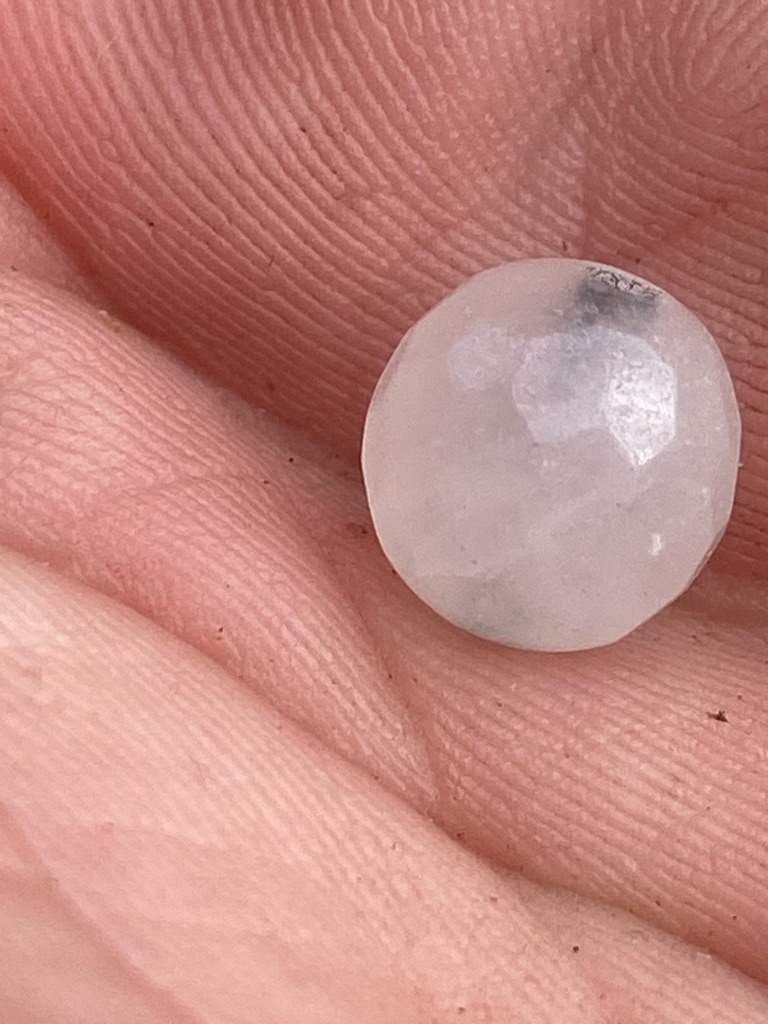
Cannot be confirmed visually; appears potentially as a rose-cut quartz, gemstone imitation, or non-diamond material due to surface texture and lustre, though professional laboratory testing is required to rule out heavily included industrial diamond.
Cannot be confirmed visually; appears potentially as a rose-cut quartz, gemstone imitation, or non-diamond material due to surface texture and lustre, though professional laboratory testing is required to rule out heavily included industrial diamond. · Round (Rose-Cut style with a domed, faceted top)
Fair to Poor (Irregular faceting and asymmetry characteristic of historic or artisan polishing) Cut
Carat
Estimated around 3.0 to 5.0 carats based on visual scale in hand, though density of the actual material will alter true weight.
Color
Near colorless to very pale milky white
Clarity
I2 to I3 (Included with visible cloudiness and dark structural inclusions near the upper edge)
Shape
Round (Rose-Cut style with a domed, faceted top)
Overall Assessment
The specimen exhibits characteristics atypical of standard commercial fine diamonds, presenting more like a rose-cut quartz or low-quality translucent mineral. Professional gemological testing (such as a thermal conductivity or refractive index test) is strongly advised to verify its true material composition.
Cut Quality
Fair to Poor (Irregular faceting and asymmetry characteristic of historic or artisan polishing)
Brilliance
Low; the milky internal structure and diffuse transparency significantly reduce white light return
Fire
Minimal dispersion of spectral colors due to low refractive transparency and heavy inclusions
Scintillation
Weak and fragmented sparkle pattern limited by uneven faceting and internal clouding
Proportions
High domed crown with lack of standard pavilion angles; atypical for modern precision-cut diamonds
Symmetry
Poor; irregular circular outline with unevenly distributed facets
Polish
Fair; visible surface texture and minor abrasion marks across facets
Fluorescence
Cannot be determined without UV light testing
Inclusions
Noticeable dark carbon spot or crystal inclusion near the top edge, alongside extensive internal cloudiness
Blemishes
Surface pitting and minor abrasions along facet junctions
Origin
Indeterminate visually; requires advanced spectroscopic testing
Treatment Detection
No obvious signs of modern enhancements like fracture filling, though potential thermal treatments cannot be ruled out without microscopic examination
Estimated Value
Nominal to low value if confirmed as quartz or decorative stone; negligible value as a gemstone if verified as low-grade industrial diamond
Certification Estimate
Unlikely to be accepted by major premier grading labs (GIA/AGS) without confirming material identity first; alternative labs might issue an identification report rather than a diamond grading report
Investment Potential
None; this specimen holds ornamental or curiosity value rather than investment or resale value
Similar Diamonds
Rough-cut or historic rose-cut diamonds, milky quartz, or low-grade translucent gemstones
Setting Suggestions
Bezel setting in antique-style or bohemian yellow/rose gold mountings to secure irregular edges and complement a rustic aesthetic
Care & Maintenance
Standard cleaning with warm soapy water and a soft brush; avoid harsh ultrasonic cleaners if inclusions create structural fragility
Interesting Facts
Stones of this cut style emulate antique Georgian and Victorian era rose-cut gems designed to glow softly under candlelight