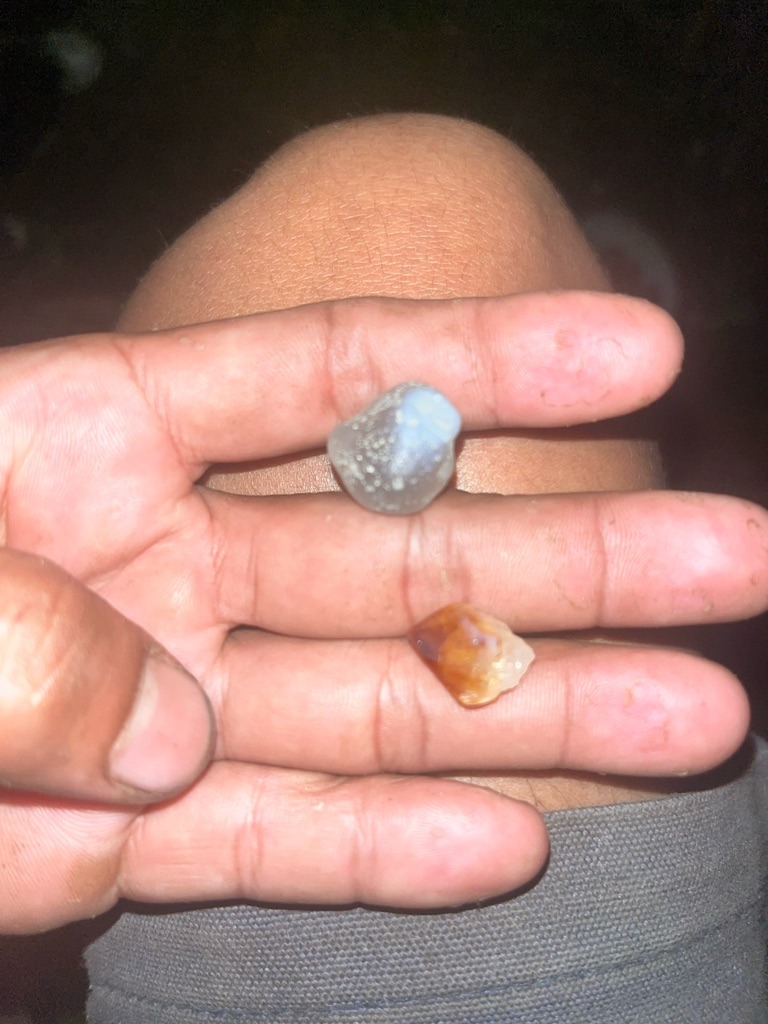
Not a diamond; these appear to be rough mineral stones such as quartz or chalcedony/agate, not diamond crystals.
Not a diamond; these appear to be rough mineral stones such as quartz or chalcedony/agate, not diamond crystals. · Rough, unpolished natural pebble or cobble stones
Not applicable; uncut raw stones with no facet polish or standard gemstone cut proportions. Cut
Carat
Not applicable; gemstone rough weight cannot be visually determined precisely without scale measurement, roughly estimated at several carats as mineral specimens.
Color
Not applicable; one stone is translucent to whitish-grey, the other displays mixed brownish-orange (carnelian-like) tones.
Clarity
Not applicable; rough stones contain natural internal inclusions, fractures, and translucency variations.
Shape
Rough, unpolished natural pebble or cobble stones
Overall Assessment
The items shown in the hand are not diamonds or gem-quality diamond rough, but rather common rough stones, likely forms of chalcedony, agate, or quartz pebbles.
Cut Quality
Not applicable; uncut raw stones with no facet polish or standard gemstone cut proportions.
Brilliance
Low to moderate vitreous to waxy luster typical of rough chalcedony or quartz.
Fire
None, as these are not high-dispersion crystalline stones like diamond.
Scintillation
Poor due to lack of standard facet structure reflecting directed light.
Proportions
Not applicable; raw mineral specimens lacking standard facet angles, table percentage, or depth ratios.
Symmetry
Asymmetrical, natural organic weathering and formation.
Polish
Unpolished, natural matte to slightly water-worn texture.
Fluorescence
Unknown without UV testing, likely none to inert in standard daylight conditions.
Inclusions
Typical natural mineral inclusions, micro-fractures, and cloudiness.
Blemishes
Natural surface irregularities, pits, and weathering marks.
Origin
Alluvial or primary geological deposits of common microcrystalline quartz.
Treatment Detection
No obvious signs of artificial treatments; appears completely natural.
Estimated Value
Nominal value as raw mineral specimens or lapidary rough, typically very low unless worked into finished gemstones.
Certification Estimate
Not certifiable as diamonds by major laboratories like GIA; may be identified by local gemological institutes as quartz var. chalcedony.
Investment Potential
None; these are common mineral specimens with no significant monetary appreciation potential.
Similar Diamonds
None, as these share no optical or physical properties with diamonds.
Setting Suggestions
Wire-wrapped organic jewelry settings or custom bezel settings if tumbled and polished into cabochons.
Care & Maintenance
Standard cleaning with mild soapy water and a soft brush; avoid harsh acids or impacts.
Interesting Facts
Often found in riverbeds and gravel bars due to water tumbling and natural erosion processes.