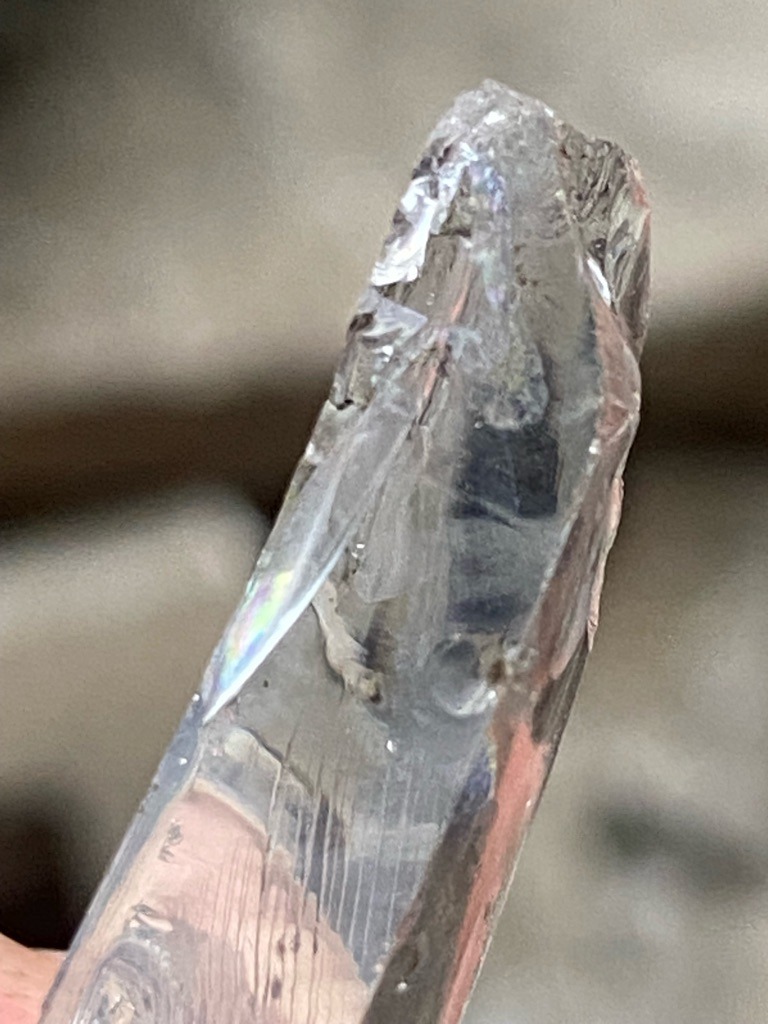
Natural rough mineral crystal (likely Quartz or generic silicate, not a diamond)
Natural rough mineral crystal (likely Quartz or generic silicate, not a diamond) · Uncut natural crystal / Rough elongated prismatic habit
Not applicable (raw, uncut specimen) Cut
Carat
Cannot accurately determine visually without precise volume and specific gravity, roughly estimated at 15-25 carats equivalent weight in mineral mass
Color
Colorless to transparent with slight natural surface weathering
Clarity
Included / Heavily included with internal fractures and striations
Shape
Uncut natural crystal / Rough elongated prismatic habit
Overall Assessment
This specimen is a raw, uncut mineral crystal rather than a diamond. It displays natural growth features such as striations and internal fractures, making it an interesting educational or collection piece but lacking the optical properties and value of a cut gemstone.
Cut Quality
Not applicable (raw, uncut specimen)
Brilliance
Varies by angle due to rough unpolished surfaces and internal reflections
Fire
Limited dispersion visible primarily along fractured edges
Scintillation
Minimal, as the stone is uncut and lacks standard facet patterns
Proportions
Elongated crystal habit, not faceted
Symmetry
Natural crystal symmetry showing typical prismatic growth striations
Polish
Raw natural crystal faces, unpolished
Fluorescence
Undetermined (requires UV light testing)
Inclusions
Visible internal fractures, veil inclusions, and growth channels
Blemishes
Natural surface etching, rough patches, and growth irregularities
Origin
Natural terrestrial geological formation
Treatment Detection
No signs of artificial treatments detected visually
Estimated Value
Nominal value as a mineral specimen or rough crystal, significantly less than a faceted gemstone
Certification Estimate
Not typically certified by major diamond grading labs like GIA as a diamond; would require mineralogical identification from an institute like GIA Colored Stone or local gemological lab
Investment Potential
Low investment potential; valued primarily for decorative or mineral collection purposes
Similar Diamonds
None, as this is a raw crystalline mineral specimen rather than a gemstone-quality diamond
Setting Suggestions
Wire-wrapped pendant, organic bespoke bezel setting, or kept as a raw mineral specimen
Care & Maintenance
Store separately to avoid scratching softer materials; clean gently with mild soapy water and a soft brush
Interesting Facts
Raw crystals often display growth lines called striations along their vertical faces, which are a hallmark of natural mineral growth