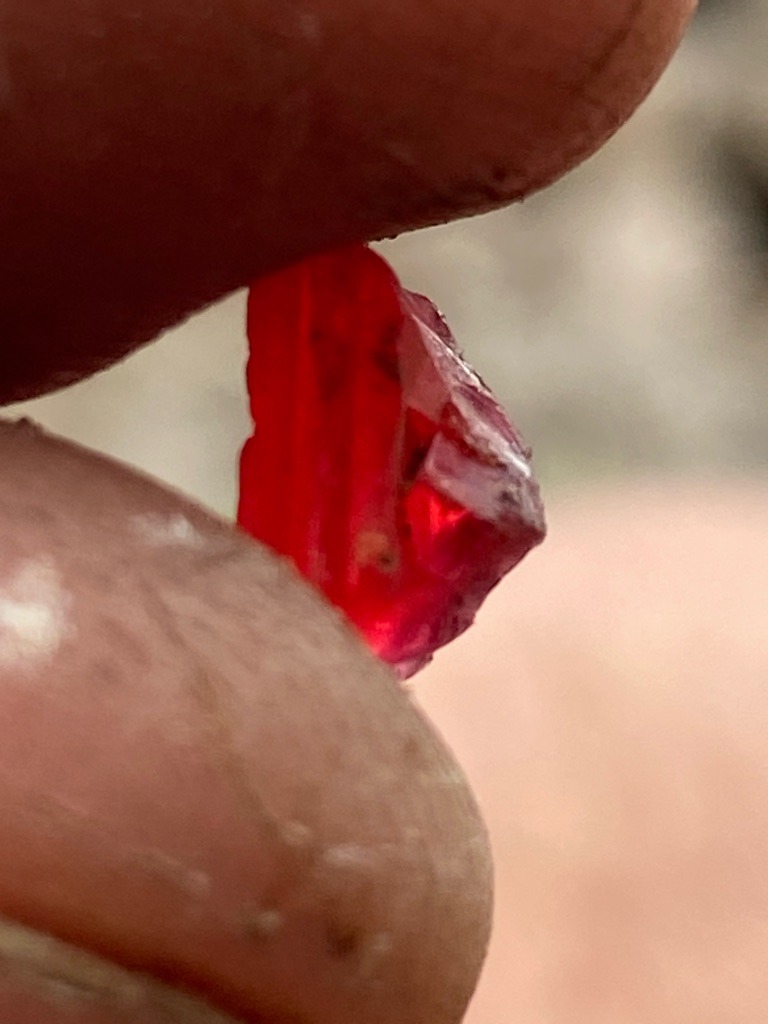
Natural gemstone crystal (Note: Appears visually to be a ruby or spinel, not technically a diamond based on vivid red color, but evaluated under gemstone parameters)
Natural gemstone crystal (Note: Appears visually to be a ruby or spinel, not technically a diamond based on vivid red color, but evaluated under gemstone parameters) · Rough crystal / Raw unpolished
Uncut / Rough Cut
Carat
Estimated 0.50 to 0.75 carats (rough form)
Color
Fancy Vivid Red
Clarity
Included (SI2 / I1 equivalent for rough)
Shape
Rough crystal / Raw unpolished
Overall Assessment
An intriguing, deeply saturated natural red rough crystal displaying classic raw growth features, highly desirable for custom lapidary work or as a raw mineral specimen collector piece.
Cut Quality
Uncut / Rough
Brilliance
Low to moderate due to rough surface and heavy saturation
Fire
Low (corundum dispersion is lower than diamond)
Scintillation
Minimal due to lack of faceted surfaces
Proportions
N/A - Uncut natural crystal formation
Symmetry
Natural asymmetric crystal growth
Polish
Raw crystal texture (unpolished)
Fluorescence
Strong Red (typical for chrome-rich ruby)
Inclusions
Natural mineral inclusions, rutile needles, and internal fractures typical of rough corundum
Blemishes
Natural surface striations, growth lines, and rough patches
Origin
Likely alluvial or metamorphic rough deposit (e.g., Myanmar, Mozambique, or Vietnam if Ruby)
Treatment Detection
No obvious signs of flux-healing, glass-filling, or heating in this raw state, but advanced testing required
Estimated Value
$100 - $500 depending on exact species (Ruby vs. Spinel) and precise geographical origin
Certification Estimate
GIA or SSEF (Gemological report for natural ruby origin)
Investment Potential
Moderate as a raw specimen; high potential if expertly cut and polished into a marketable gem
Similar Diamonds
N/A (This is a colored gemstone, not a diamond; comparable to high-saturation rough ruby specimens)
Setting Suggestions
Custom organic raw stone setting, bezel setting in yellow or rose gold to complement the rich red hue
Care & Maintenance
Store separately to avoid scratching softer materials; avoid harsh chemical cleaners and ultrasonic baths if fractures reach the surface
Interesting Facts
Natural red corundum (ruby) gets its vibrant red color from trace amounts of chromium, which also causes strong red fluorescence under UV light