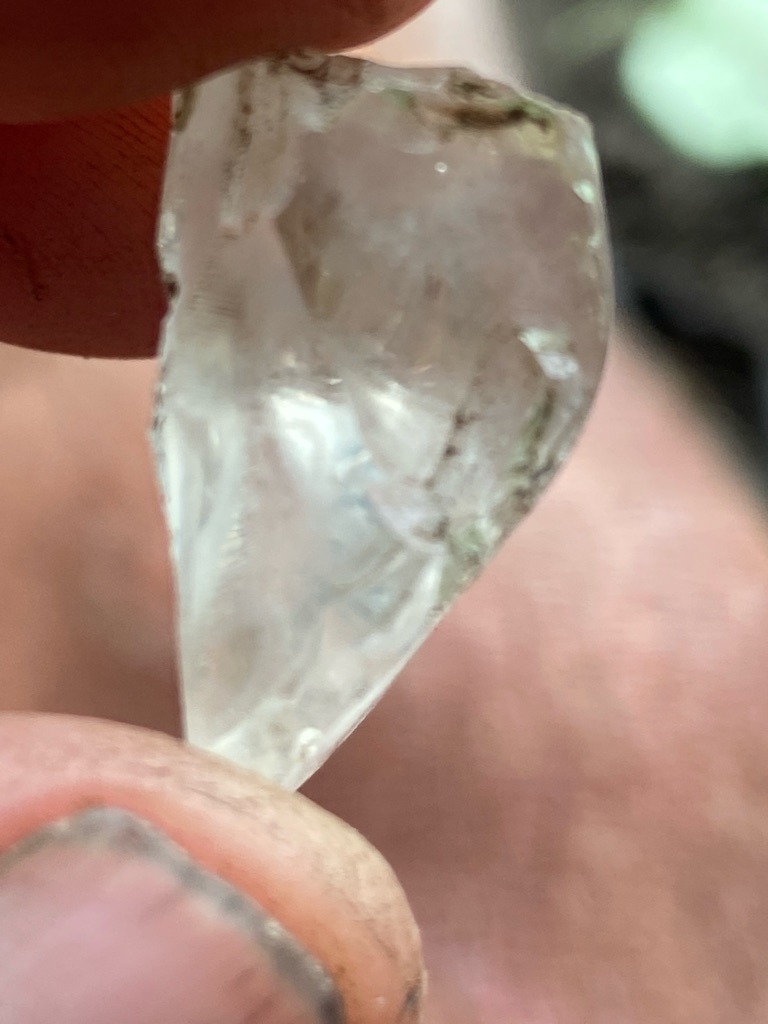
Rough diamond crystal / Natural mineral specimen
Rough diamond crystal / Natural mineral specimen · Uncut raw crystal (Irregular / Pear-like rough contour)
Not applicable (Rough uncut stone) Cut
Carat
Estimated 3.5 to 4.5 carats
Color
Near-colorless to faint brown tint (approx. G-I range)
Clarity
Included (I1 to I2 range due to internal fractures and surface features)
Shape
Uncut raw crystal (Irregular / Pear-like rough contour)
Overall Assessment
An interesting, natural rough diamond crystal displaying characteristic octahedral/irregular growth features, making it a wonderful specimen for mineral collectors or custom organic jewelry design.
Cut Quality
Not applicable (Rough uncut stone)
Brilliance
Low due to lack of facets and rough, unpolished surface
Fire
Minimal dispersion due to raw surface state
Scintillation
Poor, as light does not refract through standard facets
Proportions
Uncut rough stone, standard table/depth proportions do not apply
Symmetry
Natural rough crystal asymmetry
Polish
Raw, unpolished natural crystal surfaces and growth lines
Fluorescence
Cannot be determined without UV testing (Likely none to faint)
Inclusions
Visible internal feathers, clouds, and dark mineral spots
Blemishes
Natural surface trigons, rough skin, and minor surface pitting
Origin
Natural alluvial or primary kimberlite deposit origin
Treatment Detection
No signs of enhancement or artificial treatment detected
Estimated Value
Valued primarily as a rough specimen or collector piece, lower commercial cut value due to heavy inclusions
Certification Estimate
Gemological verification required; uncertified rough specimen
Investment Potential
Moderate, valued more as a unique geological specimen than a traditional polished investment diamond
Similar Diamonds
Raw industrial and uncut collector diamond crystals of comparable size and clarity
Setting Suggestions
Wire-wrapped pendant setting or custom organic prong setting to showcase the natural raw crystal form
Care & Maintenance
Clean with mild soapy water and a soft brush; avoid harsh chemicals and protect from impact to prevent cleavage along natural planes
Interesting Facts
This specimen represents a natural carbon crystal formed deep within the Earth's mantle before being brought to the surface through volcanic activity