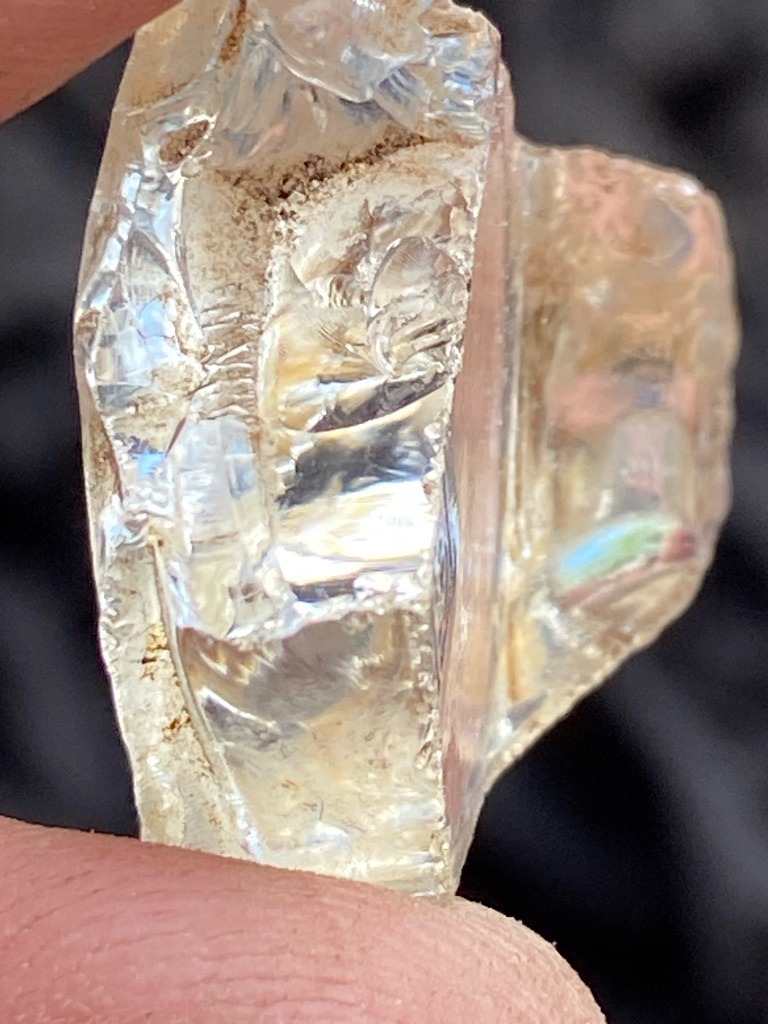
Not a diamond; appears to be raw quartz, glass slag, or another mineral specimen based on conchoidal fracturing and inclusions.
Not a diamond; appears to be raw quartz, glass slag, or another mineral specimen based on conchoidal fracturing and inclusions. · Raw, uncut, or heavily fractured crystalline specimen.
Not applicable (uncut rough stone). Cut
Carat
Unable to determine precisely from visual inspection alone, but visually significant size as a rough mineral specimen.
Color
Colorless to light brownish-yellow tint.
Clarity
Included / heavily included with internal fractures and foreign particulate matter.
Shape
Raw, uncut, or heavily fractured crystalline specimen.
Overall Assessment
Based on the conchoidal fracture, lack of adamantine luster, and visible matrix inclusion, this specimen is definitively not a diamond. It is likely a piece of raw quartz, natural crystal rough, or industrial glass slag.
Cut Quality
Not applicable (uncut rough stone).
Brilliance
Low to moderate vitreous luster, limited by lack of precision faceting.
Fire
Minimal dispersion due to material properties and lack of cut.
Scintillation
Poor, as light passes through or reflects off irregular fracture planes rather than structured facets.
Proportions
Not applicable to rough specimens.
Symmetry
Asymmetrical rough form.
Polish
Unpolished, natural or fractured surface.
Fluorescence
Unknown without UV testing.
Inclusions
Subsurface fractures, feather-like fissures, and trapped matrix/dirt sediments.
Blemishes
Surface chips, natural irregularities, and rough fracture planes.
Origin
Natural mineral rough or manufactured glass cullet.
Treatment Detection
No obvious enhancements, appears to be in its natural or raw discarded state.
Estimated Value
Nominal mineral specimen value, essentially negligible compared to gem-grade diamonds.
Certification Estimate
Not eligible for standard diamond grading laboratories (GIA/AGS); would require a gemological institute identification report (e.g., GIA Identification Report for colored stones/minerals).
Investment Potential
None; educational or mineral collecting interest only.
Similar Diamonds
None, as this specimen is fundamentally not a diamond.
Setting Suggestions
Not suitable for standard jewelry settings unless wire-wrapped as an organic raw mineral specimen.
Care & Maintenance
Standard gentle cleaning with mild soap and warm water; avoid harsh impacts due to internal fractures.
Interesting Facts
The conchoidal fracture patterns visible resemble glass or quartz rather than the octahedral cleavage typical of diamond rough.