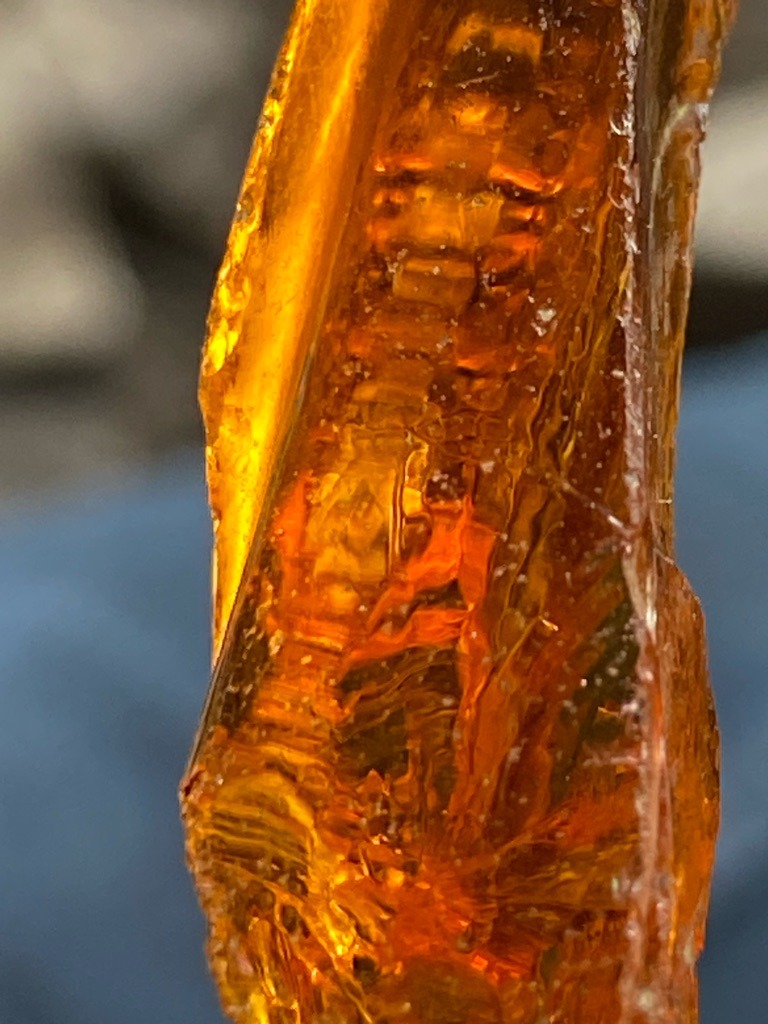
Not a diamond; this is a piece of amber or possibly a resinous organic material exhibiting strong natural irregular growth patterns and deep orange-brown coloration.
Not a diamond; this is a piece of amber or possibly a resinous organic material exhibiting strong natural irregular growth patterns and deep orange-brown coloration. · Rough, uncut, irregular elongated nodule or fragment.
Not applicable (raw, unpolished specimen). Cut
Carat
Not applicable for non-diamond gemstones; estimated mass is approximately 5 to 10 carats based on visual dimensions.
Color
Deep Fancy Dark Orange-Brown.
Clarity
Included; contains numerous internal bubbles, flow lines, and natural organic debris typical of fossilized resin.
Shape
Rough, uncut, irregular elongated nodule or fragment.
Overall Assessment
The specimen shown in the image is not a diamond or diamond simulants, but rather a warm, translucent piece of natural amber or organic resin with fascinating internal flow textures.
Cut Quality
Not applicable (raw, unpolished specimen).
Brilliance
Vitreous to resinous luster; low internal brilliance compared to crystalline gems.
Fire
None, as organic resins do not possess high refractive dispersion like diamond.
Scintillation
Low; reflects light off surface irregularities rather than internal facet patterns.
Proportions
Irregular organic morphology; measurements unavailable due to lack of standard faceted proportions.
Symmetry
Asymmetrical, completely natural form.
Polish
Raw, unpolished surface with natural resin texture and minor weathering.
Fluorescence
Strong blue-white fluorescence under UV light, common in many types of amber.
Inclusions
Abundant internal air bubbles, stress fractures, and particulate plant or insect debris characteristic of fossil resin.
Blemishes
Surface scratches, natural pits, and resin flow lines.
Origin
Likely Baltic region or Dominican Republic, famous for fossilized tree resin deposits.
Treatment Detection
Natural untreated specimen; no evidence of pressing, dyeing, or heat treatment.
Estimated Value
Low commercial value as a raw specimen, typically ranging from $20 to $100 depending on exact weight and presence of preserved inclusions.
Certification Estimate
Gemological laboratories such as GIA or local gem testing labs would identify this as amber rather than issue a diamond grading report.
Investment Potential
Minimal investment value as a gemstone; primarily valued as a collector's specimen or fossil artifact.
Similar Diamonds
None, as this material is completely distinct from diamond in chemical composition, hardness, and origin.
Setting Suggestions
Wire-wrapped in sterling silver or yellow gold to preserve its natural organic shape without drilling.
Care & Maintenance
Keep away from harsh chemicals, solvents, alcohol, and extreme heat, as amber is a soft organic material (Mohs hardness 2-2.5).
Interesting Facts
Amber is not a mineral but fossilized tree resin that can sometimes trap prehistoric insects and plant matter millions of years old.