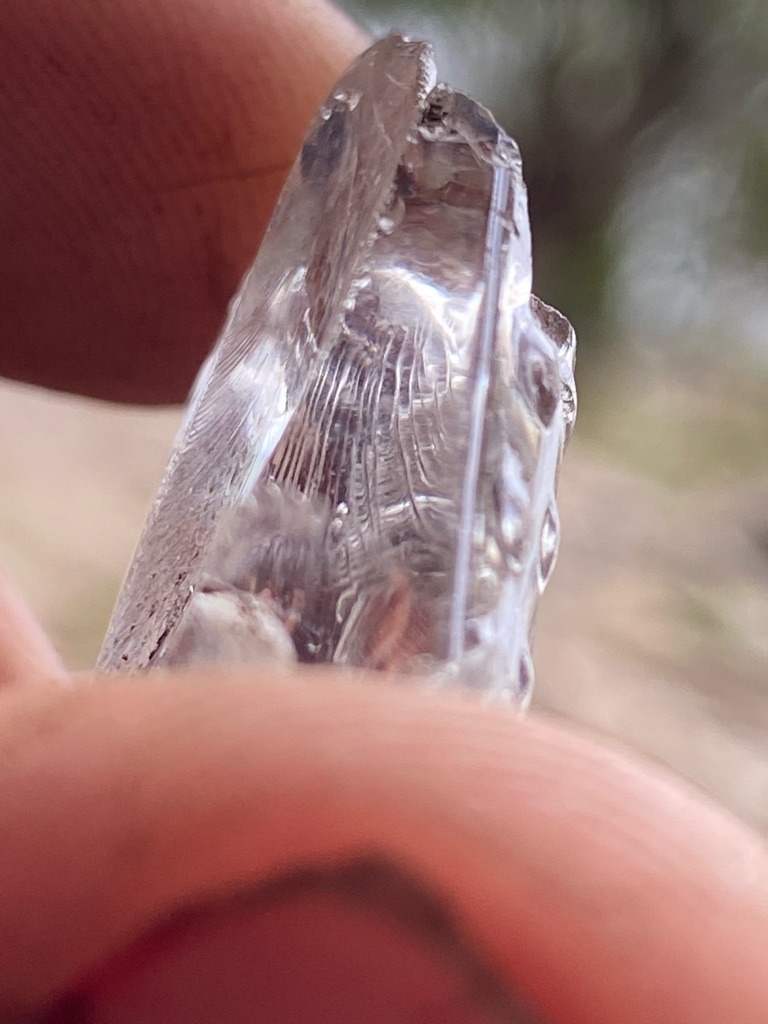
The specimen shown in the image is not a diamond; it appears to be a raw crystal of quartz or another transparent mineral, displaying conchoidal fracture and growth striations typical of quartz rather than the octahedral or dodecahedral crystal habits of rough diamond.
The specimen shown in the image is not a diamond; it appears to be a raw crystal of quartz or another transparent mineral, displaying conchoidal fracture and growth striations typical of quartz rather than the octahedral or dodecahedral crystal habits of rough diamond. · Rough crystal form, irregular elongation with natural faces and striations, completely uncut.
Not applicable (uncut, raw mineral specimen). Cut
Carat
Estimated around 3.5 to 5.0 carats equivalent weight based on visual scale in hand, though density differs from diamond.
Color
Colorless / Near-colorless transparent quartz.
Clarity
Included / Heavily included with internal fractures, veining, and cloudiness.
Shape
Rough crystal form, irregular elongation with natural faces and striations, completely uncut.
Overall Assessment
This is a natural rough quartz crystal, not a diamond. It lacks the crystal habit, hardness, and optical properties of diamond, exhibiting characteristic quartz striations and conchoidal fractures.
Cut Quality
Not applicable (uncut, raw mineral specimen).
Brilliance
Low to moderate vitreous luster, significantly lower than a properly cut diamond.
Fire
Very low dispersion compared to diamond due to lower refractive index (1.54 vs 2.42).
Scintillation
Minimal sparkle, reflective behavior is limited to broad surface flashes rather than facet-based return.
Proportions
Not applicable to raw rough mineral specimens.
Symmetry
Natural crystal symmetry showing typical trigonal or hexagonal prismatic growth patterns.
Polish
Raw, natural unpolished crystal surface with natural striations and etch marks.
Fluorescence
Unknown without UV testing, standard quartz typically shows inert or weak blue/green under long-wave UV.
Inclusions
Abundant internal feather fractures, liquid inclusions, and structural veining visible throughout the body.
Blemishes
Natural surface irregularities, growth lines, and rough fracture terminations.
Origin
Natural terrestrial mineral origin, likely quartz from a pegmatite or hydrothermal vein deposit.
Treatment Detection
No obvious signs of artificial enhancement; appears completely untreated and natural.
Estimated Value
Nominal value as a raw mineral specimen or crystal specimen (less than $10-$20 USD).
Certification Estimate
Standard gemological laboratories (GIA, IGI) would issue a gemstone identification report identifying it as quartz rather than a diamond grading report.
Investment Potential
Negligible investment value; purely a decorative or specimen mineral.
Similar Diamonds
None, as this specimen is not a diamond.
Setting Suggestions
Best kept as a raw mineral specimen or wire-wrapped in sterling silver for organic-style jewelry.
Care & Maintenance
Standard care for quartz; avoid harsh impacts as it can easily fracture along internal planes.
Interesting Facts
Many amateur prospectors mistake clear quartz crystals found in nature for rough diamonds due to their transparency and crystal faces.