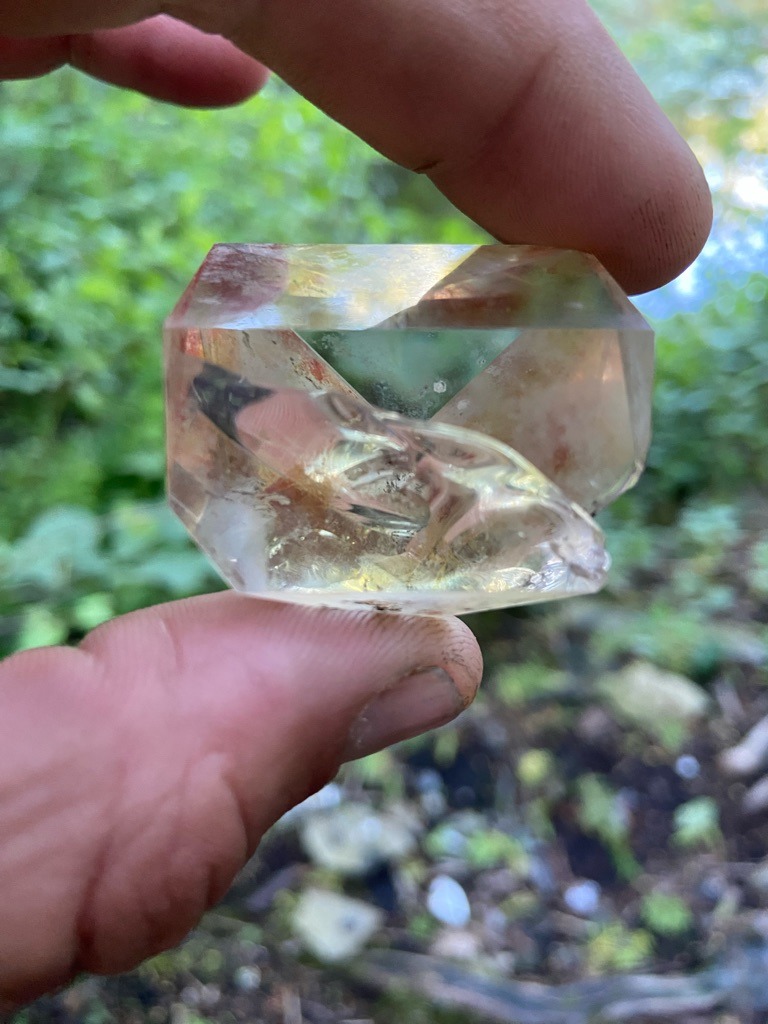
The specimen shown is not a diamond; it visually exhibits properties characteristic of quartz, specifically a heavily included or modified quartz crystal (such as citrine or smoky quartz) with rough, non-standard faceting.
The specimen shown is not a diamond; it visually exhibits properties characteristic of quartz, specifically a heavily included or modified quartz crystal (such as citrine or smoky quartz) with rough, non-standard faceting. · Irregular / Custom faceted crystal form
Poor / Hand-cut or artisan polished with irregular angles Cut
Carat
Due to it being a quartz crystal rather than a diamond, carat weight is not applicable in gemstone terms, but visually it is quite large (likely hundreds of carats in weight).
Color
Light yellow to brownish (Fancy Light Yellow/Brownish if evaluated on a diamond color scale)
Clarity
Included (I2/I3 equivalent due to prominent internal fractures, cloudiness, and foreign matter)
Shape
Irregular / Custom faceted crystal form
Overall Assessment
The specimen is a large, hand-faceted natural quartz crystal rather than a diamond. It features noticeable internal inclusions and an irregular cut, making it a unique mineral display piece rather than a traditional gemstone.
Cut Quality
Poor / Hand-cut or artisan polished with irregular angles
Brilliance
Low to moderate due to the large size, inclusions, and non-standard cut angles
Fire
Very low, as quartz lacks the high dispersion (fire) characteristic of diamond
Scintillation
Limited, showing large blocked areas of light reflection rather than crisp sparkle
Proportions
Non-standard proportions with a thick girdle and unconventional depth relative to surface area
Symmetry
Poor / Highly asymmetrical with non-uniform facet alignments
Polish
Fair to Poor / Visible surface striations and rounding on facet edges
Fluorescence
Indeterminate / Not visibly testable without UV equipment, typically inert to faint in standard quartz
Inclusions
Heavy internal fractures, feather-like veils, and potential mineral inclusions or cavities
Blemishes
Natural surface pits, chips, and abrasion marks along the edges
Origin
Natural quartz crystal, likely from a pegmatite or hydrothermal vein deposit
Treatment Detection
Appears untreatably natural, though potential heat treatment to enhance color cannot be ruled out without advanced spectroscopy
Estimated Value
Minimal commercial gemstone value; valued more as a mineral specimen or collector's rough crystal
Certification Estimate
Not applicable for major diamond grading labs (GIA, AGS); would require testing at a general gemological institute to confirm species (Quartz)
Investment Potential
Low as an investment, traded primarily as a decorative or specimen mineral
Similar Diamonds
None, as this is a large quartz crystal and not a diamond
Setting Suggestions
Wire-wrapped pendant or bespoke artisan mountings suited for large mineral specimens
Care & Maintenance
Avoid harsh impacts due to internal fracturing; clean with mild soapy water and a soft brush
Interesting Facts
Quartz is one of the most abundant minerals on Earth, contrasting sharply with the rarity and composition of true diamond (carbon)