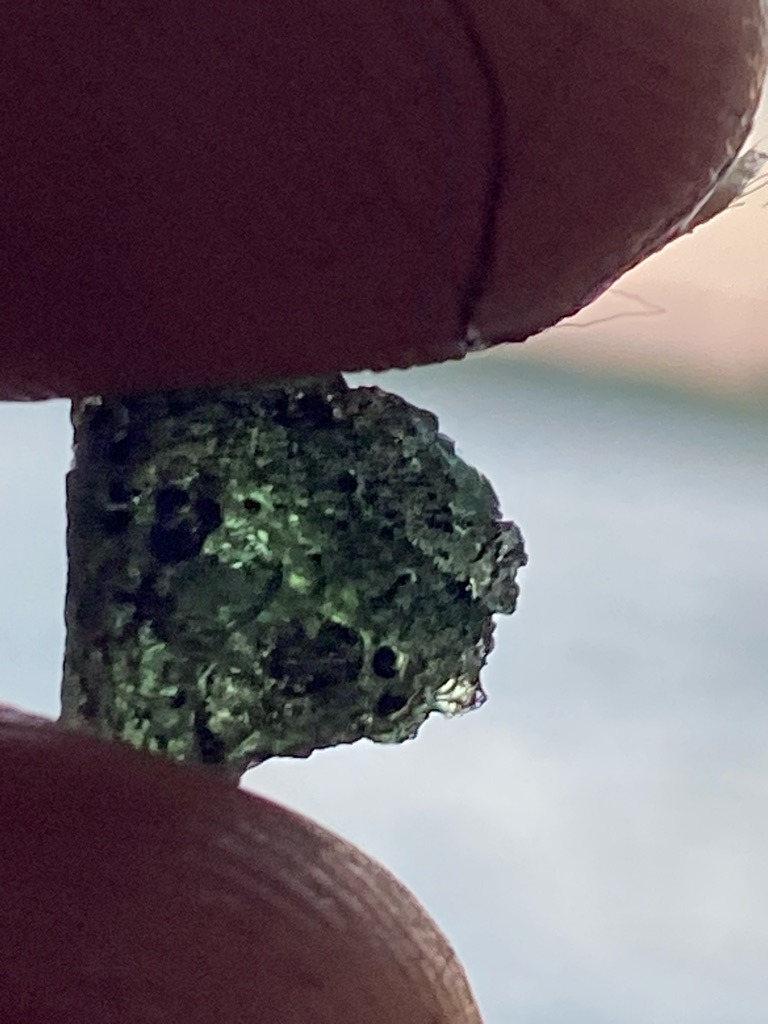
Not a diamond; this specimen appears to be an olive-green tektite (specifically Moldavite), which is a natural impact glass formed by a meteorite impact approximately 15 million years ago.
Not a diamond; this specimen appears to be an olive-green tektite (specifically Moldavite), which is a natural impact glass formed by a meteorite impact approximately 15 million years ago. · Irregular raw or rough fragment, unpolished natural shape
Not applicable (Rough, uncut natural specimen) Cut
Carat
Estimated around 3 to 5 carats based on typical density and visual scale relative to human fingers
Color
Deep olive green to forest green (Natural Fancy Green glass)
Clarity
Included (Contains characteristic gaseous bubbles, flow lines, and lechatelierite inclusions typical of impact glass)
Shape
Irregular raw or rough fragment, unpolished natural shape
Overall Assessment
An intriguing and genuine-appearing specimen of natural moldavite tektite featuring classic deep green coloration and surface texturing, highly prized by collectors and enthusiasts of rare natural stones
Cut Quality
Not applicable (Rough, uncut natural specimen)
Brilliance
Varies by transparency; glassy luster with subdued internal reflection due to heavy inclusions
Fire
Very low dispersion compared to diamond
Scintillation
Limited flash effect due to uneven, textured surface and translucency
Proportions
Not applicable to raw unfaceted glass
Symmetry
Asymmetrical, natural amorphous form
Polish
Unpolished, natural matte to textured surface with characteristic sculpture pitting
Fluorescence
Inert to faint under standard UV lighting
Inclusions
Abundant rounded gas bubbles, swirling textural patterns, and mineral inclusions (lechatelierite)
Blemishes
Natural surface pitting, corrosion channels, and textural etching from soil burial
Origin
Central European strewn field (primarily the Czech Republic, associated with the Ries crater impact)
Treatment Detection
No treatments detected; natural glass. Caution advised regarding synthetic or fake glass imitations on the market
Estimated Value
Varies widely based on weight and provenance, roughly $20 to $50 per gram for authentic Moldavite
Certification Estimate
Certified by gemological institutes specializing in colored stones or meteorites (e.g., GIA or GRS for origin determination, though typically accompanied by certificates of authenticity from meteorite dealers)
Investment Potential
Strong collectible and metaphysical market demand with increasing scarcity due to depleted mining sources in the Czech Republic
Similar Diamonds
None (moldavite is a silica-based impactite glass, chemically completely unrelated to carbon-based diamond)
Setting Suggestions
Best showcased in bespoke wire-wrapped designs, open-back bezels, or organic custom silver and gold settings that celebrate its raw, extraterrestrial nature
Care & Maintenance
Clean gently with warm soapy water and a soft cloth; avoid harsh chemicals, ultrasonic cleaners, and sudden temperature shocks
Interesting Facts
Moldavite was formed roughly 14.7 million years ago when a giant meteorite struck southern Germany, melting terrestrial rock and flinging it across Central Europe into what is now the Czech Republic