Natural Rough Diamond / Industrial Grade Selection
Natural Rough Diamond / Industrial Grade Selection · Rough / Uncut (Macle or Crystalline Fragment)
Uncut / Rough Cut
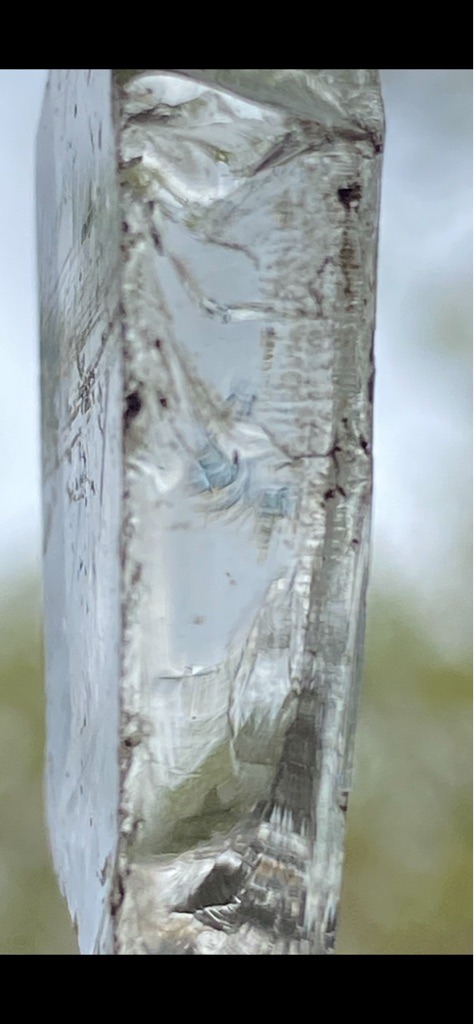
Carat
Estimated 2.5 - 5.0 carats based on visual scale and density
Color
J-L (Near Colorless with visible yellowish/greyish tint)
Clarity
I2-I3 (Included / Industrial quality)
Shape
Rough / Uncut (Macle or Crystalline Fragment)
Overall Assessment
This is a natural, unpolished rough diamond of industrial or near-gem quality. Due to the high density of inclusions and fractures, it is not an ideal candidate for traditional faceting but serves well as a geological specimen or for rustic jewelry.
Cut Quality
Uncut / Rough
Brilliance
Low (typical of unpolished rough stone)
Fire
Very Low (limited by lack of facets)
Scintillation
Minimal (light is absorbed or scattered by inclusions)
Proportions
Asymmetrical octahedral fragment with visible growth planes
Symmetry
Poor (Natural crystalline structure)
Polish
N/A (Unpolished natural surface)
Fluorescence
Undeterminable without UV light (appears Inert)
Inclusions
Extensive internal twinning wisps, dark carbon spots, and large cleavage planes
Blemishes
Chipped edges, trigons (natural growth marks), and surface pitting
Origin
Likely Alluvial or Primary deposit (Commonly Africa or Russia)
Treatment Detection
None apparent; looks like raw earth-mined material
Estimated Value
$150 - $400 USD (Low value due to heavy inclusions and industrial grade)
Certification Estimate
GIA Rough Diamond Report (Likely graded as Industrial/Near-Gem)
Investment Potential
Low (Lacks transparency and clarity for high-end retail yield)
Similar Diamonds
Uncut salt-and-pepper diamonds; industrial bort
Setting Suggestions
Rough diamond specimen jewelry (bezel or claw-prong) or display specimen
Care & Maintenance
Avoid ultrasonic cleaners due to high internal stress and cleavage planes
Interesting Facts
The surface displays natural growth patterns known as trigons, which are unique to natural diamonds.