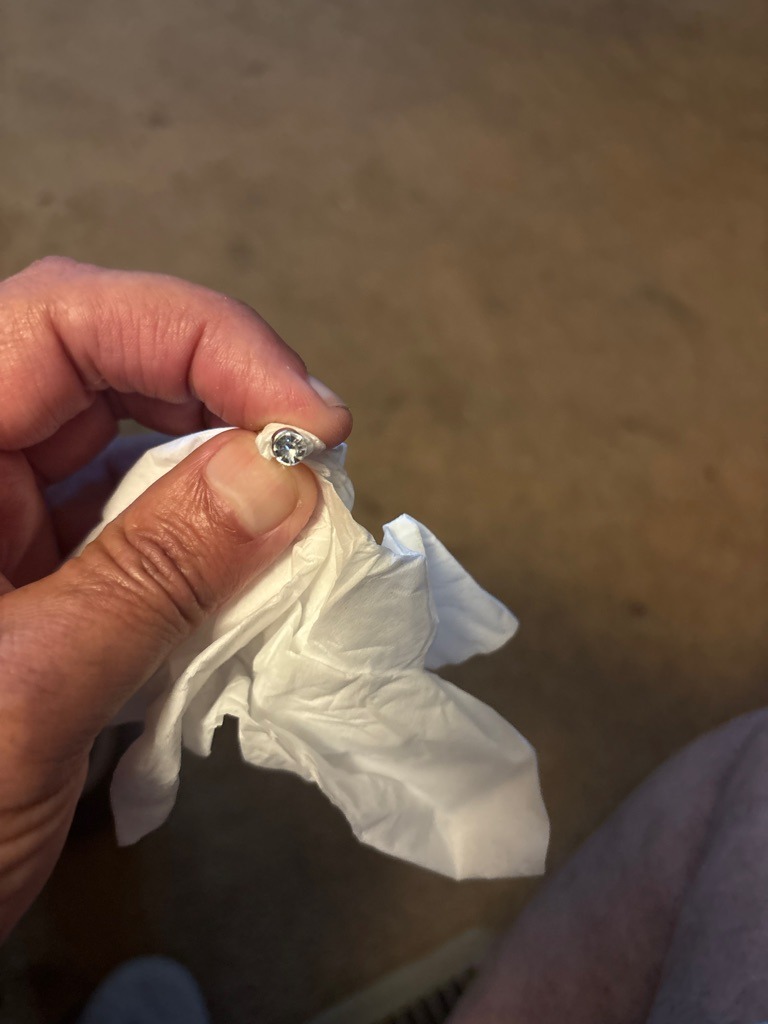
Indeterminate (Possible Diamond or High-quality Simulant)
Indeterminate (Possible Diamond or High-quality Simulant) · Round Brilliant
Good to Very Good Cut
Carat
Estimated 0.50 to 0.75 carats based on size relative to fingertip
Color
Visual estimation G-H (Near Colorless)
Clarity
Visual estimation VS2-SI1 (Small inclusions possible, not visible at this distance)
Shape
Round Brilliant
Overall Assessment
A well-proportioned round brilliant stone showing good light performance. Without professional testing, its identity as a natural diamond cannot be verified against simulants like CZ or Moissanite.
Cut Quality
Good to Very Good
Brilliance
High; shows strong white light return
Fire
Moderate; spectral colors visible in upper facets
Scintillation
Standard pattern of light and dark areas consistent with a brilliant cut
Proportions
Standard commercial round brilliant proportions, table appears slightly large
Symmetry
Good
Polish
Very Good
Fluorescence
Cannot be determined without UV light
Inclusions
No significant macroscopic inclusions visible in low-resolution photo
Blemishes
Minor surface abrasions possible consistent with loose handling
Origin
Unknown; requires microscopic or spectroscopic analysis
Treatment Detection
No obvious signs of fracture filling or coating; HPHT impossible to detect visually
Estimated Value
$1,000 - $2,500 if natural; $100 - $400 if lab-grown; <$20 if simulant
Certification Estimate
Likely GIA or IGI if natural; IGI or GCAL if lab-grown
Investment Potential
Low; standard size and grade categories are generally for consumption rather than investment
Similar Diamonds
Standard commercial grade white diamonds commonly used in engagement rings
Setting Suggestions
Six-prong solitaire in 14k white gold or platinum to maximize security and light return
Care & Maintenance
Clean with warm water, mild dish soap, and a soft brush; store separately from other jewelry
Interesting Facts
The round brilliant cut is engineered specifically for maximum light return and is the most popular diamond shape.