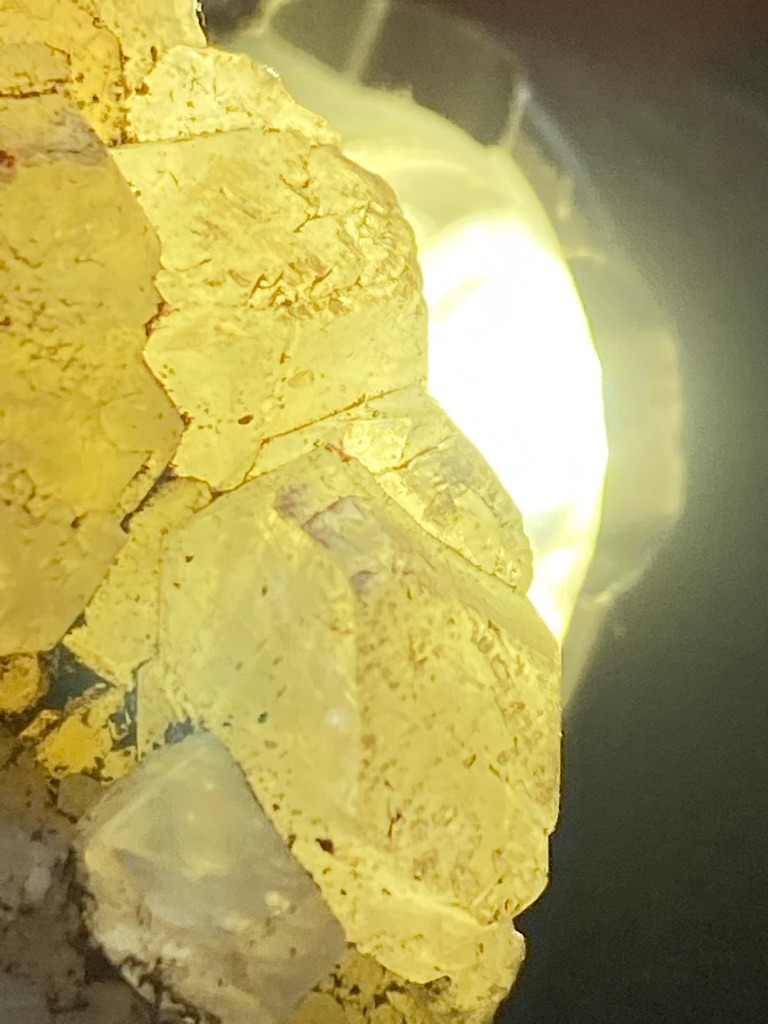
The image shows a raw mineral specimen, likely yellow sulfur crystals or another yellow mineral formation, rather than a polished diamond. Therefore, standard diamond grading metrics do not apply directly to this specimen.
The image shows a raw mineral specimen, likely yellow sulfur crystals or another yellow mineral formation, rather than a polished diamond. Therefore, standard diamond grading metrics do not apply directly to this specimen. · Natural rough mineral crystal form, not a standard faceted diamond shape.
Not applicable as this is an uncut, natural crystalline formation. Cut
Carat
Not applicable for rough mineral specimens measured in carats in this context, but estimated by mass if required.
Color
Vibrant natural yellow color, characteristic of native sulfur or similarly pigmented mineral matrices.
Clarity
Not applicable; rough mineral specimens contain numerous natural inclusions, fractures, and surface irregularities.
Shape
Natural rough mineral crystal form, not a standard faceted diamond shape.
Overall Assessment
The specimen displayed is a natural, rough crystalline mineral formation with a distinctive yellow hue, highly valued as a collectible mineral specimen rather than a gemstone.
Cut Quality
Not applicable as this is an uncut, natural crystalline formation.
Brilliance
Resinous to greasy luster rather than the optical brilliance associated with faceted diamonds.
Fire
Low dispersion compared to diamond, typical of non-diamond mineral specimens.
Scintillation
Minimal sparkle due to the matte, unpolished faces of the crystal structure.
Proportions
Determined by natural crystal habit rather than human-made diamond cutting proportions.
Symmetry
Natural crystal symmetry characteristic of the mineral's crystalline system (such as orthorhombic for sulfur).
Polish
Unpolished, natural matte to resinous luster directly from the geological formation.
Fluorescence
Cannot be definitively determined without UV light testing, though some similar minerals exhibit weak reactions.
Inclusions
Typical natural geological inclusions, micro-fractures, and matrix attachments visible throughout the rough structure.
Blemishes
Natural surface etching, pitting, and rough texture inherent to unpolished mineral specimens.
Origin
Natural geological origin, commonly found near hot springs or volcanic regions depending on the exact mineral species.
Treatment Detection
No evidence of artificial treatments; appears entirely natural and untreated.
Estimated Value
Valued as a mineral specimen for collectors rather than per-carat gemstone pricing, depending heavily on size and aesthetic presentation.
Certification Estimate
Gemological laboratories such as GIA or local institutes would classify this as a mineral specimen rather than issuing a diamond grading report.
Investment Potential
Valued primarily for mineral specimen collections and educational purposes rather than traditional gemstone investment.
Similar Diamonds
None, as this is fundamentally a different mineral category.
Setting Suggestions
Typically preserved in its raw mineral matrix for display rather than set into jewelry, especially if the mineral is soft or fragile.
Care & Maintenance
Requires careful handling, protection from high heat, moisture, and impact due to the delicate and soft nature of many raw mineral crystal formations.
Interesting Facts
Raw mineral specimens like this highlight natural geological processes and crystal growth habits before human intervention and faceting.