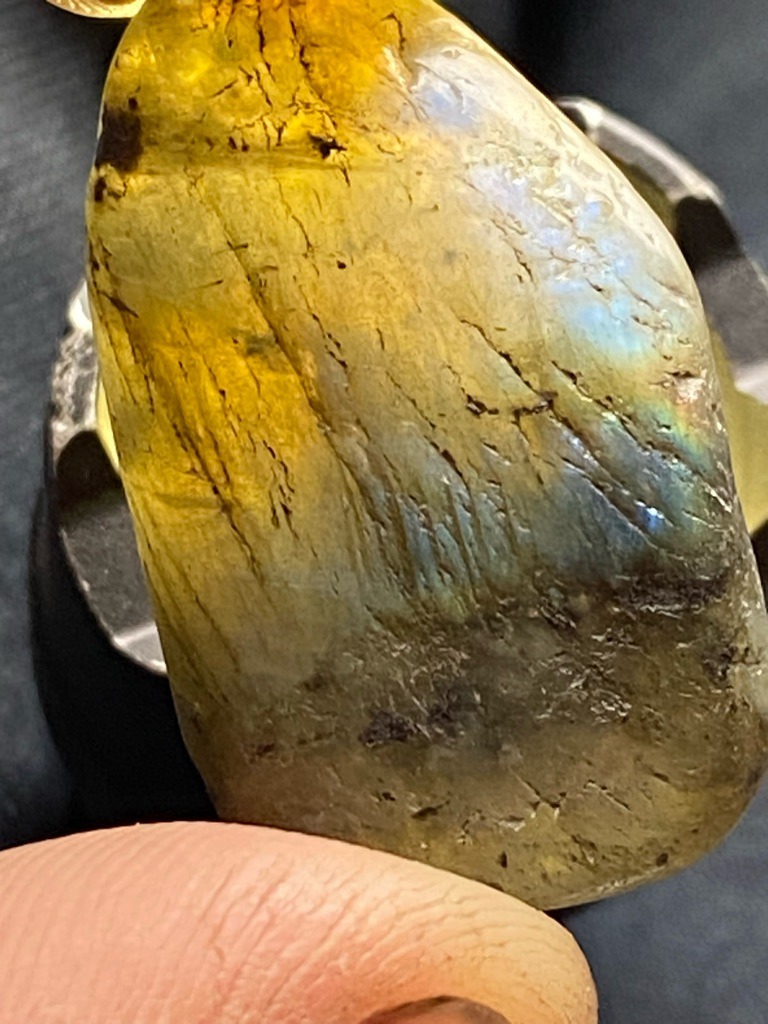
Not a diamond; this is actually Labradorite, a feldspar mineral exhibiting labradorescence.
Not a diamond; this is actually Labradorite, a feldspar mineral exhibiting labradorescence. · Freeform cabochon / tumbled piece
Not applicable (polished cabochon rather than a faceted gemstone). Cut
Carat
Estimated around 15-25 carats based on visual size relative to a finger.
Color
Yellowish-brown body color with iridescent blue and green optical flash (labradorescence).
Clarity
Included (Contains visible internal fractures, twinning planes, and dark mineral inclusions characteristic of natural feldspar).
Shape
Freeform cabochon / tumbled piece
Overall Assessment
An attractive natural specimen of yellow-to-blue flashing labradorite. While not a diamond, it makes for a wonderful mineral specimen or pendant stone.
Cut Quality
Not applicable (polished cabochon rather than a faceted gemstone).
Brilliance
Low white light brilliance; optical performance relies on internal light interference (labradorescence).
Fire
Limited spectral dispersion; exhibits interference colors rather than true fire.
Scintillation
Flashes of blue and gold sheen shift dynamically across the surface as the stone is tilted.
Proportions
Non-standard dimensions due to freeform cabochon cutting style.
Symmetry
Asymmetrical freeform shape.
Polish
Good overall polish with some surface pitting along natural cleavage planes.
Fluorescence
Inert to faint, but exhibits strong structural iridescence (labradorescence).
Inclusions
Abundant internal cleavage fractures, tension cracks, and dark inclusion patches.
Blemishes
Natural surface irregularities and minor pits along cleavage lines.
Origin
Likely sourced from Madagascar, Canada (Labrador), or Finland.
Treatment Detection
No signs of artificial treatment; natural untreated feldspar.
Estimated Value
Low commercial value, approximately $15 to $50 USD depending on the intensity of the labradorescence.
Certification Estimate
Typically identified by gemological institutes like GIA or GRS as Labradorite rather than graded for quality like a diamond.
Investment Potential
Minimal investment or resale value; primarily used as a decorative or healing crystal specimen.
Similar Diamonds
None, as this is a feldspar mineral and not a diamond or diamond simulants like moissanite.
Setting Suggestions
Best set in a sterling silver or yellow gold bezel setting or wire-wrapped pendant to protect the soft edges.
Care & Maintenance
Soft mineral (Mohs hardness 6-6.5). Avoid harsh chemicals, ultrasonic cleaners, and hard impacts due to distinct cleavage.
Interesting Facts
Labradorescence is caused by light diffraction through microscopic lamellae (thin alternating layers) of plagioclase feldspar.