Natural Diamond (estimated based on appearance, though lab-grown or high-grade simulant like CZ/moissanite cannot be definitively ruled out without physical testing)
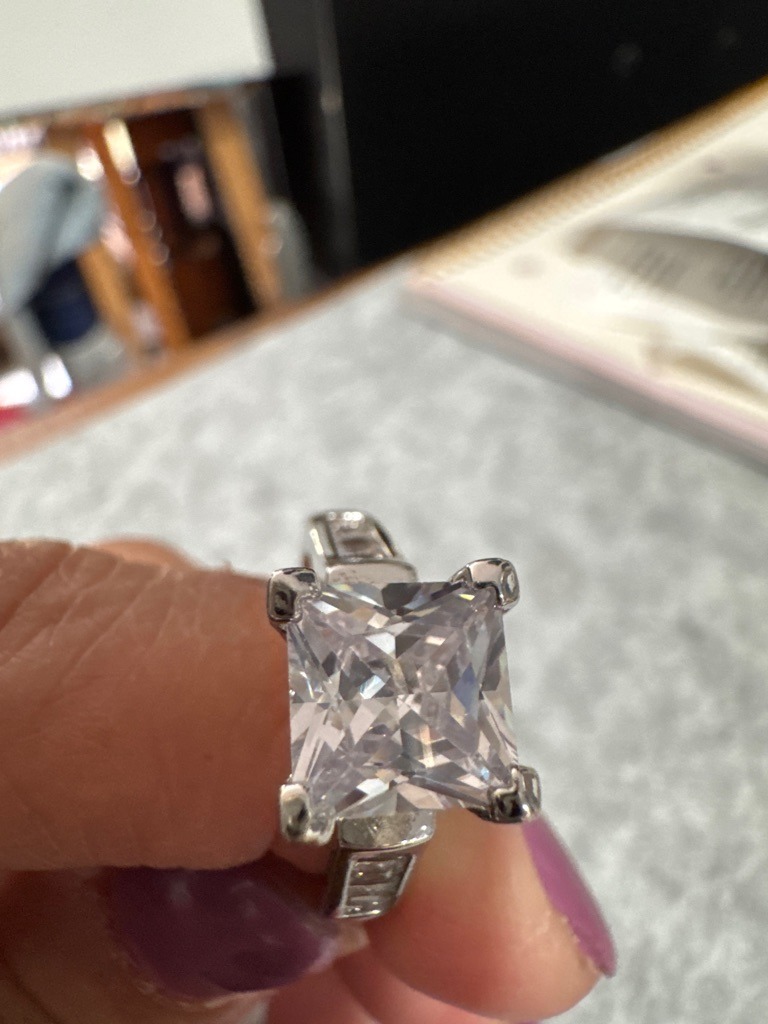
Natural Diamond (estimated based on appearance, though lab-grown or high-grade simulant like CZ/moissanite cannot be definitively ruled out without physical testing) · Princess Cut (Square Modified Brilliant)
Very Good to Excellent Cut
Carat
Estimated 2.0 to 2.5 carats
Color
Estimated G-H (Near Colorless)
Clarity
Estimated VS1-VS2 (Very Slightly Included)
Shape
Princess Cut (Square Modified Brilliant)
Overall Assessment
An attractive, classic multi-stone ring featuring a prominent square princess-cut center diamond with good proportions, high brilliance, and secure prong setting flanked by channel-set baguettes
Cut Quality
Very Good to Excellent
Brilliance
High white light reflection displaying strong brightness across the table and pavilion facets
Fire
Good spectral dispersion creating colorful flashes, characteristic of princess cut brilliant facets
Scintillation
Active sparkle with balanced areas of light and dark contrast as the diamond moves
Proportions
Appears to have a balanced table and depth percentage typical of well-cut princess diamonds; optimal corner security in the four-prong setting
Symmetry
Good to Very Good, well-aligned chevron pattern characteristic of princess cuts
Polish
Good to Very Good with smooth facet junctions
Fluorescence
Estimated None to Faint
Inclusions
No major naked-eye visible inclusions; minor pinpoints or feather might be present under magnification
Blemishes
None readily apparent on surface inspection
Origin
Likely mined natural diamond, though exact country of origin (e.g., Canada, Botswana, South Africa) requires laser inscription or specialized spectroscopy
Treatment Detection
No obvious visible indications of high-pressure high-temperature (HPHT) treatment, laser drilling, or fracture filling
Estimated Value
Approximate retail market value range of $15,000 to $25,000 USD if natural and high quality, dependent on exact certification
Certification Estimate
GIA or IGI grading likely; estimated GIA report would confirm color G, clarity VS2, cut Very Good
Investment Potential
Moderate to stable value retention typical of classic larger natural diamonds; lab-grown diamonds depreciate faster, while natural ones hold better intrinsic value
Similar Diamonds
High-grade princess cut diamonds from major retailers like Blue Nile, James Allen, or Tiffany & Co.
Setting Suggestions
Classic four-prong platinum or white gold setting to protect the sharp corners of the princess cut while maximizing light entry, complemented by baguette side stones
Care & Maintenance
Clean regularly with warm soapy water and a soft brush; check the four corner prongs periodically by a jeweler to ensure the stone remains securely held
Interesting Facts
The princess cut is one of the most popular fancy shapes, invented in the 1960s to combine the brilliant faceting of a round diamond with a modern square or rectangular silhouette