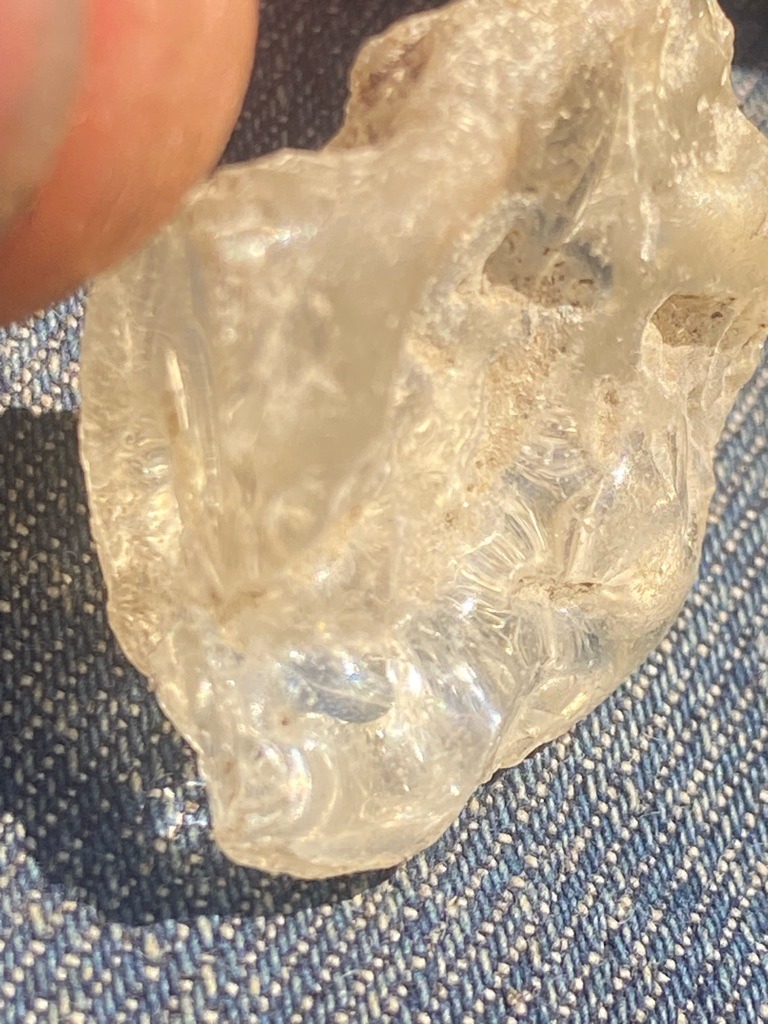
The specimen does not appear to be a diamond; the visual characteristics, specifically the conchoidal (shell-like) fracture patterns and waxy luster, are indicative of common Quartz or industrial Glass/Slag.
The specimen does not appear to be a diamond; the visual characteristics, specifically the conchoidal (shell-like) fracture patterns and waxy luster, are indicative of common Quartz or industrial Glass/Slag. · Rough/Uncut. The specimen lacks any defined crystal habit (like the octahedral shape typical of rough diamonds) and shows irregular, broken surfaces.
Not Applicable (Rough Specimen). Cut
Carat
Estimated 25 to 50 carats based on size relative to a human fingertip and the density of silica-based minerals.
Color
Near-colorless with a slight yellowish or grey tint, consistent with common white quartz or weathered glass.
Clarity
Included (I3 equivalent or lower). It is translucent rather than transparent, containing high densities of internal fractures and clouding.
Shape
Rough/Uncut. The specimen lacks any defined crystal habit (like the octahedral shape typical of rough diamonds) and shows irregular, broken surfaces.
Overall Assessment
Based on the visual evidence of luster, fracture pattern, and lack of diamond crystal structure, this specimen is identified as a piece of rough Quartz or glass cullet rather than a diamond.
Cut Quality
Not Applicable (Rough Specimen).
Brilliance
Very Low. The material demonstrates a glassy luster rather than the high adamantine luster associated with diamonds.
Fire
None detected under the current lighting; the material lacks the refractive index to produce significant dispersion.
Scintillation
Poor; light reflects off random surface fractures rather than internal facets.
Proportions
N/A (No geometric facets present).
Symmetry
Fair to Poor (Irregular natural mass).
Polish
N/A (Rough, unpolished surface).
Fluorescence
Unknown without a UV light source, though quartz typically shows none to faint inertness.
Inclusions
Massive internal fracturing, veining, and possible mineral inclusions that disrupt light path.
Blemishes
Deep pitting, heavy surface abrasion, and sharp conchoidal fracture edges.
Origin
Terrestrial origin, likely secondary alluvial deposit or simple landscaping/road gravel.
Treatment Detection
Natural weathering; no evidence of gemstone treatments like HPHT or coating.
Estimated Value
Minimal/Decorative value only (less than $5 USD).
Certification Estimate
Unlikely to be accepted by GIA/AGS as a gemstone; a mineralogical laboratory would likely identify it as Quartz.
Investment Potential
None. This is a common mineral specimen with no market rarity.
Similar Diamonds
None. Visually similar to Quartz, Clear Chalcedony, or bottle glass.
Setting Suggestions
Not recommended for fine jewelry. Suitable as a mineral specimen or for tumbling.
Care & Maintenance
Avoid heavy impact; while quartz is durable (Mohs 7), the pre-existing internal fractures make it prone to splitting.
Interesting Facts
The curved, shell-like fracture lines seen on the surface are 'conchoidal' fractures, a diagnostic feature of silica-based materials like quartz and glass, whereas diamonds usually break along flat cleavage planes.