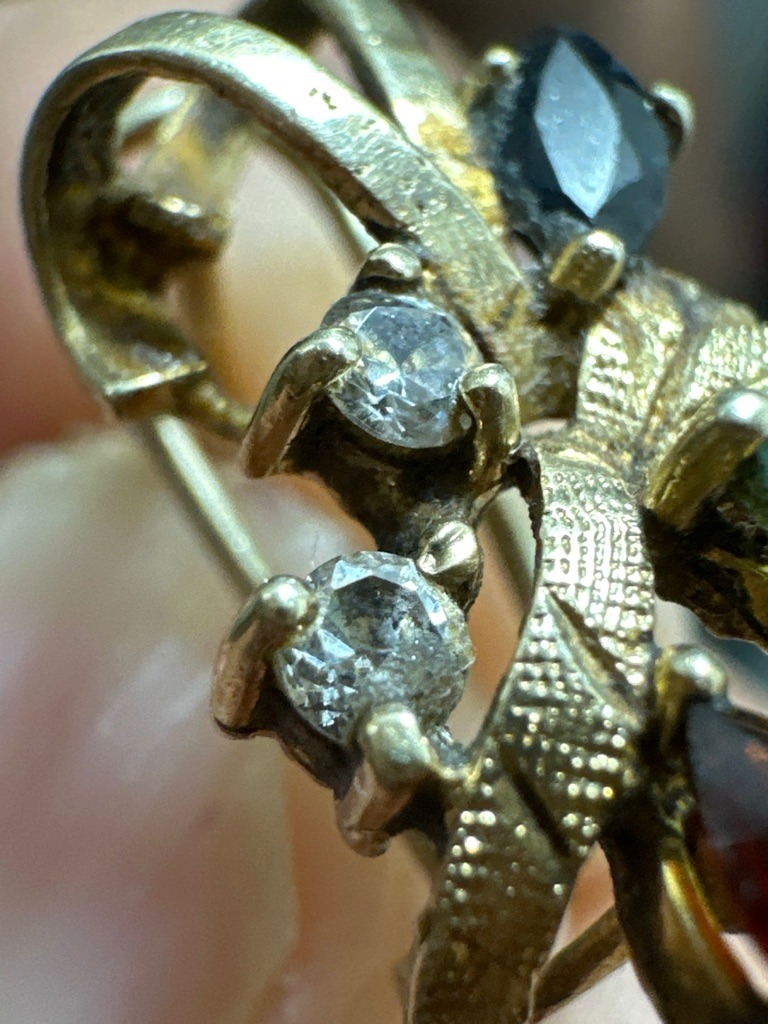
Likely Natural Melee (Prominent inclusions suggest lower-grade natural diamond or possibly synthetic/glass stimulant due to visible wear)
Likely Natural Melee (Prominent inclusions suggest lower-grade natural diamond or possibly synthetic/glass stimulant due to visible wear) · Round Brilliant
Fair to Poor Cut
Carat
Estimated 0.03 - 0.05 carats per individual stone
Color
I - J (Light Brown/Near Colorless)
Clarity
I2 - I3 (Included)
Shape
Round Brilliant
Overall Assessment
The stones are low-quality decorative rounds with significant inclusions and surface wear. They serve as accent pieces in a vintage setting rather than standalone gems of high value.
Cut Quality
Fair to Poor
Brilliance
Low; light return is dampened by internal inclusions and surface grime
Fire
Minimal; spectral dispersion is restricted by stone quality
Scintillation
Weak; irregular light-to-dark pattern
Proportions
Non-standard; high crown and irregular pavilion angles visible
Symmetry
Fair
Polish
Poor (significant surface abrasions and dirt visible)
Fluorescence
Indeterminate from image
Inclusions
Heavy internal clouding, dark crystals, and potential internal fractures
Blemishes
Significant surface pitting, facet edge abrasions, and heavy oxidation/dirt accumulation on the setting
Origin
Likely natural, sourced from commercial-grade mines for costume/vintage jewelry
Treatment Detection
None apparent, though oiling or surface filling cannot be ruled out without cleaning
Estimated Value
$10 - $25 USD per stone (Commercial/Decorative value only)
Certification Estimate
Unlikely to be certified due to low carat weight and grade; would not meet GIA standards for a full report
Investment Potential
None; these stones possess utility value only
Similar Diamonds
Commercial 'salt and pepper' melee or promotional grade diamonds
Setting Suggestions
Currently set in a decorative cast-metal brooch or ribbon-style ring; best suited for vintage restoration
Care & Maintenance
Professional ultrasonic cleaning and steam treatment to remove heavy biological/metal oxidation buildup
Interesting Facts
The faceted blue and red stones adjacent suggest this is a multi-gemstone piece, likely from the mid-20th century.