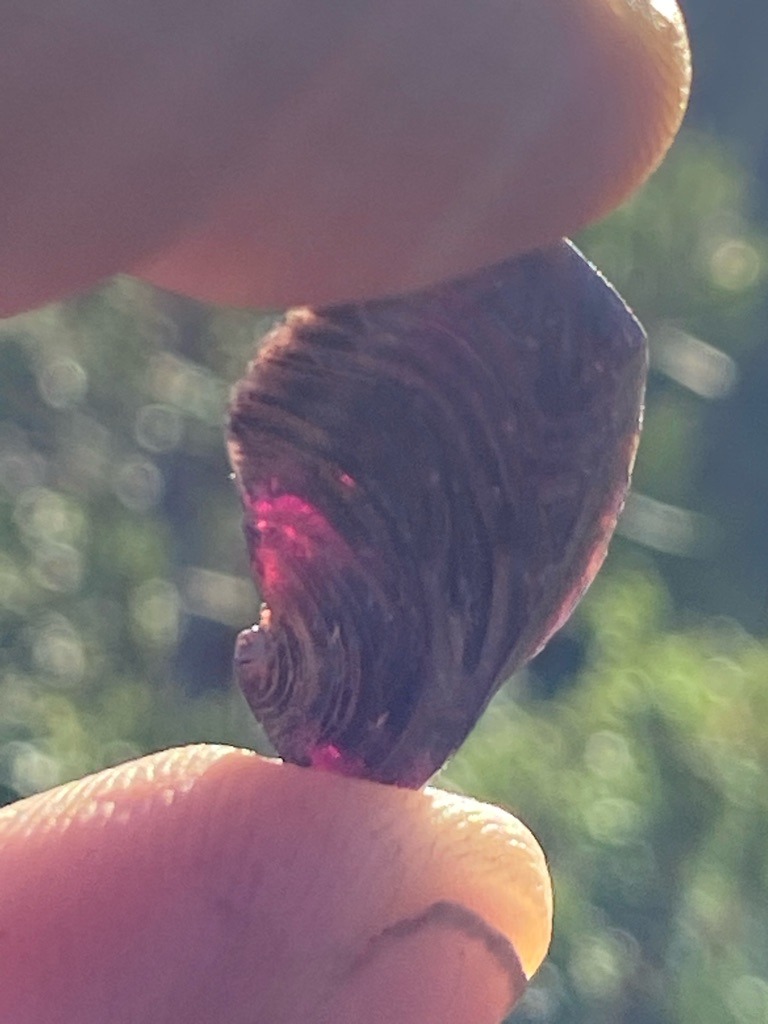
Not a diamond; appears to be a natural rough garnet or colored gemstone crystal with distinct conchoidal fracture patterns.
Not a diamond; appears to be a natural rough garnet or colored gemstone crystal with distinct conchoidal fracture patterns. · Rough uncut crystal / irregular pebble form.
Not applicable (Rough, uncut stone). Cut
Carat
Estimated around 3.5 to 5.0 carats visually.
Color
Deep reddish-purple (Fancy Dark Purplish Red).
Clarity
Included (Contains visible internal growth lines and fractures).
Shape
Rough uncut crystal / irregular pebble form.
Overall Assessment
The specimen shown is a raw, deep red gemstone crystal—likely a garnet—exhibiting natural conchoidal fractures, rather than a diamond.
Cut Quality
Not applicable (Rough, uncut stone).
Brilliance
Low due to lack of facets and opaque/dark zones in rough state.
Fire
Minimal to none in current rough state.
Scintillation
Poor due to absence of faceted surfaces.
Proportions
Not applicable to uncut rough stones.
Symmetry
Natural asymmetrical crystal formation.
Polish
Unpolished, raw natural state with smooth fracture surfaces.
Fluorescence
Unknown without UV testing, likely inert.
Inclusions
Conchoidal growth ripples, internal fractures, and fluid or mineral inclusions typical of raw garnet.
Blemishes
Natural surface pitting and uneven raw texture.
Origin
Likely alluvial or primary metamorphic deposit origin.
Treatment Detection
No obvious signs of artificial treatment; appears completely untreated and natural.
Estimated Value
Nominal value as a mineral specimen; low commercial jewelry value until cut and polished.
Certification Estimate
Gemological laboratories such as GIA or IGI would classify this as natural garnet rough rather than diamond.
Investment Potential
Low investment potential in raw, uncertified gemstone form.
Similar Diamonds
None, as this is visually identified as a colored gemstone crystal rather than diamond.
Setting Suggestions
Wire-wrapped pendant or bespoke organic bezel setting if left raw.
Care & Maintenance
Store separately to avoid scratching softer materials; clean gently with mild soapy water and a soft brush.
Interesting Facts
The swirling patterns visible on the surface are conchoidal fracture lines, characteristic of how certain silicate minerals break.