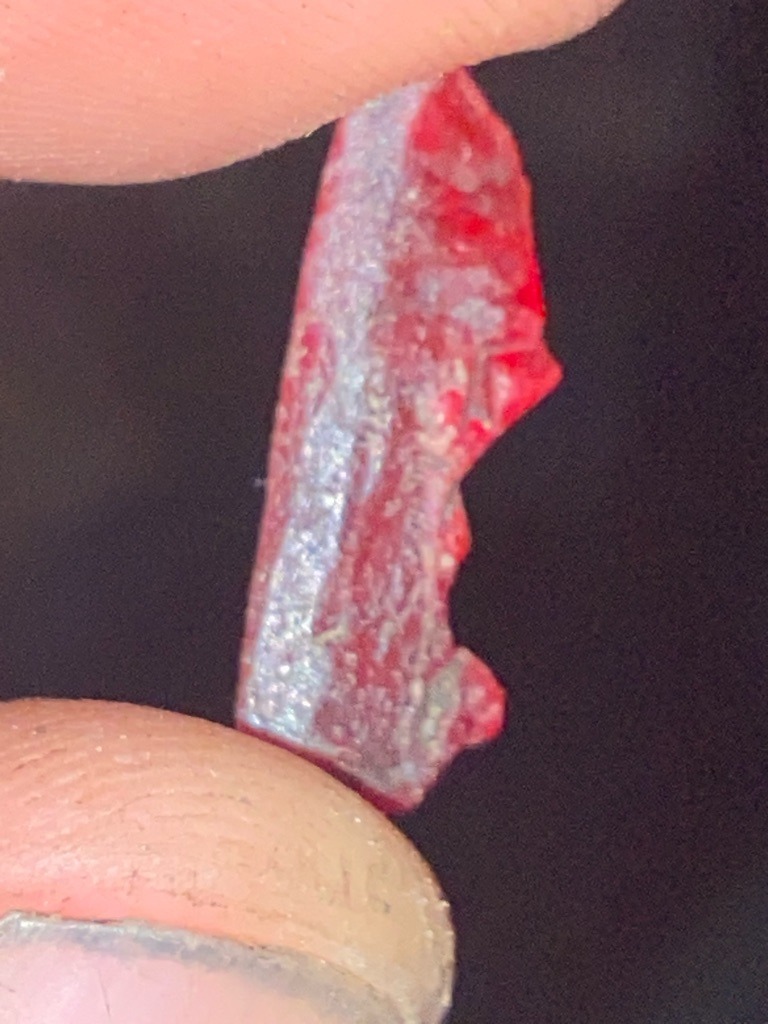
Not a diamond; this specimen appears to be a heavily fractured, opaque red rough mineral or crystal, potentially colored quartz, jasper, or resin/plastic rather than gem-quality carbon crystal.
Not a diamond; this specimen appears to be a heavily fractured, opaque red rough mineral or crystal, potentially colored quartz, jasper, or resin/plastic rather than gem-quality carbon crystal. · Irregular rough shard / fragment with no standard faceted gemstone shape.
Not applicable (uncut raw fragment). Cut
Carat
Cannot be accurately assessed visually, but roughly estimated at 1 to 3 carats equivalent mass based on scale.
Color
Opaque deep red with whitish or greyish surface alterations.
Clarity
I3 / Heavily included and fractured; completely opaque throughout the visible structure.
Shape
Irregular rough shard / fragment with no standard faceted gemstone shape.
Overall Assessment
The specimen shown in the image is definitively not a diamond. It is an opaque, heavily fractured red rough mineral fragment lacking the optical and physical properties of diamond.
Cut Quality
Not applicable (uncut raw fragment).
Brilliance
Poor to none, due to lack of transparency, faceting, and high opacity.
Fire
None, as the material lacks the refractive index dispersion and optical clarity to produce fire.
Scintillation
None; opaque surfaces do not return light effectively.
Proportions
Non-standard; elongated, fractured shard with no symmetrical table, crown, or pavilion.
Symmetry
Asymmetrical raw mineral fragment.
Polish
Unpolished, rough natural or broken texture.
Fluorescence
Unknown without UV testing, though unlikely to display traditional diamond fluorescence.
Inclusions
Abundant internal fractures, veining, and micro-fissures typical of low-grade or non-gem aggregate materials.
Blemishes
Surface pitting, rough breakage planes, and white surface residue or matrix attachment.
Origin
Natural terrestrial mineral matrix or aggregate, exact location undetermined.
Treatment Detection
Visual inspection suggests possible surface coating, dyeing, or alteration, but comprehensive testing is required.
Estimated Value
Nominal or negligible commercial gemstone value; primarily of mineralogical or specimen curiosity interest.
Certification Estimate
Major grading labs like GIA or IGI would not issue diamond reports for this specimen, as it is not a diamond.
Investment Potential
None; this specimen holds no financial investment or resale value as a gemstone.
Similar Diamonds
None, as this bears no resemblance to diamond material.
Setting Suggestions
Not recommended for fine jewelry due to fragility and lack of gemological quality; could be used in wire-wrapping or raw mineral collections.
Care & Maintenance
Keep dry, avoid harsh chemicals, ultrasonic cleaners, and drops, as the high degree of fracturing makes it fragile.
Interesting Facts
Red rough minerals are often mistaken for rubies or fancy colored diamonds by untrained observers, but composition testing usually reveals common silicates or oxides.