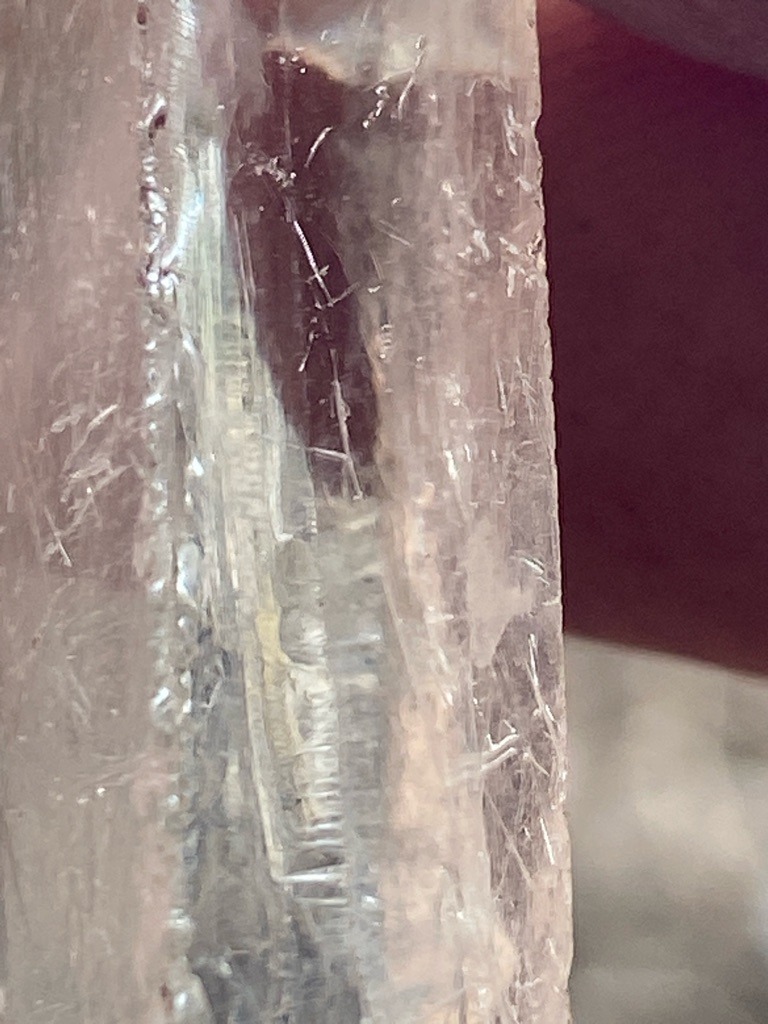
The image shows a raw, uncut mineral crystal matrix rather than a faceted diamond. Visually, it appears to be a quartz or beryl crystal with needle-like inclusions (resembling tourmaline or rutile), not a diamond.
The image shows a raw, uncut mineral crystal matrix rather than a faceted diamond. Visually, it appears to be a quartz or beryl crystal with needle-like inclusions (resembling tourmaline or rutile), not a diamond. · Rough crystal / uncut mineral form (no standard diamond shape)
Not applicable (rough, uncut stone) Cut
Carat
Cannot be accurately estimated as a diamond; rough crystal weight would require specific density and volume measurements.
Color
Colorless to pale translucent with dark matrix features
Clarity
I3 (heavy inclusions and surface characteristics visible in rough form)
Shape
Rough crystal / uncut mineral form (no standard diamond shape)
Overall Assessment
This specimen is a raw, natural mineral crystal containing prominent needle-like inclusions rather than a faceted diamond. Professional gemological testing (such as refractometer or Raman spectroscopy) is recommended to confirm the exact mineral species.
Cut Quality
Not applicable (rough, uncut stone)
Brilliance
Low due to lack of faceting and rough surface texture
Fire
Minimal to none due to lack of facet dispersion
Scintillation
Poor, as it is an unpolished rough crystal
Proportions
Prismatic crystal habit, non-standard diamond proportions
Symmetry
Natural crystal symmetry (elongated prismatic form)
Polish
Raw, unpolished natural crystal faces with striations
Fluorescence
Unknown (requires UV testing)
Inclusions
Heavy needle-like inclusions and internal fractures
Blemishes
Natural surface etching, striations, and rough patches
Origin
Natural rough mineral specimen, likely from a pegmatite or hydrothermal vein deposit.
Treatment Detection
No visible treatments; appears completely natural and untreated.
Estimated Value
Nominal mineral specimen value, highly dependent on exact mineral species (e.g., quartz with tourmaline vs. raw beryl).
Certification Estimate
Not typically graded by diamond labs like GIA as a diamond; would be analyzed by general gemological labs (GIA, GIA Colored Stone, etc.) for mineral identification.
Investment Potential
Low as an investment, mainly valued as a mineral specimen or educational piece.
Similar Diamonds
None, as this is visually a rough quartz/silicate crystal rather than diamond material.
Setting Suggestions
Wire-wrapped in sterling silver or gold for an organic, bohemian jewelry look if polished or encased as a specimen.
Care & Maintenance
Avoid harsh chemicals, ultrasonic cleaners, and hard impacts to prevent fracturing along natural cleavage or inclusion planes.
Interesting Facts
The fibrous or needle-like inclusions running through the crystal matrix create a striking visual pattern commonly sought after by mineral collectors.