Potential Diamond Simulant (Cubic Zirconia or Moissanite)
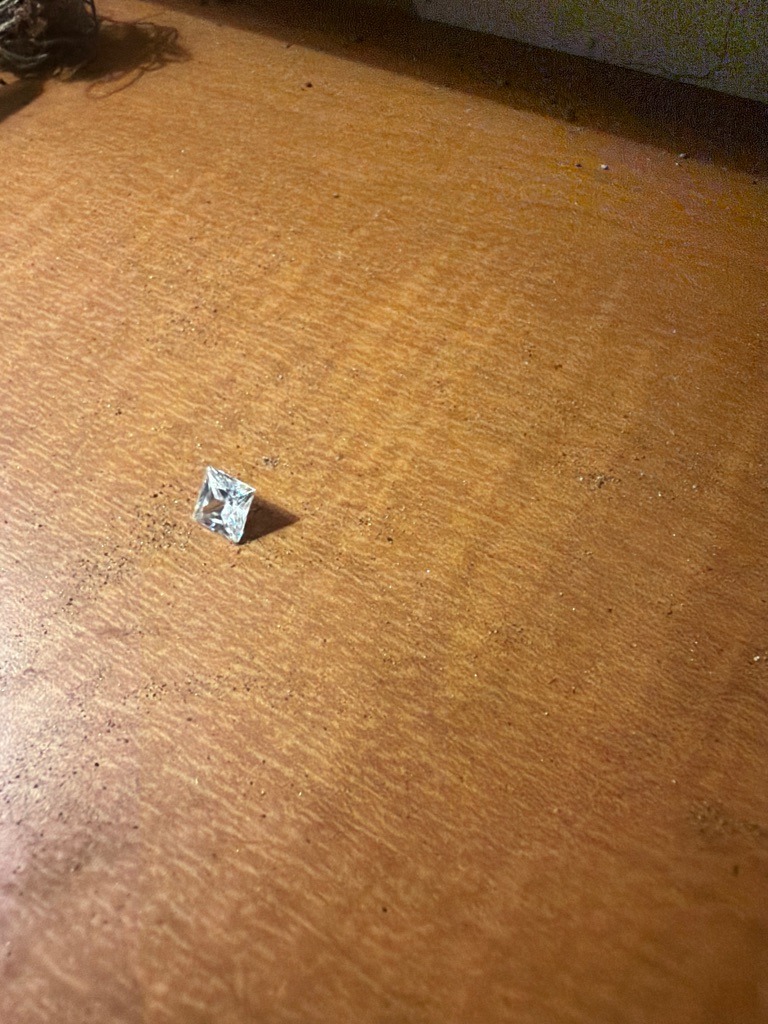
Potential Diamond Simulant (Cubic Zirconia or Moissanite) · Princess Cut
Good Cut
Carat
Estimated 1.5 - 2.0 carats (based on surface area relative to wood grain)
Color
Colorless (D-F Range)
Clarity
Eye-Clean (Estimated VS1-IF equivalent)
Shape
Princess Cut
Overall Assessment
The stone exhibits the high-contrast 'X' pattern typical of a Princess Cut. However, the high degree of fire and clarity visible in a casual setting often points toward a simulant. Professional testing with a thermal/electrical conductivity probe is required for definitive identification.
Cut Quality
Good
Brilliance
High surface reflectivity
Fire
High; colorful dispersion suggests a possible simulant like Moissanite or CZ
Scintillation
Crisp contrast between light and dark facets
Proportions
Standard Princess Cut faceting; specific table/depth percentages require physical measurement
Symmetry
Good
Polish
Good
Fluorescence
Indeterminable from photo
Inclusions
No significant internal inclusions visible at this magnification and resolution
Blemishes
No visible surface scratches or chips, though sharp corners are prone to chipping
Origin
Likely synthetic/manufactured based on visual clarity and setting
Treatment Detection
None visible; requires UV light and spectroscopy to confirm
Estimated Value
$5 - $50 (if CZ); $300 - $800 (if Moissanite); $2,000+ (if Lab Diamond); $10,000+ (if Natural Diamond)
Certification Estimate
Likely ungertified; if authentic, GIA or IGI (if lab-grown)
Investment Potential
Low (especially if verified as a simulant)
Similar Diamonds
Standard 6mm Princess Cut loose stones
Setting Suggestions
V-prong setting to protect the vulnerable sharp corners
Care & Maintenance
Keep clean with mild soap; avoid harsh impact on corners due to cleavage planes in Princess cuts
Interesting Facts
Princess cuts use about 60-80% of the original rough diamond weight, making them more efficient than rounds.