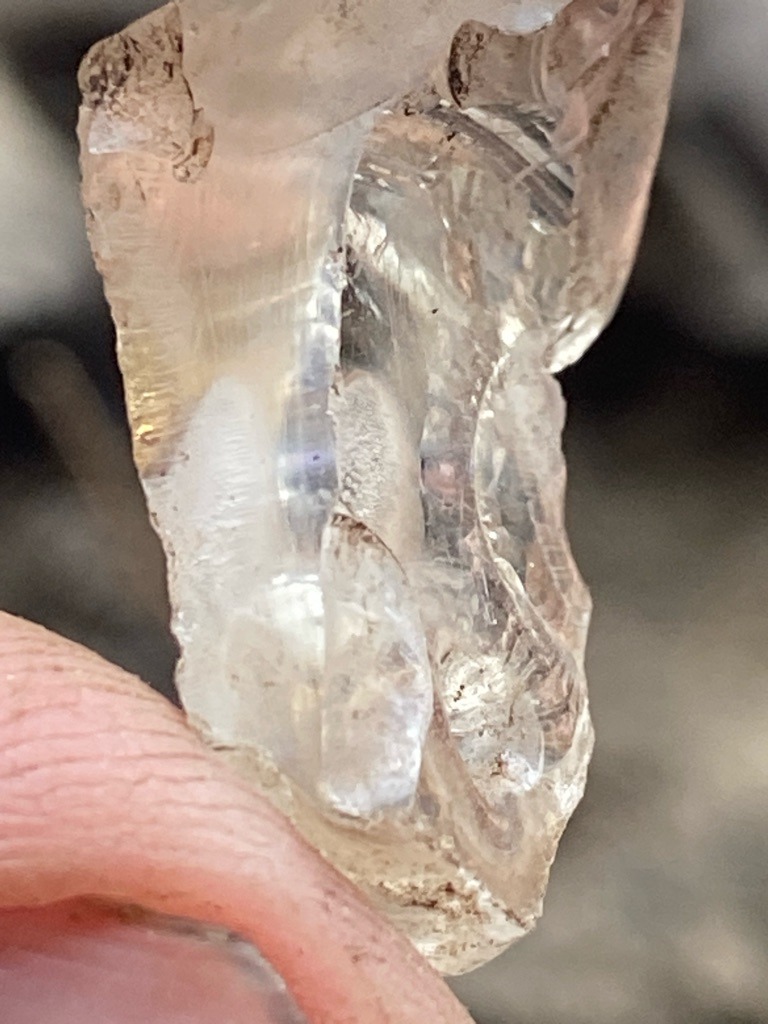
The image shows a raw, uncut mineral crystal rather than a faceted diamond; visually, it resembles rough quartz or similar pegmatite mineral, but if evaluated as a rough diamond specimen, it displays natural crystal growth features.
The image shows a raw, uncut mineral crystal rather than a faceted diamond; visually, it resembles rough quartz or similar pegmatite mineral, but if evaluated as a rough diamond specimen, it displays natural crystal growth features. · Rough Crystal / Raw Uncut Mineral
Not applicable as this is an uncut, unpolished raw crystal. Cut
Carat
Estimated rough crystal weight exceeds standard gem diamonds due to size, roughly 5.0 to 10.0+ carats equivalent if measured in gem mass, though specific gravity differs.
Color
Near-colorless with subtle brownish or yellowish undertones typical of raw crystal specimens.
Clarity
Included (I1-I3 equivalent for rough) due to numerous natural internal fractures, growth lines, and inclusions.
Shape
Rough Crystal / Raw Uncut Mineral
Overall Assessment
The specimen displayed is a raw, unpolished mineral crystal featuring natural growth lines and irregular fracture patterns, valuable primarily as a rough specimen rather than a finished gemstone.
Cut Quality
Not applicable as this is an uncut, unpolished raw crystal.
Brilliance
Low to moderate due to raw, unpolished surfaces scattering light internally rather than reflecting it uniformly.
Fire
Minimal dispersion visible on raw fracture planes.
Scintillation
Absent due to lack of standard faceted angles.
Proportions
Non-standard; raw crystal form with natural striations and uneven depth.
Symmetry
Natural asymmetrical crystal growth with irregular habit.
Polish
Raw, unpolished natural crystal faces and fracture surfaces.
Fluorescence
Cannot be definitively determined without UV testing, likely none to faint.
Inclusions
Feathers, internal fractures, cloudiness, and mineral deposits typical of raw stones.
Blemishes
Natural surface etching, irregularities, roughness, and adhere matrix traces.
Origin
Natural terrestrial rough mineral specimen.
Treatment Detection
No evidence of artificial treatments; appears entirely natural and untreated.
Estimated Value
Minimal commercial gemstone value; primarily valued as a raw mineral specimen for collectors.
Certification Estimate
Unlikely to be certified by major gemological labs like GIA as a diamond; would require basic mineralogical identification.
Investment Potential
Low investment potential for resale, suitable mainly for educational or mineral collection purposes.
Similar Diamonds
Comparable to other raw industrial or specimen-grade rough diamond crystals, or raw quartz crystal specimens.
Setting Suggestions
Wire-wrapped raw crystal pendant or organic bezel setting to preserve its natural form.
Care & Maintenance
Clean gently with warm soapy water and a soft brush; protect from hard impacts that could propagate natural fractures.
Interesting Facts
Raw diamond and gemstone crystals often exhibit natural growth features such as striations, trigons, and irregular habit before undergoing the cutting and polishing process.