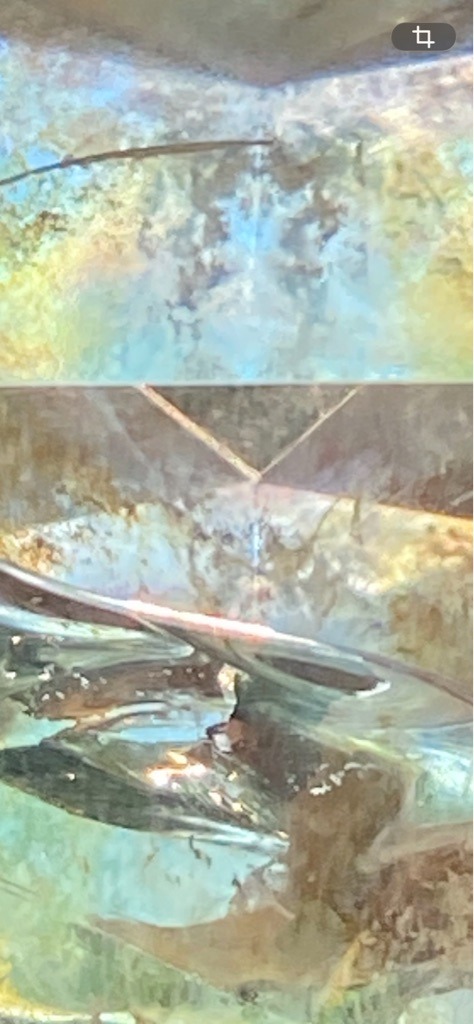
Unable to determine conclusively from the provided macro/distorted image, potentially natural or synthetic mineral given the surface reflections and inclusions.
Unable to determine conclusively from the provided macro/distorted image, potentially natural or synthetic mineral given the surface reflections and inclusions. · Not clearly determinable due to extreme close-up of internal facets and reflections.
Cannot be assessed accurately without standard facet proportion measurements. Cut
Carat
Cannot be accurately estimated from the microscopic/distorted view provided.
Color
Appears to show some coloration due to lighting reflections, but standard D-Z scale cannot be applied.
Clarity
Features visible inclusions and surface textures, suggesting a lower clarity grade, but precise grading is impossible without a standard loupe view.
Shape
Not clearly determinable due to extreme close-up of internal facets and reflections.
Overall Assessment
The provided image is too close and distorted for a definitive gemological evaluation. A physical inspection with standard gemological instruments (loupe, microscope, spectrometer) is necessary.
Cut Quality
Cannot be assessed accurately without standard facet proportion measurements.
Brilliance
Displays some light return, but hindered by internal characteristics.
Fire
Spectral dispersion is visible in certain facets under the current lighting.
Scintillation
Pattern of light and dark areas cannot be fully evaluated without movement and standard lighting.
Proportions
Not measurable from the provided image.
Symmetry
Cannot be assessed from the provided partial image.
Polish
Surface lines and wear visible, but full polish grade requires specialized equipment.
Fluorescence
Cannot be determined without UV light testing.
Inclusions
Visible internal fractures, feathers, or mineral crystals reflecting light internally.
Blemishes
Surface scratches or abrasions likely present based on the visual texture.
Origin
Unknown origin; physical testing (spectroscopy) required to distinguish natural from lab-grown.
Treatment Detection
Microscopic examination required to check for fracture filling or laser drilling.
Estimated Value
Cannot be determined without precise carat, color, clarity, and cut specifications.
Certification Estimate
Standard grading labs (GIA, IGI) would require physical examination for certification.
Investment Potential
Low to moderate depending on final certified quality grades.
Similar Diamonds
None can be accurately matched without complete grading parameters.
Setting Suggestions
Protective settings like bezel or V-prong are recommended if inclusions threaten structural integrity.
Care & Maintenance
Clean with warm soapy water and a soft brush; avoid harsh chemicals and ultrasonic cleaners if heavily included.
Interesting Facts
Close-up imaging of diamond facets reveals the complex path light takes through internal reflections and refractions.