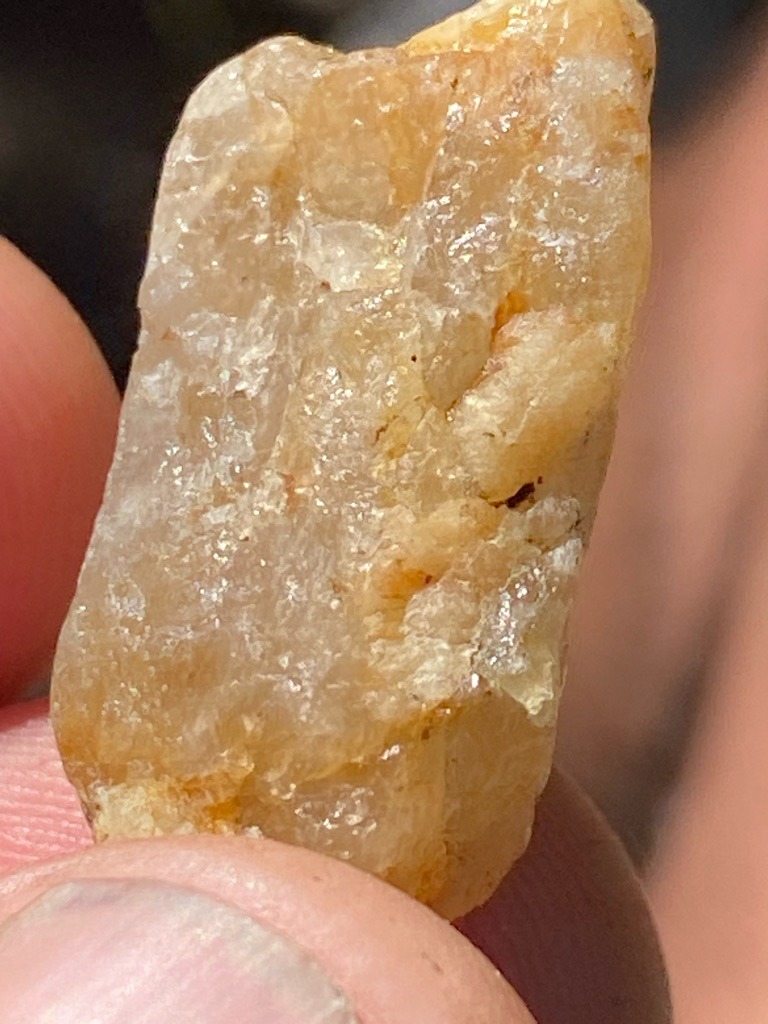
The image appears to show a raw, unpolished crystal aggregate or quartz/citrine-like mineral specimen rather than a standard faceted diamond, though rough industrial-grade diamond crystals can sometimes appear unstructured; based on visual texture, this is likely not a gem-quality diamond.
The image appears to show a raw, unpolished crystal aggregate or quartz/citrine-like mineral specimen rather than a standard faceted diamond, though rough industrial-grade diamond crystals can sometimes appear unstructured; based on visual texture, this is likely not a gem-quality diamond. · Rough crystal / Uncut natural mineral form
Not applicable (Rough, un-cut stone) Cut
Carat
Difficult to determine precisely without density testing, but visually around 5-10 carats if gemstone material.
Color
Light yellow-brown to orange-yellow (Fancy Light Brownish Yellow if diamond)
Clarity
Included / Heavily included (I3 equivalent due to numerous internal fractures and cloudiness)
Shape
Rough crystal / Uncut natural mineral form
Overall Assessment
The specimen shown exhibits the characteristics of a rough, included mineral crystal rather than a high-grade faceted diamond. Professional gemological testing (such as a thermal conductivity test or Raman spectroscopy) is recommended for definitive identification.
Cut Quality
Not applicable (Rough, un-cut stone)
Brilliance
Low due to opaque and fractured nature
Fire
Minimal to none due to lack of precision faceting and internal clarity
Scintillation
Poor, lacking distinct facets to return light dynamically
Proportions
Irregular raw crystal shape with no standard pavilion, table, or crown measurements
Symmetry
Natural asymmetric crystal growth
Polish
Raw, unpolished surface texture with natural crystal faces and fractures
Fluorescence
Unknown without UV testing (likely none to faint)
Inclusions
Dense internal fracturing, feather inclusions, and mineral staining
Blemishes
Natural surface roughness, pits, and growth irregularities
Origin
Natural rough mineral, likely alluvial or pegmatitic origin
Treatment Detection
No obvious signs of artificial enhancement; appears completely natural and untreated.
Estimated Value
Nominal value as a mineral specimen; very low commercial value as a gemstone.
Certification Estimate
Major labs like GIA or IGI would issue a gemstone identification report rather than a standard diamond grading report, likely identifying it as rough quartz or industrial mineral.
Investment Potential
Negligible investment potential as a gemstone; primarily of interest as a mineral specimen.
Similar Diamonds
Industrial-grade boart or low-quality natural rough diamond fragments
Setting Suggestions
Wire-wrapped raw crystal jewelry or organic boho-style settings if mounted as a specimen piece.
Care & Maintenance
Standard gentle cleaning with warm soapy water and a soft brush; avoid harsh ultrasonic cleaners due to internal fracturing.
Interesting Facts
Raw diamond and quartz crystals often share similar initial appearances to the untrained eye, requiring specific thermal or gravity testing to differentiate.