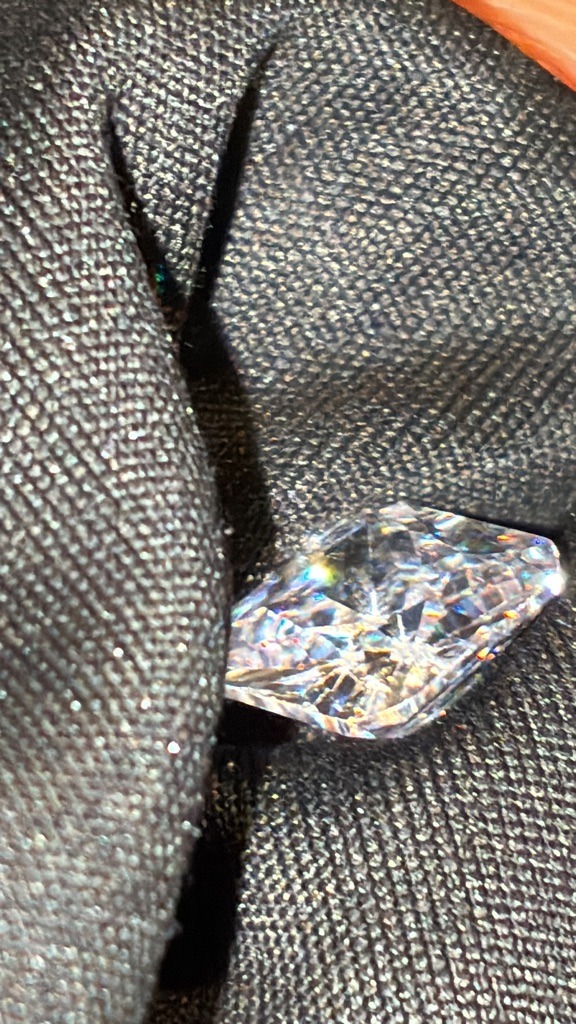
Likely Moissanite or High-Quality Diamond Simulant
Likely Moissanite or High-Quality Diamond Simulant · Radiant / Modified Rectangular Brilliant
Excellent/Very Good Cut
Carat
Estimated 1.5 - 2.0 carats
Color
Likely D-E-F (Colorless)
Clarity
Estimated VVS1 - VVS2 (Eye Clean)
Shape
Radiant / Modified Rectangular Brilliant
Overall Assessment
Visible doubling of facet junctions and excessive fire indicate a high-quality Moissanite gemstone. It presents as a stunning, colorless, and eye-clean stone with beautiful symmetry.
Cut Quality
Excellent/Very Good
Brilliance
Very High; the stone shows exceptional white light return
Fire
Extreme; there is a high degree of rainbow spectral dispersion (doubling of facets suggests Moissanite)
Scintillation
Strong with a high-frequency sparkle pattern
Proportions
Standard Radiant proportions with a large table and slightly shallow profile
Symmetry
Very Good
Polish
Excellent
Fluorescence
None visible
Inclusions
No significant internal inclusions visible at this resolution; clean facets
Blemishes
Minor surface dust or lint from the fabric background
Origin
Likely Lab-Created (typical for high-fire gems of this clarity)
Treatment Detection
None detected; possible CVD or HPHT if lab-grown diamond
Estimated Value
$100 - $800 (if Moissanite); $15,000+ (if Natural Diamond)
Certification Estimate
Likely IGI or specialized gemstone certificate for lab-grown/simulants
Investment Potential
Low as a simulant/lab-grown; primarily decorative and aesthetic value
Similar Diamonds
Equivalent to a Forever One Moissanite or a GIA-graded Colorless Radiant Natural Diamond
Setting Suggestions
Platinum or White Gold four-prong solitaire to maximize light entry
Care & Maintenance
Clean with warm soapy water and a soft brush; avoid abrasive cloths
Interesting Facts
The intense rainbow 'fire' is often more pronounced in Moissanite than in natural diamonds due to a higher refractive index.