Non-diamond (Glass or Quartz)
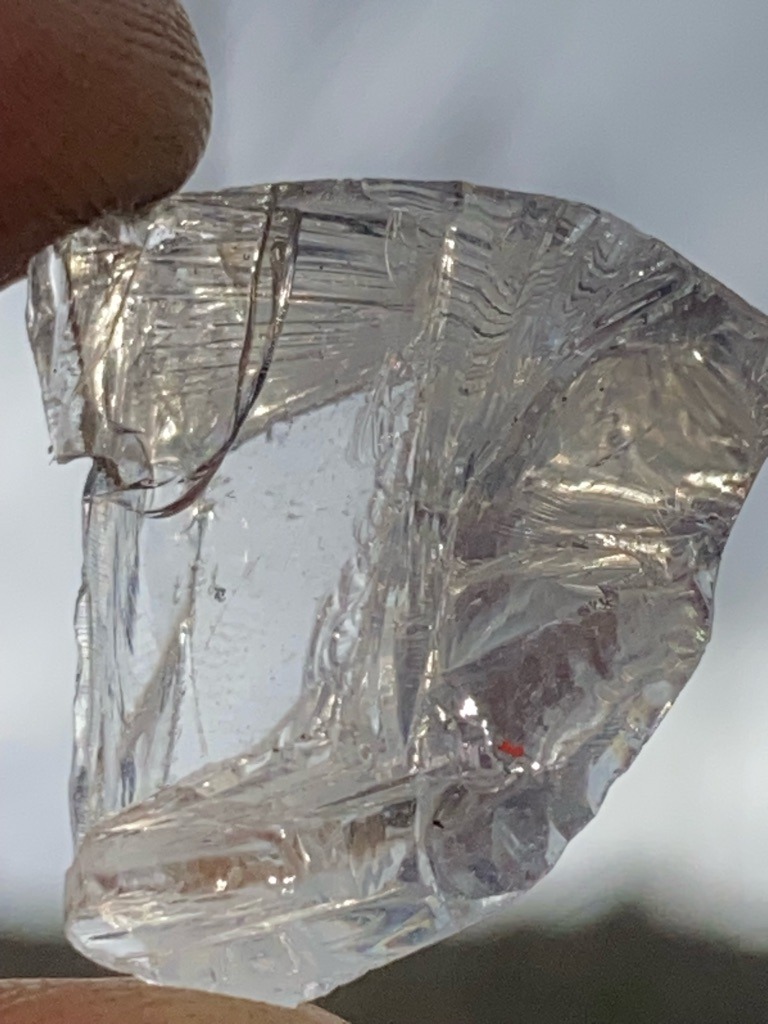
Non-diamond (Glass or Quartz) · Rough/Uncut fragment
None (Rough/Uncut) Cut
Carat
Estimated 10-20 carats based on visual size relative to fingers
Color
Colorless to Near-Colorless (comparable to G-H range but lacks diamond luster)
Clarity
Included (visible fractures and surface-reaching features)
Shape
Rough/Uncut fragment
Overall Assessment
This specimen is not a diamond. It lacks the adamantine luster, specific gravity appearance, and geometric crystalline structure of a diamond. It appears to be a fragment of decorative glass or common quartz.
Cut Quality
None (Rough/Uncut)
Brilliance
Low (Lacks the high refractive index of a diamond)
Fire
None visible (Low dispersion)
Scintillation
Minimal (Lacks facet reflections)
Proportions
N/A (Non-faceted)
Symmetry
None (Asymmetrical rough fragment)
Polish
N/A (Rough exterior)
Fluorescence
Unknown without UV light
Inclusions
Heavy internal fractures, concavity, and shelf-like growth or fracture planes
Blemishes
Chipped edges, conchoidal fractures, and surface striations typical of glass or quartz
Origin
Likely industrial glass or common quartz mineral
Treatment Detection
None detected; appears to be raw waste material or common mineral
Estimated Value
Negligible (Less than $5 USD)
Certification Estimate
Likely ungradable as a diamond; would be identified as glass or quartz by GIA or IGI
Investment Potential
None
Similar Diamonds
None; does not exhibit diamond skeletal structure or adamantine luster
Setting Suggestions
Not suitable for traditional jewelry setting in current state
Care & Maintenance
Avoid high heat or pressure as glass and quartz are prone to thermal shock and shattering
Interesting Facts
The conchoidal (shell-like) fracture patterns seen on the edges are a hallmark of glass or silica-based minerals, unlike the octahedral cleavage of a diamond.