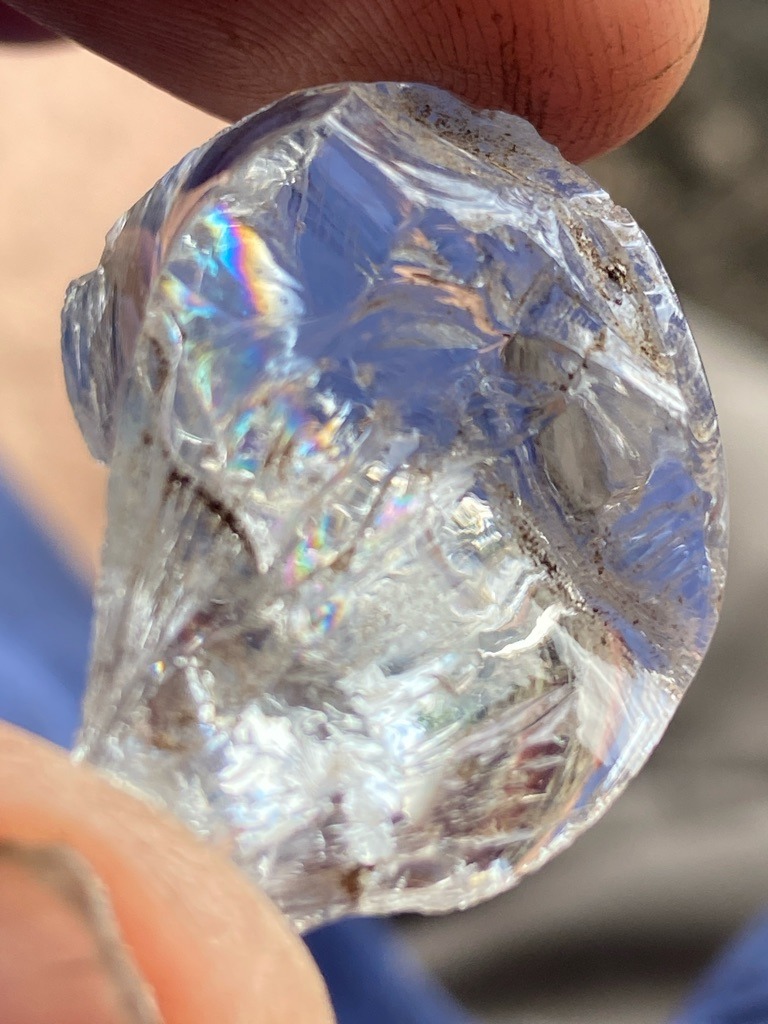
Natural diamond in rough, uncut form showing natural conchoidal fracture and crystal faces
Natural diamond in rough, uncut form showing natural conchoidal fracture and crystal faces · Rough crystal / Irregular uncut shape with natural octahedral or rounded contours
Not applicable (Uncut rough stone, requires professional cutting and faceting) Cut
Carat
Estimated between 5.0 to 8.0 carats based on visual scale compared to fingers
Color
Colorless to near-colorless (Estimated G-J range), with slight surface reflections capturing ambient light
Clarity
I1 to I3 (Included rough), visible internal fractures, feathering, and inclusions typical of unpolished diamond rough
Shape
Rough crystal / Irregular uncut shape with natural octahedral or rounded contours
Overall Assessment
This is an impressive, substantial natural diamond in its raw, uncut state. It exhibits strong adamantine luster and interesting internal fracture mechanics with rainbow dispersion. Transforming this rough stone into a finished gemstone requires expert planning, sawing, and faceting to maximize carat retention and minimize internal flaws.
Cut Quality
Not applicable (Uncut rough stone, requires professional cutting and faceting)
Brilliance
Limited in current rough state; shows vitreous to adamantine luster on fracture surfaces
Fire
Displays spectral fire (rainbow dispersion) along internal fracture planes acting as prisms
Scintillation
Minimal to none in rough state; will improve dramatically upon proper cutting and polishing
Proportions
Not applicable for rough stones until faceted
Symmetry
Natural irregular symmetry characteristic of raw crystal formation
Polish
Natural unpolished crystal skin and fracture surfaces (trigons and etching features potentially present)
Fluorescence
Unable to determine accurately without UV light testing, likely Faint to Medium blue based on standard rough characteristics
Inclusions
Heavy internal feathering, cleavage planes, carbon spots, and internal stress cracks visible
Blemishes
Natural surface pitting, rough skin, and conchoidal fracture ridges
Origin
Likely alluvial or primary kimberlite deposit origin (African, Canadian, or Russian sources common for rough stones)
Treatment Detection
No obvious signs of artificial treatments; appears completely untreated and natural
Estimated Value
Variable depending on final cut yield, clarity retention, and weight loss during cutting; rough value significantly lower than finished polished gem
Certification Estimate
GIA or IGI would issue a rough diamond report or certification post-cutting
Investment Potential
High speculative value depending on the cutter's ability to maximize yield and clarity during the sawing and faceting process
Similar Diamonds
Other unpolished industrial or gem-grade diamond rough stones of comparable weight
Setting Suggestions
Can be set raw in an organic, rustic, or bohemian-style bespoke mounting (e.g., in yellow or rose gold using a bezel or prong setting to protect rough edges)
Care & Maintenance
Store separately to prevent scratching other jewelry; clean gently with warm soapy water and a soft brush; avoid harsh impacts along natural cleavage planes
Interesting Facts
Rough diamonds often look unassuming or like ordinary glass until examined closely under magnification or exposed to light, where their high refractive index and adamantine luster give them away