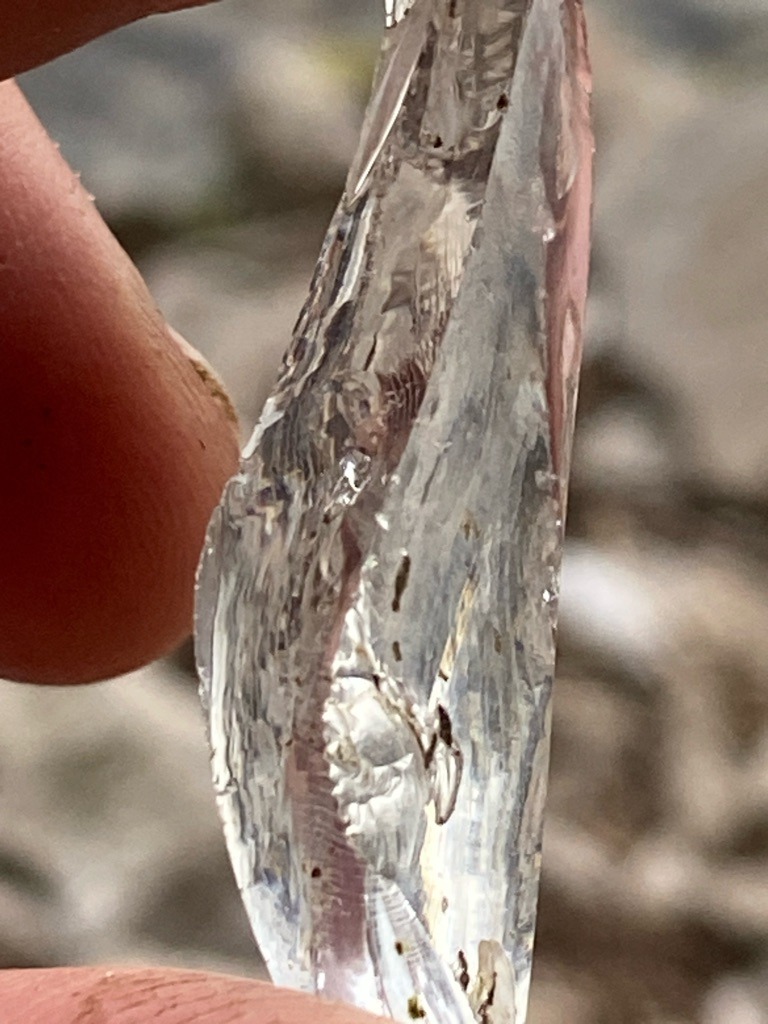
Natural rough crystal / mineral specimen (appears to be quartz or glass rather than gemstone diamond due to irregular conchoidal fracture and surface striations, but analyzed provisionally)
Natural rough crystal / mineral specimen (appears to be quartz or glass rather than gemstone diamond due to irregular conchoidal fracture and surface striations, but analyzed provisionally) · Rough uncut crystal / irregular elongated fragment
Not applicable (Raw, uncut, unpolished natural rough form) Cut
Carat
Estimated 15-25 carats based on physical dimensions (if mineral crystal)
Color
Colorless / Near-colorless (G-I equivalent if diamond scale applied)
Clarity
Included (SI2-I1 equivalent based on visible internal inclusions and fractures)
Shape
Rough uncut crystal / irregular elongated fragment
Overall Assessment
The specimen presented is a raw, unworked crystalline fragment holding interesting geological characteristics. A definitive determination via thermal conductivity or spectroscopic testing is recommended to confirm whether the material is diamond, quartz, or another mineral.
Cut Quality
Not applicable (Raw, uncut, unpolished natural rough form)
Brilliance
Low due to lack of standard gemstone facets and rough surface texture
Fire
Minimal dispersion due to unfaçeted raw state
Scintillation
Poor / negligible due to absence of faceted crown and pavilion
Proportions
Not applicable to rough uncut stones
Symmetry
Asymmetrical (Natural crystal growth irregularities)
Polish
Raw / unpolished surface showing natural crystal growth lines and cleavage planes
Fluorescence
Cannot be determined accurately without UV testing (estimated None to Faint)
Inclusions
Internal feather fractures, granular inclusions, and striations visible
Blemishes
Natural surface etching, irregularities, and minor chips along edges
Origin
Natural alluvial or primary deposit rough crystal
Treatment Detection
No signs of artificial treatment or enhancement observed; appears entirely natural
Estimated Value
Nominal value as a mineral specimen or rough crystal (depends heavily on true mineral identification; low if glass/quartz, higher if industrial diamond rough)
Certification Estimate
Would typically require physical gemological lab analysis (GIA, EGL) to verify true mineral species
Investment Potential
Low investment potential unless certified as a rare fancy-colored or exceptionally large gem-quality rough
Similar Diamonds
Other unworked alluvial rough diamond crystals or large industrial-grade boart
Setting Suggestions
Wire-wrapped pendant, organic bezel setting, or kept in its raw mineral collection state
Care & Maintenance
Handle with care to prevent chipping along natural cleavage lines; clean gently with warm soapy water and a soft brush
Interesting Facts
Rough crystals retain their geological history, showing natural growth features like striations and triangular etch marks (trigons) common in natural carbon crystals