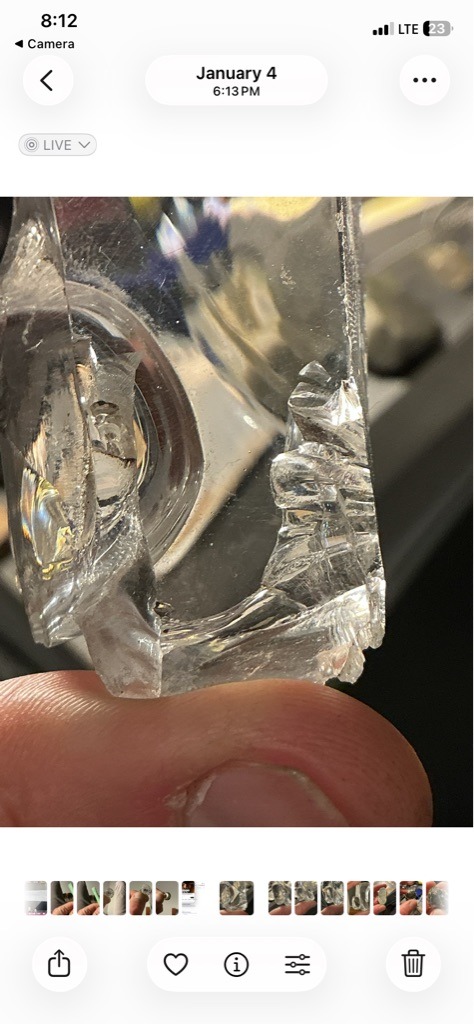
Not a diamond; appears to be raw quartz, glass, or mineral crystal fragment with conchoidal fracturing
Not a diamond; appears to be raw quartz, glass, or mineral crystal fragment with conchoidal fracturing · Raw, unpolished, irregularly fractured fragment
Poor / Uncut / Raw mineral specimen Cut
Carat
Cannot be accurately determined by visual estimation due to irregular shape, but appears substantial in physical size
Color
Colorless to near-colorless
Clarity
I3 / Heavily included with severe structural fractures
Shape
Raw, unpolished, irregularly fractured fragment
Overall Assessment
The specimen depicted in the image is definitively not a diamond. It exhibits characteristics of a raw, heavily fractured mineral crystal (such as quartz) or a piece of industrial glass, displaying classic conchoidal fracture patterns rather than the crystal faces or standard facet symmetry of a gemstone.
Cut Quality
Poor / Uncut / Raw mineral specimen
Brilliance
Very low due to lack of standard facet proportions and internal fracturing
Fire
Minimal to none
Scintillation
Poor, light escapes and refracts haphazardly through internal fractures rather than returning through a table
Proportions
Not applicable to raw unpolished mineral specimens
Symmetry
None (natural, irregular fragment)
Polish
None (raw, unpolished fracture surfaces)
Fluorescence
Unable to determine without UV testing equipment
Inclusions
Large internal feathers, fractures, and structural flaws visible throughout
Blemishes
Severe chips, jagged edge fractures, and conchoidal break patterns
Origin
Natural mineral rough or manufactured glass cullet
Treatment Detection
No artificial treatments detected; physical damage/fractures are structural
Estimated Value
Nominal value as a raw mineral specimen or glass fragment (effectively negligible gemological value)
Certification Estimate
Not eligible for standard diamond grading laboratories (GIA, AGS, IGI); would require a mineralogical report if identified
Investment Potential
None as an investment asset
Similar Diamonds
None, as this object is not a diamond
Setting Suggestions
Not suitable for jewelry setting in its current state
Care & Maintenance
Handle with care to avoid injury from sharp, jagged edges and newly formed glass or crystal splinters
Interesting Facts
The prominent curved, scoop-like break patterns shown on the right side are known as conchoidal fractures, typical of brittle materials like quartz, glass, and obsidian