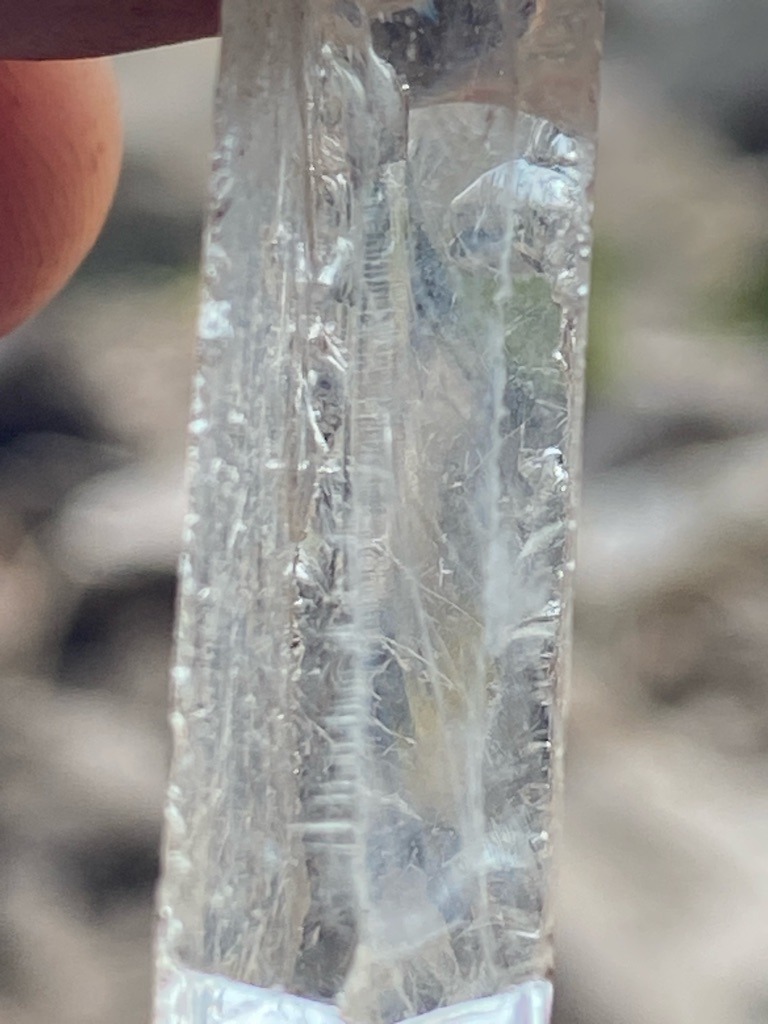
Not a diamond; this is a raw, unpolished quartz crystal showing typical striations and natural growth features.
Not a diamond; this is a raw, unpolished quartz crystal showing typical striations and natural growth features. · Raw crystal / Untouched rough mineral specimen
Not applicable (Rough, unworked crystal) Cut
Carat
Not applicable in gem terms, but specimen weight is roughly estimated visually at 5-15 carats equivalent mass
Color
Colorless / Clear quartz
Clarity
Included (Contains internal feather-like fractures and natural growth striations)
Shape
Raw crystal / Untouched rough mineral specimen
Overall Assessment
An interesting and educational natural quartz crystal rough specimen, unsuitable for cutting into a faceted gemstone due to heavy internal fracturing and lack of gem-grade clarity.
Cut Quality
Not applicable (Rough, unworked crystal)
Brilliance
Low to moderate due to raw, unpolished surfaces scattering light
Fire
Minimal to none, characteristic of quartz rather than diamond
Scintillation
Poor due to lack of faceted surfaces
Proportions
Elongated crystal prism form; depth and table percentages do not apply
Symmetry
Natural crystal symmetry (elongated prism form)
Polish
Raw, unpolished natural crystal faces
Fluorescence
Unknown without UV testing, typically inert or faint blue in natural quartz
Inclusions
Heavy internal feather fractures, veil inclusions, and internal growth structures
Blemishes
Surface etching, natural striations, and irregular rough texture
Origin
Natural mineral specimen, likely from a pegmatite or hydrothermal vein deposit
Treatment Detection
No signs of artificial treatment; entirely natural mineral growth
Estimated Value
Nominal mineral specimen value ($5 - $20 USD depending on locality)
Certification Estimate
Typically not certified by major gemological labs (GIA, AGS) as it is rough quartz rather than a gemstone
Investment Potential
Low; valued primarily as a mineral specimen or educational piece rather than an investment asset
Similar Diamonds
None, as this is quartz (silicon dioxide) and not carbon
Setting Suggestions
Wire-wrapped rough mineral setting or bespoke organic jewelry mounting
Care & Maintenance
Clean with mild soapy water and a soft brush; avoid harsh chemicals and hard impacts to prevent fracturing along natural cleavage/fracture planes
Interesting Facts
Displays clear horizontal growth striations along the prism faces, which is a classic diagnostic feature distinguishing quartz from other minerals like calcite or tourmaline