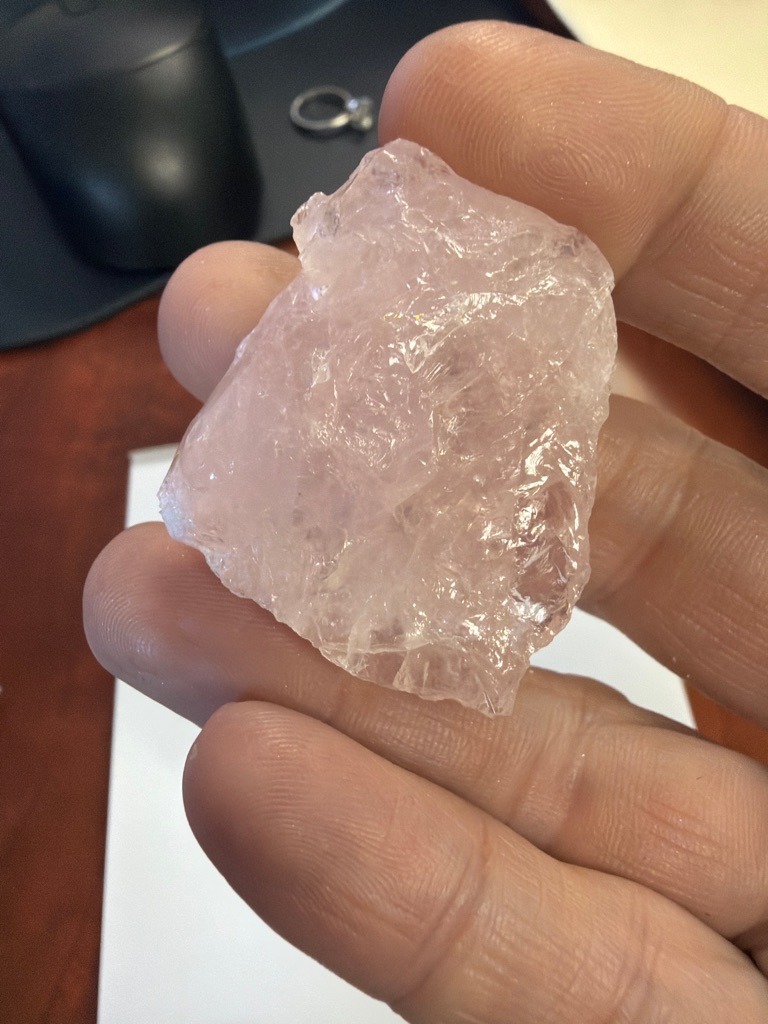
Not a diamond; this is a raw, unpolished specimen of rose quartz (macrocrystalline quartz).
Not a diamond; this is a raw, unpolished specimen of rose quartz (macrocrystalline quartz). · Raw, uncut, and unshaped rough crystalline chunk.
Not applicable as this is a rough, un-faceted mineral specimen. Cut
Carat
Estimated to be roughly 150 to 200 carats (approximately 30 to 40 grams) based on volume and density.
Color
Natural pale pink to light rose coloration, characteristic of rose quartz.
Clarity
Included / Heavily included with internal fractures, typical for large raw quartz chunks.
Shape
Raw, uncut, and unshaped rough crystalline chunk.
Overall Assessment
This is a large, attractive specimen of natural raw rose quartz rather than a diamond. It is ideal for decorative display, lapidary cabochon cutting, or artisan wire-wrapped jewelry.
Cut Quality
Not applicable as this is a rough, un-faceted mineral specimen.
Brilliance
Low to moderate vitreous to greasy luster on fractured surfaces; lacks diamond-like brilliance.
Fire
None, as quartz has a low dispersion rate compared to diamond.
Scintillation
Minimal light return due to translucent to opaque internal structure and lack of facets.
Proportions
Irregular raw chunk dimensions with no standard faceted proportions.
Symmetry
Asymmetrical due to natural raw crystallization and breakage patterns.
Polish
Unpolished rough surface, displaying natural conchoidal fracture textures.
Fluorescence
Typically inert or very faint inertness under long-wave and short-wave UV light.
Inclusions
Abundant internal fractures, veil-like inclusions, and cloudiness characteristic of natural quartz.
Blemishes
Natural surface pitting, rough ridges, and fracture traces from handling and extraction.
Origin
Commonly found worldwide; major deposits exist in Brazil, Madagascar, South Africa, and the USA.
Treatment Detection
No obvious signs of artificial irradiation or dyeing, appears completely natural.
Estimated Value
Low commercial value, typically ranging from $10 to $50 depending on aesthetics and size as a mineral specimen.
Certification Estimate
Not typically certified by major diamond grading labs like GIA; may be accompanied by a general mineralogical certificate or sold as a specimen.
Investment Potential
Minimal monetary investment potential; valued primarily for decorative, metaphysical, or collection purposes.
Similar Diamonds
None, as it is a completely different mineral species (silicon dioxide vs. pure carbon).
Setting Suggestions
Best suited for wire-wrapped jewelry, organic artisan settings, or displayed as a raw mineral specimen.
Care & Maintenance
Clean with mild soapy water and a soft brush; avoid harsh chemicals, prolonged direct sunlight to prevent fading, and ultrasonic cleaners due to internal fractures.
Interesting Facts
Rose quartz gets its delicate pink color from microscopic fibers of pink dumortierite or titanium/manganese impurities trapped within the crystal structure.