Cubic Zirconia (Simulant)
Cubic Zirconia (Simulant) · Oval Brilliant
Good Cut
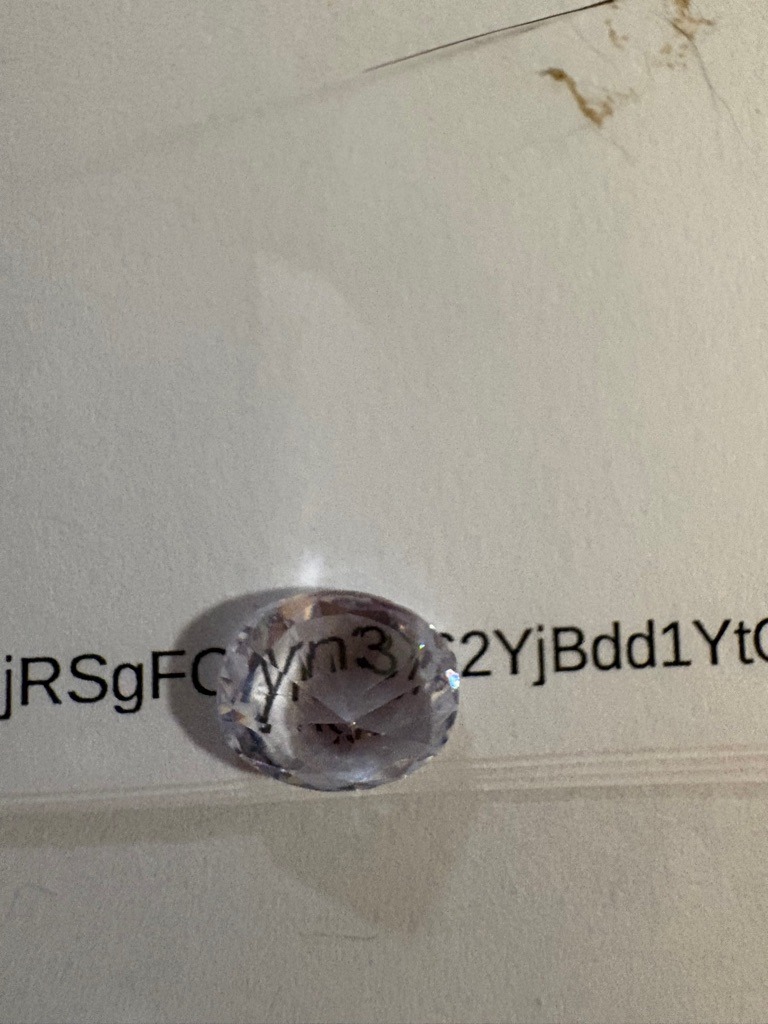
Carat
Estimated 1.50 - 2.00 carats based on visual dimensions
Color
Colorless (equivalent to D-F range)
Clarity
Eye-Clean (equivalent to VS1-VS2 range)
Shape
Oval Brilliant
Overall Assessment
This stone is a clear cubic zirconia simulant, evident by the high dispersion of fire and the characteristic distortion showing text clearly beneath the table facet (the 'letters test')
Cut Quality
Good
Brilliance
High initial brilliance, though slightly reduced compared to a genuine diamond due to lower refractive index dispersion
Fire
Very high fire (exhibits excessive dispersion compared to a natural diamond)
Scintillation
Moderate flash and sparkle under direct lighting
Proportions
Standard oval brilliant cut proportions, slightly deep pavilion
Symmetry
Fair to Good
Polish
Good
Fluorescence
None
Inclusions
None visible to the naked eye; typical synthetic simulation material without natural crystal inclusions
Blemishes
Minor surface scratches or wear typical of handled simulant stones
Origin
Laboratory-created synthetic simulant (Cubic Zirconia)
Treatment Detection
Synthetic material manufactured via skull-crucible method
Estimated Value
$10 - $30 USD
Certification Estimate
Not applicable for grading laboratories like GIA or AGS, as this is a simulant
Investment Potential
None; simulant stones hold no resale or investment value
Similar Diamonds
Comparable to budget-friendly commercial synthetic simulants rather than natural diamonds
Setting Suggestions
Cost-effective settings such as sterling silver or gold-plated brass
Care & Maintenance
Avoid harsh chemicals, ultrasonic cleaners, and abrasive surfaces as cubic zirconia can scratch easily over time
Interesting Facts
Cubic zirconia has a lower thermal conductivity than diamond, making it easily distinguishable via standard thermal diamond testers