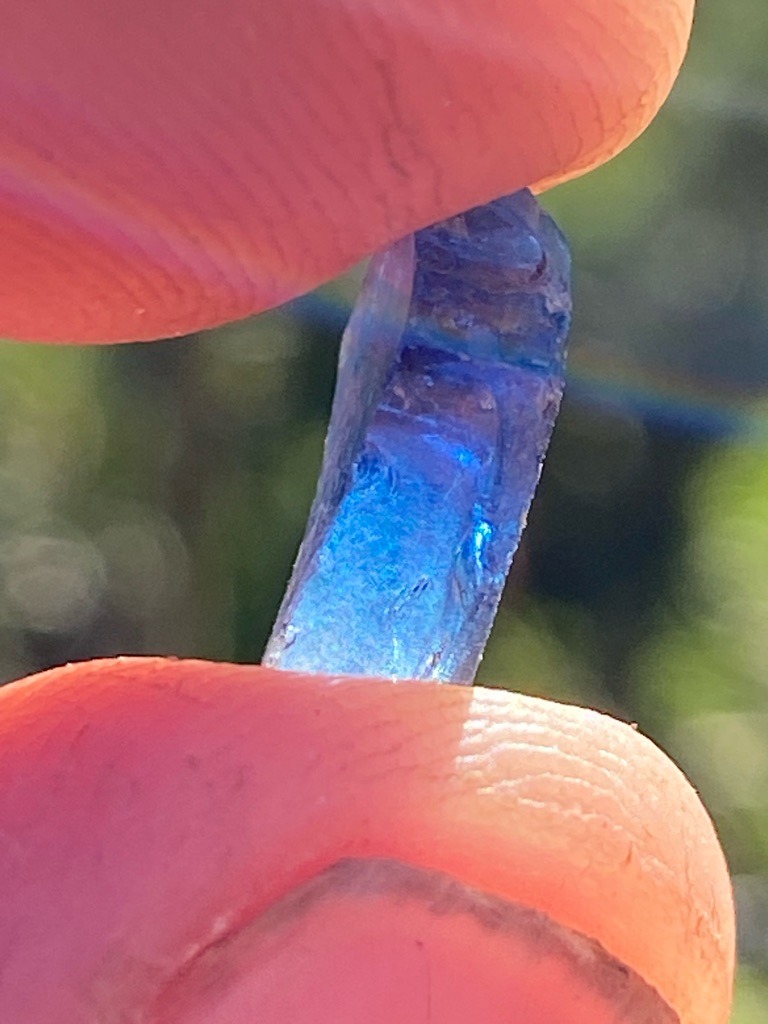
Not a diamond; this specimen is a rough mineral crystal, likely blue sapphire or tanzanite, exhibiting strong pleochroism and natural crystal striations.
Not a diamond; this specimen is a rough mineral crystal, likely blue sapphire or tanzanite, exhibiting strong pleochroism and natural crystal striations. · Rough crystal / Uncut elongated prismatic crystal form
Not Applicable (Uncut rough crystal specimen) Cut
Carat
Estimated at approximately 1.5 to 2.5 carats based on visual proportions held between fingers.
Color
Vivid Blue to Violet-Blue (Fancy Color equivalent)
Clarity
Included (Contains visible internal feather fractures, zoning, and inclusion channels typical of rough corundum or zoisite)
Shape
Rough crystal / Uncut elongated prismatic crystal form
Overall Assessment
A striking rough blue mineral crystal held in fingers, displaying natural growth lines and vibrant color saturation, highly prized by mineral collectors and lapidaries before cutting.
Cut Quality
Not Applicable (Uncut rough crystal specimen)
Brilliance
Translucent vitreous luster with internal light trapping and scattering.
Fire
Low to moderate dispersion limited by rough surfaces and body color saturation.
Scintillation
Flashes of bright blue internal reflection when moved under directional light.
Proportions
Elongated tabular/prismatic rough formation; depth and table percentages do not apply to uncut specimens.
Symmetry
Natural asymmetrical elongated prismatic crystal habit
Polish
Raw, unpolished natural crystal faces with striations
Fluorescence
Inert to Moderate Inert under standard lighting, though strong internal light scattering is visible due to translucency.
Inclusions
Internal crystal inclusions, growth tubes, and internal stress fractures visible along the vertical axis.
Blemishes
Natural surface etching, growth hillocks, and uneven crystal faces.
Origin
Natural rough gemstone crystal, likely from East Africa (Tanzania/Madagascar) or Sri Lanka.
Treatment Detection
No obvious signs of surface coating or fracture filling in its current rough state; standard unheated/untreated appearance.
Estimated Value
$50 - $200 USD as a mineral specimen / rough gemstone material depending on exact species and weight.
Certification Estimate
Gemological Institute of America (GIA) or SSEF for origin determination if tested as sapphire or tanzanite.
Investment Potential
Low as a diamond substitute, but moderate to high for collectors of fine mineral crystal specimens.
Similar Diamonds
None (This is a colored gemstone rough, not a diamond)
Setting Suggestions
Wire-wrapped or custom organic bezel setting to preserve the raw, natural aesthetic of the crystal.
Care & Maintenance
Avoid ultrasonic cleaners if fractures reach the surface; clean gently with warm soapy water and a soft brush.
Interesting Facts
Stones like tanzanite and sapphire exhibit strong pleochroism, showing different colors when viewed from different crystal directions.