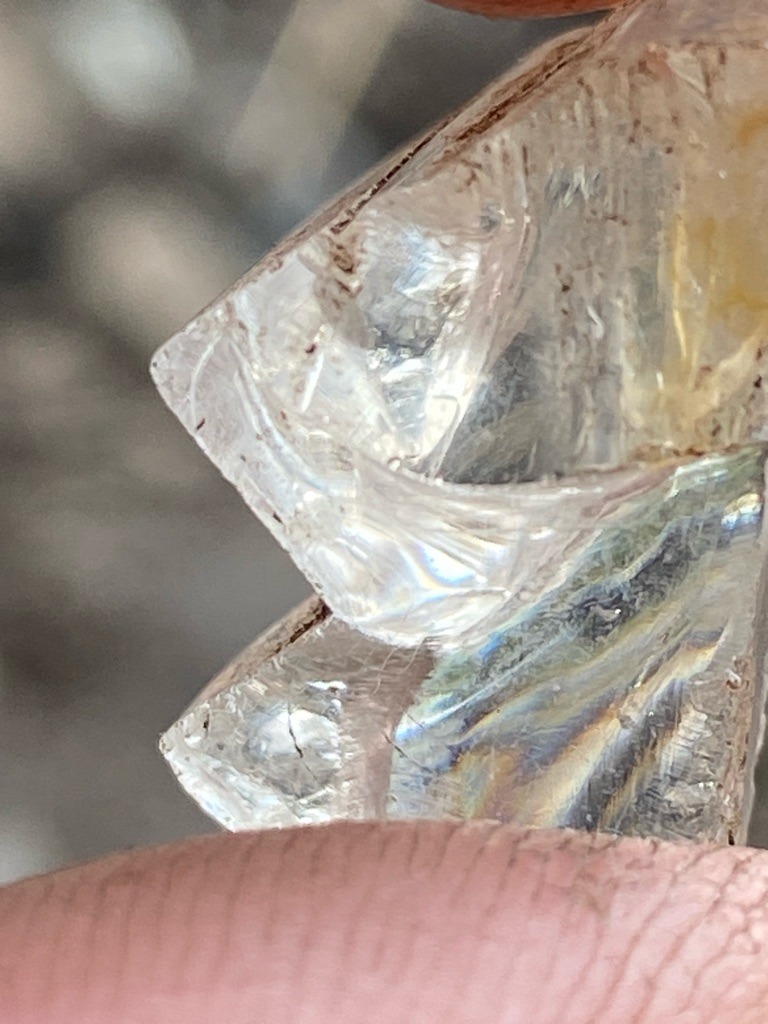
The specimen shown in the image appears to be rough, untreated mineral crystal, likely quartz or a similar crystalline rock rather than a genuine diamond crystal based on the conchoidal fracture patterns and surface features.
The specimen shown in the image appears to be rough, untreated mineral crystal, likely quartz or a similar crystalline rock rather than a genuine diamond crystal based on the conchoidal fracture patterns and surface features. · Rough crystal shard with irregular, broken form, not possessing a standard diamond cut shape.
Not applicable as this is a rough mineral fragment rather than a faceted gemstone. Cut
Carat
Difficult to estimate accurately from visual assessment alone due to irregular rough shape, roughly estimated between 2.0 to 4.0 carats based on relative size.
Color
Colorless to slightly yellowish tint in certain lighting angles, roughly equivalent to K-L range if evaluated on a diamond scale.
Clarity
Included / Imperfect (I2/I3 equivalent) due to prominent internal fractures, surface fissures, and structural inclusions visible throughout.
Shape
Rough crystal shard with irregular, broken form, not possessing a standard diamond cut shape.
Overall Assessment
Based on visual analysis, the specimen is a rough, fractured mineral crystal (likely quartz) rather than a diamond, and lacks the necessary physical properties, value, and structure for gemstone use.
Cut Quality
Not applicable as this is a rough mineral fragment rather than a faceted gemstone.
Brilliance
Low brilliance due to light scattering through internal fractures rather than internal reflection off precise facets.
Fire
Minimal fire or dispersion observed, characteristic of rough quartz rather than diamond.
Scintillation
Absent due to the lack of polished, symmetrical facets required to create sparkling flash patterns.
Proportions
Not applicable for rough stones lacking standard tables, crowns, and pavilions.
Symmetry
Asymmetrical rough stone with no standardized faceting or geometric proportions.
Polish
Unpolished natural rough surface showing prominent conchoidal fractures and step-like cleavage planes.
Fluorescence
Cannot be reliably determined without UV light testing, likely inert.
Inclusions
Heavy internal fracturing, feather cracks, and possible mineral staining trapped within fissures.
Blemishes
Deep surface chips, natural growth lines, and rough fracture edges spanning the exterior.
Origin
Likely natural mineral specimen mined from a pegmatite or quartz vein, though exact geological origin is unknown.
Treatment Detection
No visible evidence of artificial treatments such as fracture filling, coating, or irradiation.
Estimated Value
Nominal value as a mineral specimen, essentially negligible for gemstone jewelry purposes.
Certification Estimate
Standard gemological laboratories like GIA or AGS would not issue a diamond grading report for this specimen as it is not a diamond.
Investment Potential
None as an investment asset, possesses educational or decorative mineral value only.
Similar Diamonds
None, as this specimen is not a diamond; comparable to rough quartz crystal fragments.
Setting Suggestions
Not recommended for fine jewelry settings in its current form due to fragility and composition.
Care & Maintenance
Handle with care to prevent further chipping along existing fracture lines; clean gently with mild soap and water.
Interesting Facts
The conchoidal fracture patterns visible on the surface are characteristic of brittle crystalline materials like quartz breaking under stress.