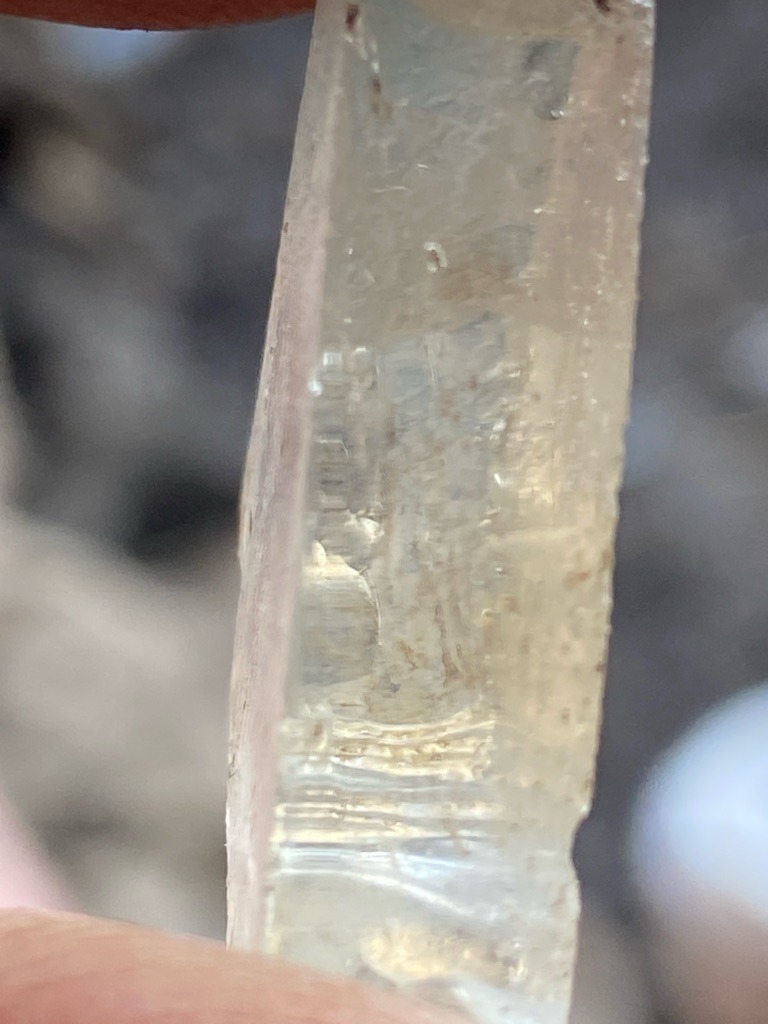
Natural rough crystal (likely Quartz or Beryl based on prismatic habit and striations, though evaluated as a raw mineral sample)
Natural rough crystal (likely Quartz or Beryl based on prismatic habit and striations, though evaluated as a raw mineral sample) · Rough crystal, uncut elongated prism
Uncut / Rough raw crystal (Not applicable) Cut
Carat
Estimated 3.5 - 5.0 carats based on visual dimensions
Color
Near colorless to light yellowish tint
Clarity
Included (SI2 / I1 due to internal fractures and mineral inclusions)
Shape
Rough crystal, uncut elongated prism
Overall Assessment
An interesting natural rough mineral specimen featuring visible growth striations and internal characteristics, ideal for mineral collectors rather than fine jewelry use.
Cut Quality
Uncut / Rough raw crystal (Not applicable)
Brilliance
Low to moderate due to rough surfaces and opacity
Fire
Minimal due to lack of faceted surfaces
Scintillation
Limited, showing mostly surface reflection
Proportions
Elongated prismatic crystal habit
Symmetry
Natural crystal symmetry showing striations along the prism face
Polish
Raw, natural unpolished surface texture
Fluorescence
Unknown / Not tested under UV
Inclusions
Internal feather fractures, trapped mineral particulate, and growth lines
Blemishes
Natural surface etching, minor abrasions, and rough edges
Origin
Natural geological formation, alluvial or pegmatite deposit
Treatment Detection
No signs of artificial treatment; completely natural state
Estimated Value
Low commercial value as a raw specimen (approx. $20 - $100 depending on exact mineral ID)
Certification Estimate
Requires professional laboratory testing (GIA or local gem lab) to confirm exact mineral species
Investment Potential
Minimal monetary investment value; valued more as a mineral specimen for collectors
Similar Diamonds
Comparable to low-grade industrial rough or specimen-grade quartz/beryl crystals
Setting Suggestions
Wire-wrapped pendant or rustic prong setting to preserve its raw organic crystal form
Care & Maintenance
Avoid harsh chemicals, ultrasonic cleaners, and hard impacts due to inherent internal fractures
Interesting Facts
Raw crystals exhibit natural growth lines called striations, which are key indicators of crystal formation direction