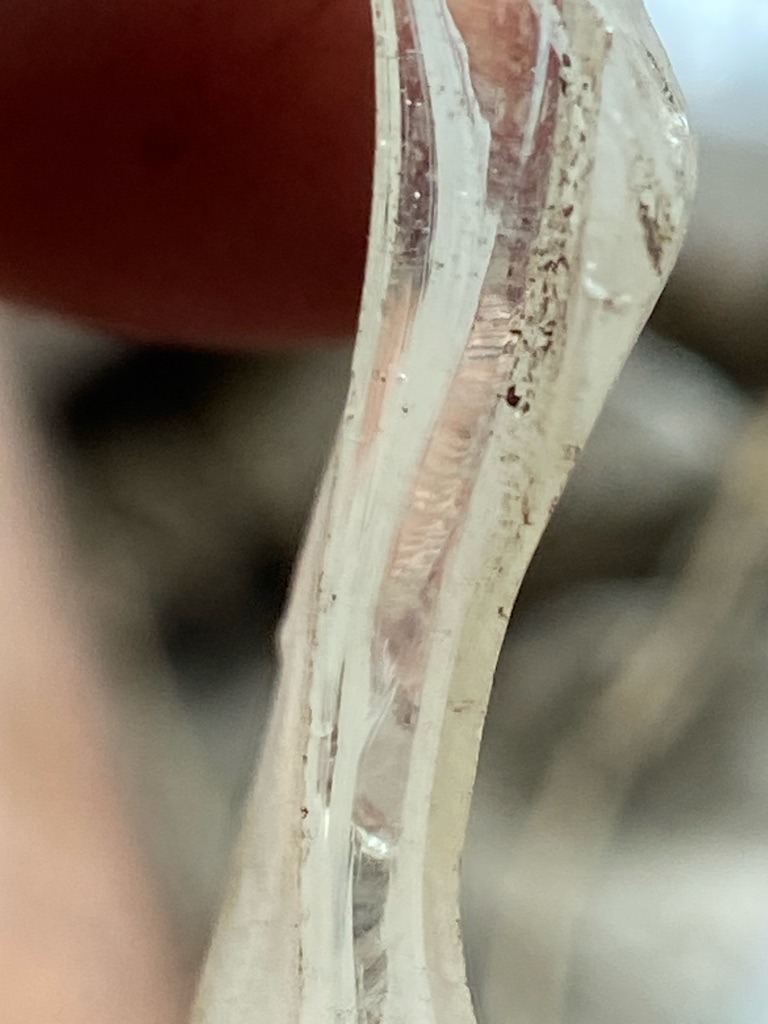
Not a diamond; appears to be industrial glass, quartz, or a synthetic silicate material with fracture-filled structures and significant surface wear.
Not a diamond; appears to be industrial glass, quartz, or a synthetic silicate material with fracture-filled structures and significant surface wear. · Irregular / Raw fragment shard
Poor / Non-standard irregular break Cut
Carat
Not applicable (not a gemstone)
Color
Colorless with opaque white banding and inclusions
Clarity
Included heavily with internal fractures and foreign deposits (I3 equivalent if graded)
Shape
Irregular / Raw fragment shard
Overall Assessment
The specimen shown in the image is not a diamond or a gemstone, but rather a fragment of broken glass or common mineral showing internal stress lines and fractures. It has no gemological value.
Cut Quality
Poor / Non-standard irregular break
Brilliance
Very low due to lack of standard facet geometry
Fire
Minimal to none
Scintillation
Negligible
Proportions
Not applicable
Symmetry
Asymmetrical shard
Polish
Rough fracture surfaces with uneven texture
Fluorescence
Cannot be definitively determined without UV testing
Inclusions
Abundant internal fractures, feather-like fissures, and trapped debris
Blemishes
Chips, surface scratches, and edge abrasions
Origin
Man-made industrial glass or common quartz aggregate
Treatment Detection
Evidence of wear and fractured internal structure
Estimated Value
Minimal scrap or decorative value (negligible gem value)
Certification Estimate
Not eligible for certification by major gemological laboratories (GIA, AGS, IGI)
Investment Potential
None
Similar Diamonds
None, as this material is entirely distinct from diamond
Setting Suggestions
Not suitable for jewelry setting
Care & Maintenance
Handle with care to avoid cuts from sharp glass or mineral edges
Interesting Facts
Often mistaken by novices for raw rough diamond due to irregular translucent appearance, but lacks hardness and optical properties of diamond.