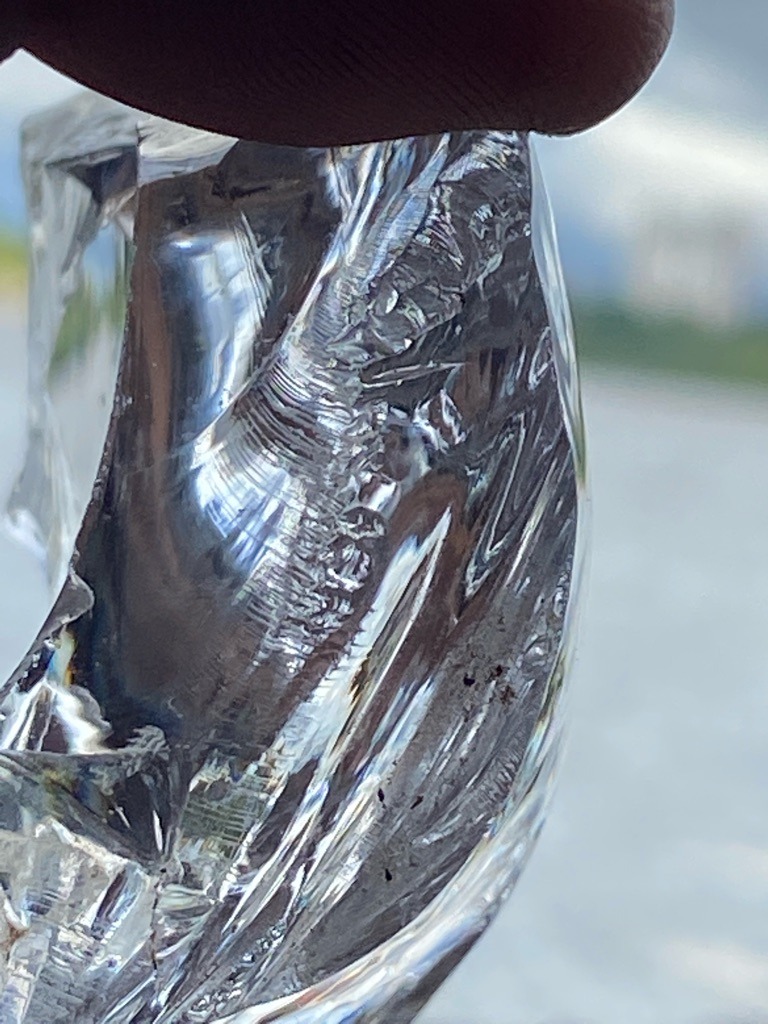
Not a diamond; this is likely optical glass or quartz showing conchoidal fracture patterns.
Not a diamond; this is likely optical glass or quartz showing conchoidal fracture patterns. · Raw, unpolished crystal / irregular fragment
Not applicable (Rough/Uncut) Cut
Carat
Cannot be reliably determined visually for non-gem materials, but appears substantial (likely over 50 carats equivalent weight in glass/quartz).
Color
Colorless
Clarity
Not applicable to rough glass/quartz (contains flow lines and internal stress marks)
Shape
Raw, unpolished crystal / irregular fragment
Overall Assessment
The specimen displayed in the image is not a diamond. It exhibits characteristic conchoidal fracture lines and striations typical of optical glass, slag glass, or clear quartz crystal rather than the crystal faces and high refractive index of a rough diamond.
Cut Quality
Not applicable (Rough/Uncut)
Brilliance
Varies by angle due to curved, wavy fracture surfaces
Fire
Low dispersion typical of glass or quartz rather than diamond
Scintillation
Poor, lacks standard facets to create distinct sparkle
Proportions
Not applicable
Symmetry
Asymmetrical rough piece
Polish
Unpolished, natural fracture surfaces
Fluorescence
Unknown without UV testing
Inclusions
Conchoidal fracture lines, striations, and potential gas bubbles typical of glass
Blemishes
Surface scratches and chips along the edges
Origin
Synthetic or manufactured glass / Natural quartz crystal
Treatment Detection
None detected; standard raw material state
Estimated Value
Nominal value as a mineral specimen or decorative glass piece (negligible gem value)
Certification Estimate
Gemological laboratories would issue a report identifying this as glass or quartz, not diamond.
Investment Potential
None as a gemstone
Similar Diamonds
None (material is fundamentally different from diamond)
Setting Suggestions
Not suitable for standard jewelry settings due to material softness and lack of standard facet geometry
Care & Maintenance
Standard cleaning with warm soapy water and a soft cloth; avoid harsh impacts to prevent chipping
Interesting Facts
The smooth, curved ripples visible on the surface are called conchoidal fractures, which are characteristic of how amorphous materials like glass and crystalline quartz break.