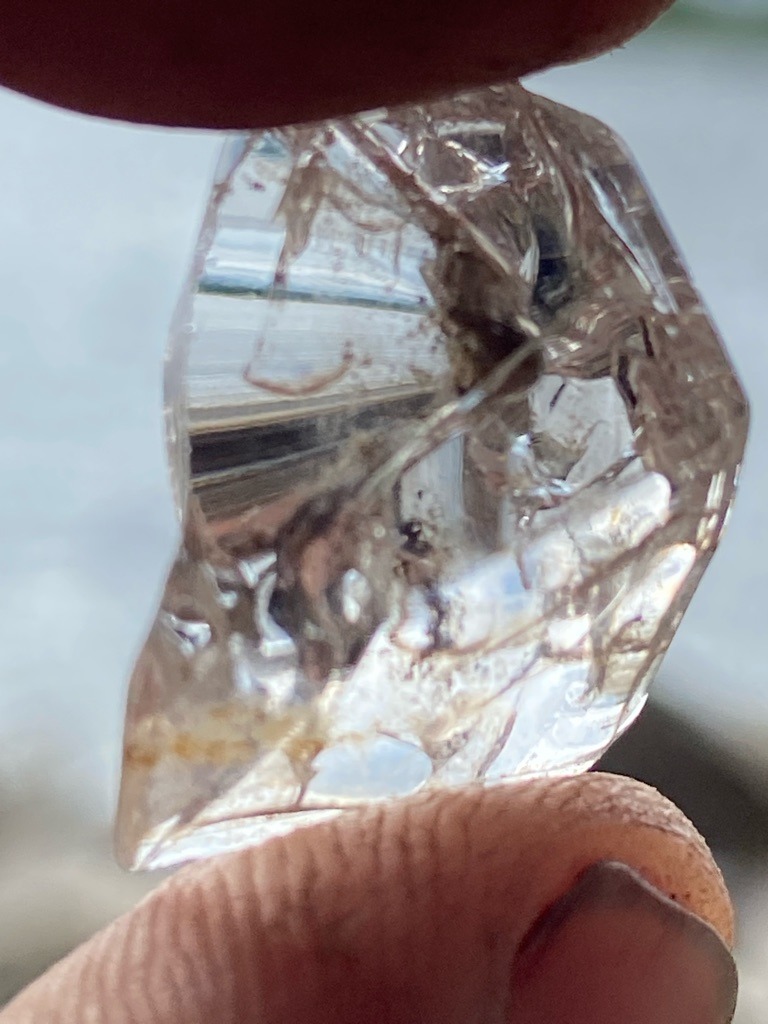
Natural rough diamond crystal
Natural rough diamond crystal · Uncut or partially worked irregular rough crystal
Not applicable (Rough, unpolished state) Cut
Carat
Estimated 2.5 to 3.5 carats
Color
Near-colorless to light brown tint (K-M range)
Clarity
I2 to I3 due to prominent natural inclusions, fractures, and surface features
Shape
Uncut or partially worked irregular rough crystal
Overall Assessment
A fascinating specimen of a natural rough diamond displaying strong raw character, significant natural inclusions, and structural fractures that limit its use primarily to niche organic jewelry or re-cutting potential.
Cut Quality
Not applicable (Rough, unpolished state)
Brilliance
Low due to lack of standard facet geometry and high inclusion density
Fire
Minimal dispersion due to raw surface and internal fracturing
Scintillation
Poor, light is scattered internally rather than reflected uniformly
Proportions
Natural rough proportions, deep and unoptimized for light return
Symmetry
Natural crystal symmetry, asymmetric due to raw form
Polish
Raw crystal surface with natural growth lines (trigons/striations)
Fluorescence
Indeterminate from visual inspection, likely Faint to Medium blue if tested under UV
Inclusions
Heavy internal feather fractures, dark carbon spots, and mineral inclusions
Blemishes
Natural surface etch channels, pits, and rough edges
Origin
Likely alluvial or primary kimberlitic African or South American origin
Treatment Detection
No signs of artificial treatment; completely untreated natural rough
Estimated Value
Industrial to lower-tier ornamental value, typically ranging from $100 to $400 depending on cutting potential
Certification Estimate
GIA or local gemological laboratory report detailing rough dimensions and weight
Investment Potential
Low for resale as-is; value is primarily speculative if masterfully cut into polished gems
Similar Diamonds
Typical industrial-grade or lower commercial-quality rough diamond specimens
Setting Suggestions
Best suited for custom organic raw-diamond jewelry settings, wire-wrapping, or cut down into smaller brilliant stones
Care & Maintenance
Handle with care to prevent breakage along natural cleavage planes and internal fractures; clean with mild soapy water
Interesting Facts
Shows prominent natural growth striations on the crystal face, telling the story of its journey under extreme mantle pressure