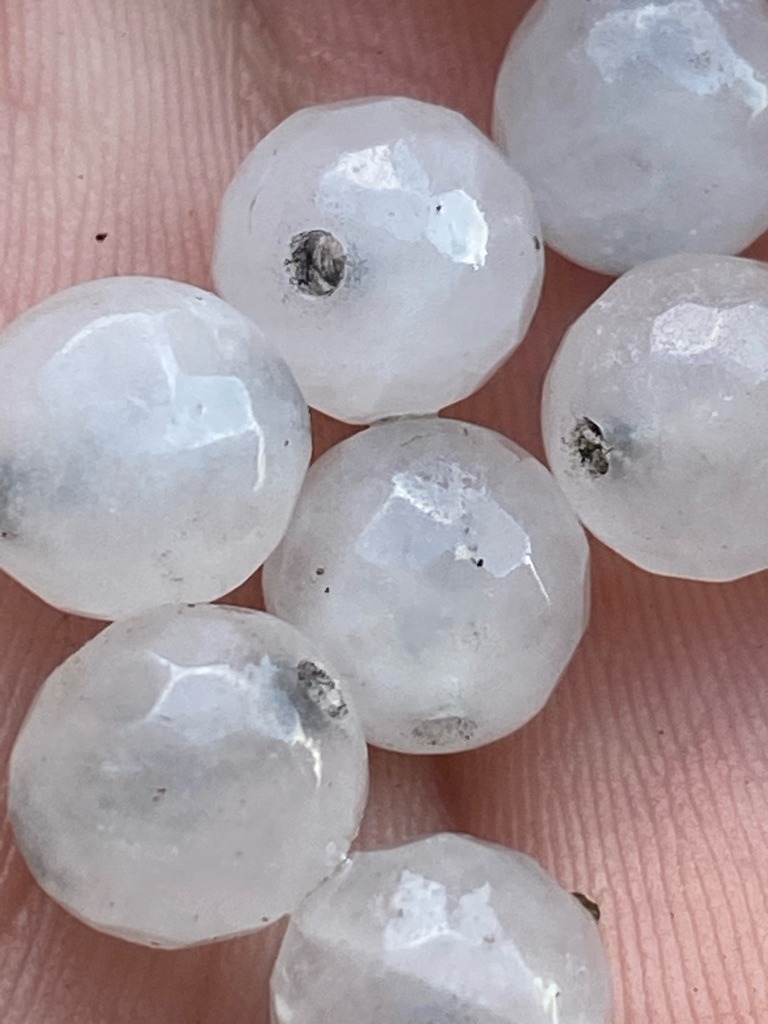
Not a diamond; these appear to be faceted natural mineral beads (such as quartz, chalcedony, or moonstone) rather than gem-grade diamond.
Not a diamond; these appear to be faceted natural mineral beads (such as quartz, chalcedony, or moonstone) rather than gem-grade diamond. · Faceted Round Bead
Fair to Poor (crafted as ornamental beads with coarse faceting) Cut
Carat
Variable per bead, estimated around 2 to 5 carats equivalent per bead
Color
Milky White to Translucent Grayish-White
Clarity
Included (I3 equivalent, containing prominent mineral inclusions and dark drill-hole residues)
Shape
Faceted Round Bead
Overall Assessment
A collection of milky, heavily included natural mineral beads featuring rough faceted cuts and drill holes, suitable for casual costume jewelry rather than fine diamond or high-end gemstone collections
Cut Quality
Fair to Poor (crafted as ornamental beads with coarse faceting)
Brilliance
Low due to high inclusion levels and milky body color
Fire
Minimal to absent
Scintillation
Low, limited by lack of optical transparency and traditional symmetrical faceting
Proportions
Spherical bead proportions with non-standard facets
Symmetry
Fair
Polish
Moderate to Low
Fluorescence
Indeterminate without UV testing
Inclusions
Heavy internal cloudiness, fractures, and prominent dark mineral inclusions near drilling points
Blemishes
Surface pits, rough areas, and drilling imperfections
Origin
Natural mineral source, commonly sourced from countries with major quartz/chalcedony deposits (e.g., Brazil, India, Madagascar)
Treatment Detection
No obvious enhancement treatments detected beyond standard tumbling, cutting, and drilling
Estimated Value
Low commercial value as ornamental gemstone beads (likely under $20 for the strand)
Certification Estimate
Not typically certified by major gemological labs like GIA or AGS due to being ornamental mineral beads
Investment Potential
None; ornamental beads are purchased for decorative wear rather than financial investment
Similar Diamonds
None, as these are quartz or chalcedony beads and lack diamond optical properties
Setting Suggestions
Best utilized in bead-stringing, wire-wrapping, or bohemian-style multi-strand jewelry designs
Care & Maintenance
Clean with mild soapy water and a soft cloth; avoid harsh chemicals and ultrasonic cleaners
Interesting Facts
The dark spots visible at the pole of each bead are the residue or matrix material surrounding the drill holes, common in lower-grade beaded mineral strings