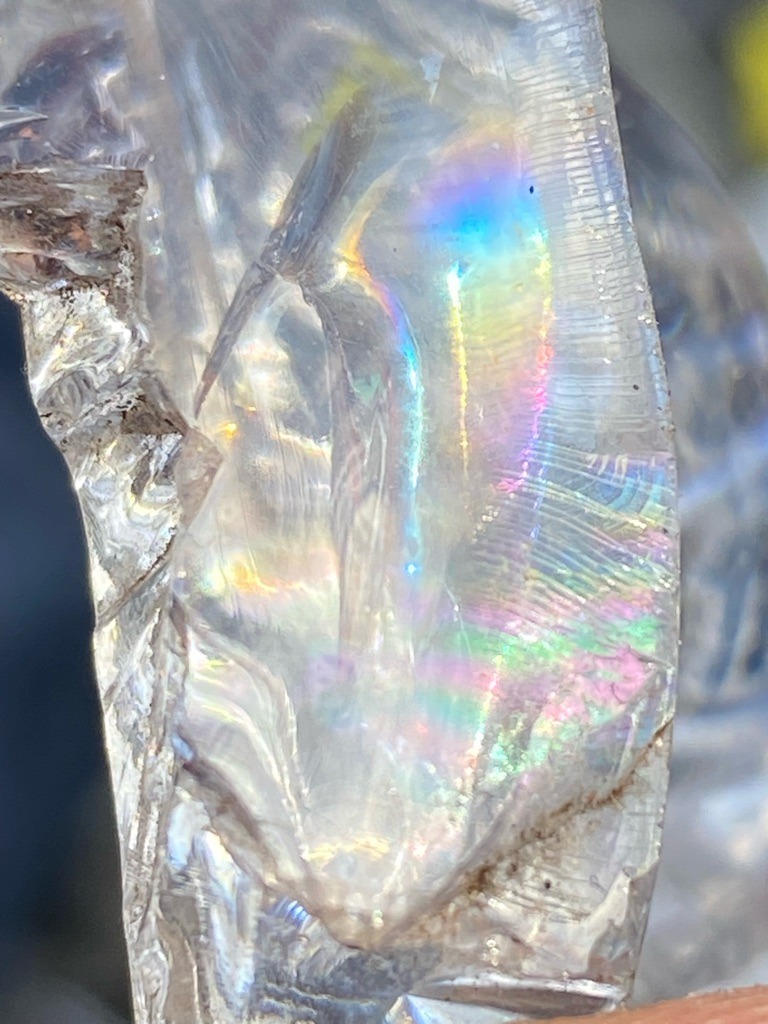
The specimen appears to be non-diamond, likely a variety of Quartz (Rock Crystal) or Glass/Slag based on the conchoidal fracture and lack of adamantine luster.
The specimen appears to be non-diamond, likely a variety of Quartz (Rock Crystal) or Glass/Slag based on the conchoidal fracture and lack of adamantine luster. · Rough / Uncut (Natural fragment)
N/A (Rough/Uncut) Cut
Carat
Difficult to estimate without scale, but likely between 5 to 15 carats based on visible surface texture.
Color
Colorless / Transparent with internal iris effect (interference colors).
Clarity
I3 (Included) - Contains significant internal fractures and structural flaws.
Shape
Rough / Uncut (Natural fragment)
Overall Assessment
This specimen is not a diamond. The visible conchoidal fracture (curved, shell-like break) and rhythmic lines on the break surface are classic indicators of Quartz or Silica-based glass. Diamonds exhibit octahedral cleavage and do not typically fracture in this manner.
Cut Quality
N/A (Rough/Uncut)
Brilliance
Low; surface reflects light but lacks the high refractive index characteristic of diamond.
Fire
High iridescent play-of-color caused by light interference in internal thin-film fractures (Iris effect), not dispersion.
Scintillation
Poor; large flat fracture surfaces provide occasional broad flashes rather than faceted sparkle.
Proportions
Non-geometric / Irregular fragment
Symmetry
N/A (Asymmetric rough fragment)
Polish
N/A (Natural/Fractured surfaces with rhythmic ripple marks)
Fluorescence
Indeterminate (natural indoor/outdoor lighting show no specific UV reaction).
Inclusions
Heavy internal fracturing, cleavage-like planes, and visible 'iris' or 'rainbow' diffraction effects within cracks.
Blemishes
Severe surface abrasions, jagged edges, and conchoidal (shell-like) fracture patterns.
Origin
Mineralogical specimen, likely from a common geologic source or man-made glass waste (Slag).
Treatment Detection
None detected; appears to be a natural fracture or man-made break.
Estimated Value
Minimal specimen value ($1 - $20 USD) depending on size and origin.
Certification Estimate
Unlikely to be graded by gemstone labs (GIA/IGI) as a diamond; would likely be identified as Quartz or Glass.
Investment Potential
None; this is not a gemstone-quality investment piece.
Similar Diamonds
Low-grade 'Bort' or industrial diamond fragments, though those typically lack the clarity seen here.
Setting Suggestions
Wire wrapping or a protective cage setting for use as a curiousity specimen or pendant.
Care & Maintenance
Avoid hard impacts; if it is quartz or glass, it has a lower Mohs hardness than diamond and is prone to chipping.
Interesting Facts
The rainbow effect seen in the fractures is known as 'Iris' or 'Rainbow Quartz' effect, caused by light interference between thin layers of air or mineral trapped in fractures.