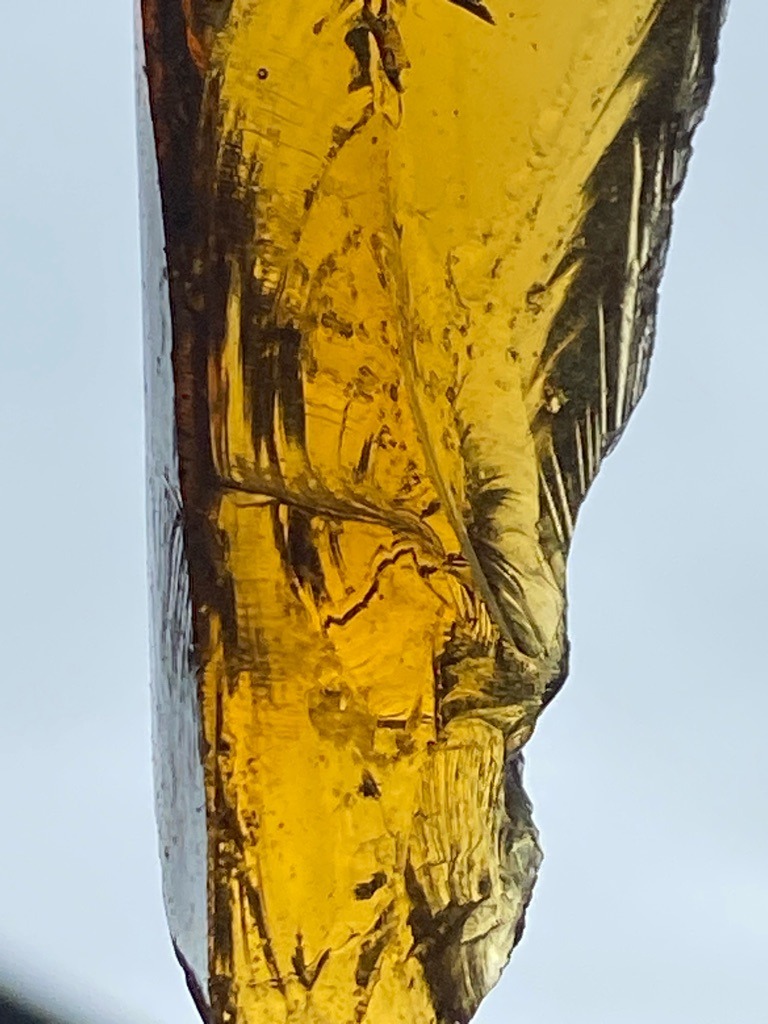
The specimen displayed in the image is not a diamond; it appears to be a natural amber resin or a similar organic gemstone / mineral slice with distinctive flow lines and a warm golden-brown coloration.
The specimen displayed in the image is not a diamond; it appears to be a natural amber resin or a similar organic gemstone / mineral slice with distinctive flow lines and a warm golden-brown coloration. · Irregular raw crystal or polished slab / freeform slice rather than a standard faceted diamond cut.
Not applicable (raw or cabochon slice) Cut
Carat
Not applicable as this is a non-diamond specimen.
Color
Fancy Deep Yellow-Brown / Amber
Clarity
Not applicable (contains natural inclusions, striations, and flow lines typical of amber or resin)
Shape
Irregular raw crystal or polished slab / freeform slice rather than a standard faceted diamond cut.
Overall Assessment
The specimen shown is an organic amber resin slice rather than a diamond, featuring captivating natural internal flow lines, rich golden-yellow hues, and unique textural character.
Cut Quality
Not applicable (raw or cabochon slice)
Brilliance
Vitreous to resinous luster rather than diamond adamantine brilliance
Fire
None, as this material lacks diamond-level dispersion
Scintillation
Low to moderate reflection across rounded or flat polished planes
Proportions
Irregular slab thickness and dimensions
Symmetry
Asymmetrical raw specimen
Polish
Smooth surface polish showing natural striations and growth lines
Fluorescence
Often exhibits blue or green fluorescence under UV light if amber, but indeterminable from visual RGB image alone.
Inclusions
Natural organic debris, trapped air bubbles, and internal stress fracture lines
Blemishes
Surface scratches, natural resin flow marks, and edge chipping
Origin
Terrestrial organic resin (fossilized tree resin from various global deposits such as the Baltic region, Dominican Republic, or Myanmar)
Treatment Detection
No obvious treatments visible, though pressed or reconstituted amber is common in the market.
Estimated Value
Varies significantly depending on exact weight, provenance, and presence of any inclusions (e.g., insects in amber), generally modest compared to high-grade diamonds.
Certification Estimate
Gemological laboratories such as GIA or GRS would identify this as amber or organic resin rather than issuing a diamond report.
Investment Potential
Generally considered a collector or decorative gemstone rather than a high-liquidity investment asset like certified diamonds.
Similar Diamonds
None, as this is an amber specimen and not a diamond.
Setting Suggestions
Wire-wrapped in sterling silver or bezel-set in warm-toned metals like yellow gold to complement the rich amber hue.
Care & Maintenance
Soft organic material; avoid harsh chemicals, ultrasonic cleaners, extreme heat, and prolonged direct sunlight.
Interesting Facts
Amber is not a mineral but a fossilized tree resin that can sometimes preserve ancient insects, plant matter, and air bubbles millions of years old.