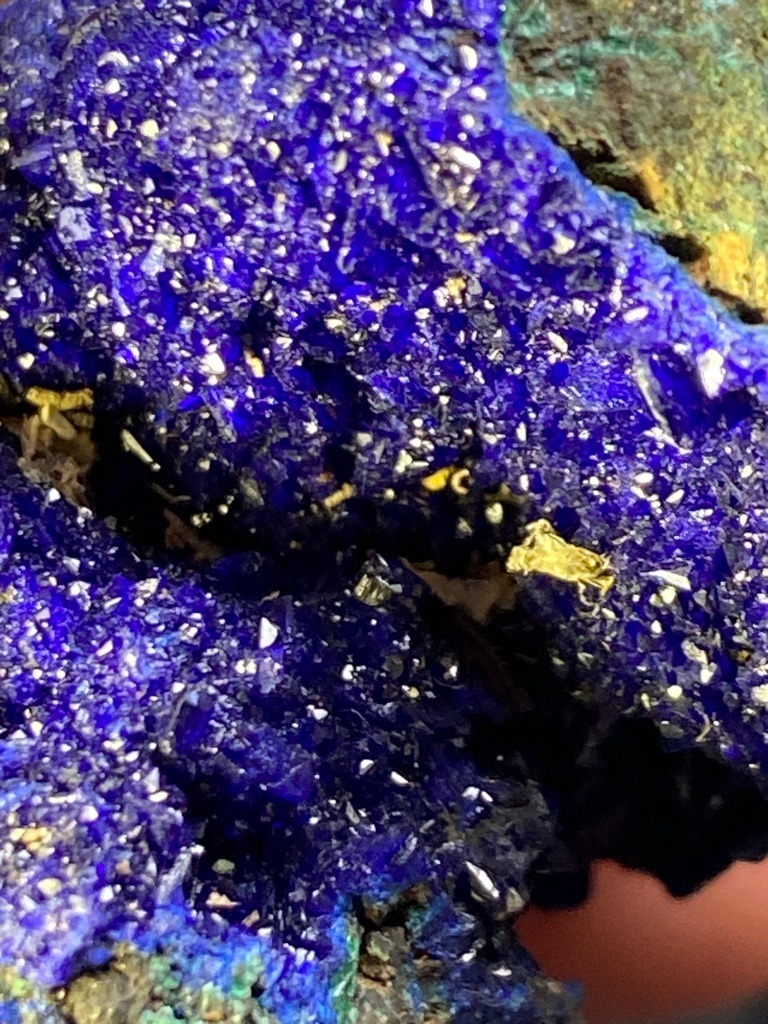
Not a diamond; this is a mineral specimen showing deep blue azurite, likely with associated pyrite or malachite, not crystalline diamond material.
Not a diamond; this is a mineral specimen showing deep blue azurite, likely with associated pyrite or malachite, not crystalline diamond material. · Not applicable; raw mineral matrix with crystal aggregates, not a cut gemstone.
Not applicable; uncut raw mineral specimen. Cut
Carat
Not applicable; raw mineral specimen measured by total weight rather than carat.
Color
Not applicable; deep royal blue with metallic inclusions, outside the diamond D-Z color grading system.
Clarity
Not applicable; raw aggregate containing heavy internal matrix and mineral inclusions.
Shape
Not applicable; raw mineral matrix with crystal aggregates, not a cut gemstone.
Overall Assessment
An attractive raw mineral specimen featuring deep blue azurite formations, completely distinct from diamond.
Cut Quality
Not applicable; uncut raw mineral specimen.
Brilliance
Vitreous to dull luster depending on the specific mineral grain, lacking diamond-like brilliance.
Fire
Absent; azurite and associated minerals do not exhibit diamond-like dispersion.
Scintillation
Flashes of light from small metallic crystal faces rather than structured diamond scintillation.
Proportions
Not applicable; raw specimen without standard faceted proportions.
Symmetry
Not applicable; natural crystal habit rather than faceting symmetry.
Polish
Not applicable; natural unpolished crystal faces and matrix.
Fluorescence
Not applicable; requires gemological testing under UV light.
Inclusions
Dense mineral matrix inclusions typical of raw copper carbonate ore specimens.
Blemishes
Natural surface irregularities, fractures, and matrix voids.
Origin
Typical of world-class azurite localities such as Chessy (France), Tsumeb (Namibia), or Bisbee (Arizona, USA).
Treatment Detection
No signs of gemstone enhancement; natural untreated mineral specimen.
Estimated Value
Varies widely based on specimen quality, size, and aesthetic appeal as a mineral collector's piece.
Certification Estimate
Certified by mineralogical institutions or academic laboratories rather than diamond grading labs like GIA.
Investment Potential
Valued as a collector mineral specimen rather than a gemstone investment.
Similar Diamonds
None, as this is a completely different mineral species.
Setting Suggestions
Best displayed as a raw mineral specimen in a custom mount or shadow box rather than jewelry.
Care & Maintenance
Keep away from moisture, acids, and harsh chemicals, as azurite is a soft (Mohs 3.5-4) and sensitive copper mineral.
Interesting Facts
Azurite has been used historically as a blue pigment in painting and is often found in association with green malachite.