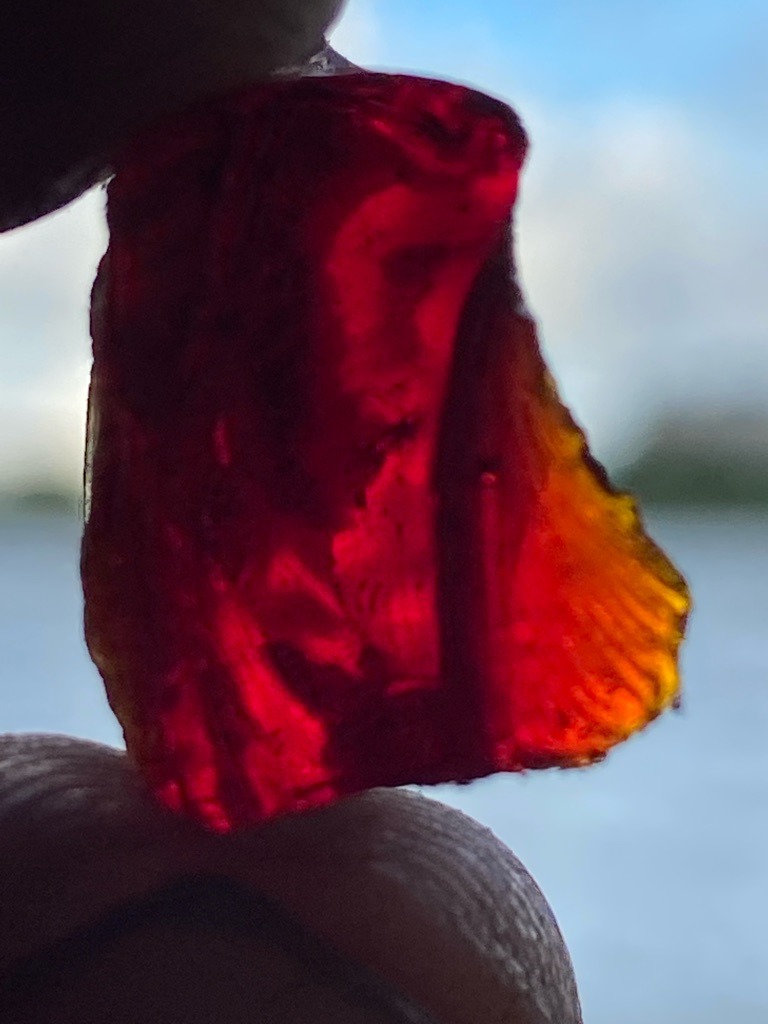
Not a diamond; visual characteristics strongly suggest colored glass, slag, or a low-value colored gemstone rough such as red quartz or corundum, requiring physical testing for definitive identification.
Not a diamond; visual characteristics strongly suggest colored glass, slag, or a low-value colored gemstone rough such as red quartz or corundum, requiring physical testing for definitive identification. · Uncut rough / irregular fragment
Not applicable (Rough stone) Cut
Carat
Estimated 3.50 to 5.00 carats based on visual dimensions relative to human fingers
Color
Fancy Deep Red with secondary orange flashes
Clarity
Included / SI2 equivalent due to internal gas bubbles or fracture lines visible
Shape
Uncut rough / irregular fragment
Overall Assessment
Based on the translucent appearance, internal flow lines, and lack of crystal habit typical of carbon-based diamonds, this specimen is visually identified as non-diamond material—most likely colored glass or mineral slag—and requires professional gemological testing such as refractometry or spectroscopy for exact confirmation.
Cut Quality
Not applicable (Rough stone)
Brilliance
Low to moderate due to lack of standard facet geometry
Fire
Minimal due to material composition and optical properties
Scintillation
Poor, as light is primarily transmitted through the translucent body rather than reflected
Proportions
Not applicable (Rough stone)
Symmetry
Asymmetrical rough stone
Polish
Unpolished / Natural rough surface
Fluorescence
Indeterminate without UV testing
Inclusions
Internal flow lines, potential gas bubbles, and internal fractures characteristic of glass or untreated rough
Blemishes
Surface pitting and irregular fractures
Origin
Synthetic or manufactured (if glass/slag); unknown geographic origin if natural mineral
Treatment Detection
Potential coloration agents or coatings typical of decorative art glass
Estimated Value
Nominal value (under $10 USD) if identified as decorative glass or industrial slag
Certification Estimate
Standard gemological laboratories (GIA, IGI) would issue a colored stone identification report noting it as glass or mineral rough rather than a diamond grading report.
Investment Potential
None; ornamental or decorative use only
Similar Diamonds
None, as diamonds do not naturally occur in this rough translucent red glass-like form
Setting Suggestions
Wire-wrapping or bespoke artisan bezel setting if used for ornamental jewelry
Care & Maintenance
Avoid harsh chemicals, ultrasonic cleaners, and extreme thermal shock
Interesting Facts
Translucent red rough is frequently mistaken for ruby or red diamond by untrained observers, though natural red diamonds are among the rarest colored diamonds in the world.