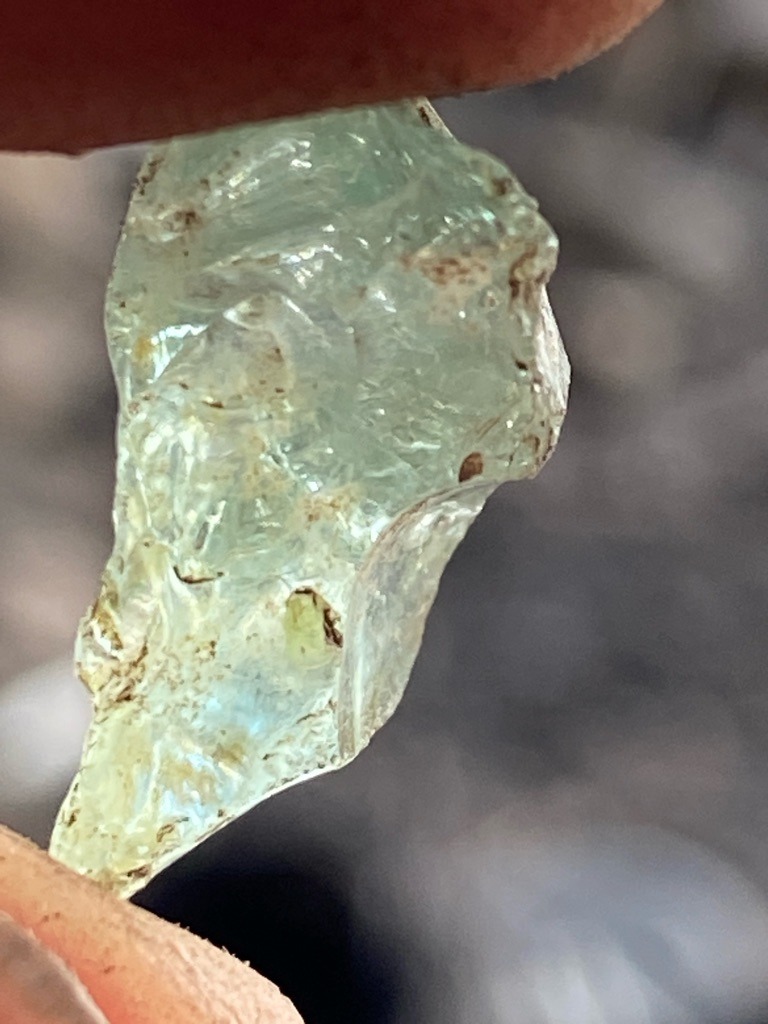
Rough gemstone mineral, appears to be an unpolished rough crystal or fragment, likely quartz, beryl (aquamarine), or glass-like slag rather than a traditional gem-quality diamond.
Rough gemstone mineral, appears to be an unpolished rough crystal or fragment, likely quartz, beryl (aquamarine), or glass-like slag rather than a traditional gem-quality diamond. · Rough, uncut, irregular crystal fragment with natural fracture faces.
Not Applicable (Uncut rough stone). Cut
Carat
Estimated around 3.5 to 5 carats based on visual volume relative to standard finger scale.
Color
Pale greenish-blue / aquamarine tint.
Clarity
Included (I2/I3 equivalent for rough stones due to internal inclusions, fractures, and surface matrix).
Shape
Rough, uncut, irregular crystal fragment with natural fracture faces.
Overall Assessment
An interesting raw mineral or crystal fragment showing natural light-greenish hues and surface textures, ideal for amateur rock-hounding collections or lapidary practice.
Cut Quality
Not Applicable (Uncut rough stone).
Brilliance
Low to moderate vitreous luster, limited by rough surface texture.
Fire
Minimal to none due to lack of precision facet geometry.
Scintillation
Negligible until properly cut and polished.
Proportions
N/A for rough stones; irregular dimensions without standard table or pavilion facets.
Symmetry
Asymmetrical, natural rough formation.
Polish
Unpolished, natural crystal surface showing growth lines and conchoidal fractures.
Fluorescence
Unable to determine without UV light testing.
Inclusions
Visible internal mineral inclusions, micro-fractures, and trapped dirt or matrix debris.
Blemishes
Surface pitting, rough patches, and natural edge chips.
Origin
Alluvial deposit or rough mining matrix origin (unknown exact locality without spectroscopic testing).
Treatment Detection
No visible signs of enhancement; appears entirely natural as-mined.
Estimated Value
Nominal value as a raw mineral specimen, ranging from $10 to $50 depending on the exact mineral species.
Certification Estimate
Standard gemological labs (GIA, IGI) would issue a colored stone or mineral identification report rather than a diamond grading report.
Investment Potential
Low investment potential; sold primarily as a rough mineral specimen or lapidary rough.
Similar Diamonds
None, as this visually lacks the crystalline structure and optical properties of diamond.
Setting Suggestions
Wire-wrapped pendant setting or custom organic bezel setting if polished into a cabochon.
Care & Maintenance
Gentle washing with warm soapy water and a soft brush to remove surface dirt; protect from hard impacts.
Interesting Facts
Rough mineral specimens in this state show the natural crystallization or fracture patterns before human lapidary intervention.