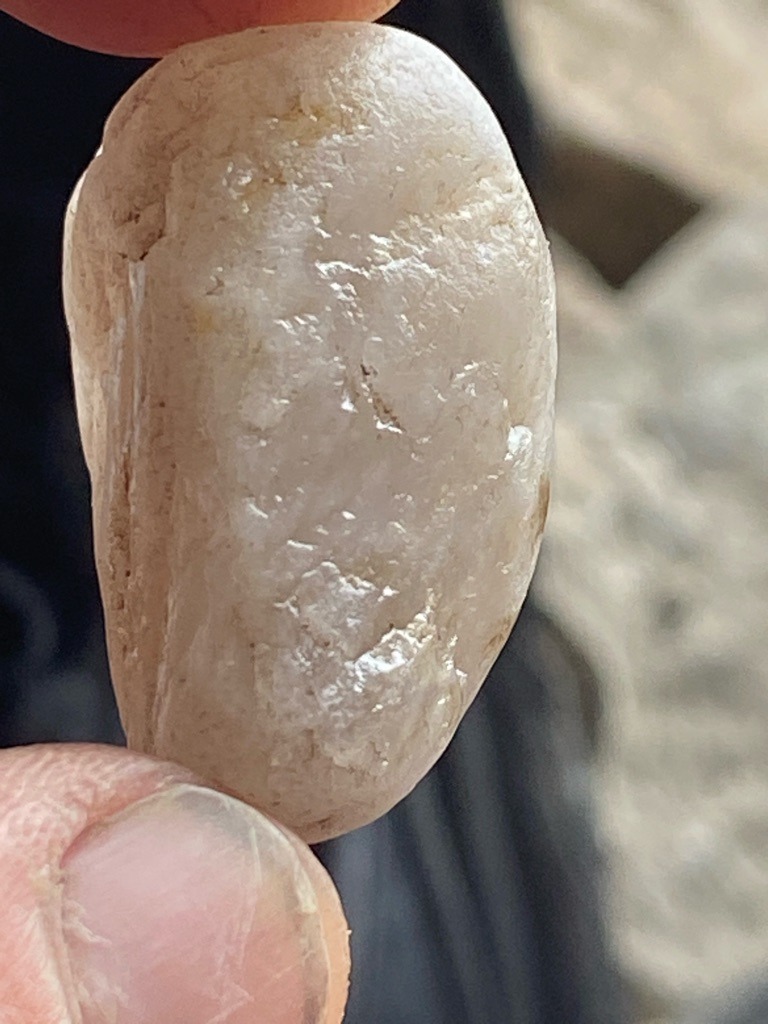
Rough natural diamond or alluvial crystal stone
Rough natural diamond or alluvial crystal stone · Uncut, natural rounded pebble form with irregular elongation
Not applicable (uncut rough crystal) Cut
Carat
Estimated 3 to 5 carats based on relative finger size comparison
Color
Off-white to light brownish-yellow (K-M range)
Clarity
I1 to I2 estimated due to visible surface flaws and internal clouds
Shape
Uncut, natural rounded pebble form with irregular elongation
Overall Assessment
An interesting, natural rough crystal specimen that requires professional cutting and polishing to unlock its true optical brilliance and market value
Cut Quality
Not applicable (uncut rough crystal)
Brilliance
Low to moderate due to raw, unpolished surfaces diffusing light
Fire
Minimal dispersion observed through rough, frosted skin
Scintillation
Absent due to lack of faceted surfaces
Proportions
Natural rough proportions, non-standard geometric dimensions
Symmetry
Natural asymmetrical formation
Polish
Raw, unpolished natural surface texture with water-worn or etched features
Fluorescence
Cannot be determined without UV testing (likely none to medium)
Inclusions
Internal crystal flaws, feathers, and dark mineral spots typical of rough stones
Blemishes
Natural surface pitting, trigons or etching marks, and irregular growth lines
Origin
Alluvial deposit origin indicated by rounded pebble morphology
Treatment Detection
No treatments detected; completely natural raw state
Estimated Value
Depends heavily on internal sawing potential, roughly $1,500 to $4,000 as a rough specimen
Certification Estimate
GIA or local gemological institute report for rough weight verification
Investment Potential
Moderate speculatively; higher risk until cut and polished to reveal true yielding potential
Similar Diamonds
Unaltered alluvial rough stones from African or South American diamond fields
Setting Suggestions
Can be wire-wrapped in yellow gold or platinum as a raw organic jewelry piece
Care & Maintenance
Standard ultrasonic cleaning or warm soapy water with a soft brush
Interesting Facts
Most diamonds are found as rough, octahedral, or rounded alluvial pebbles shaped by nature over millions of years