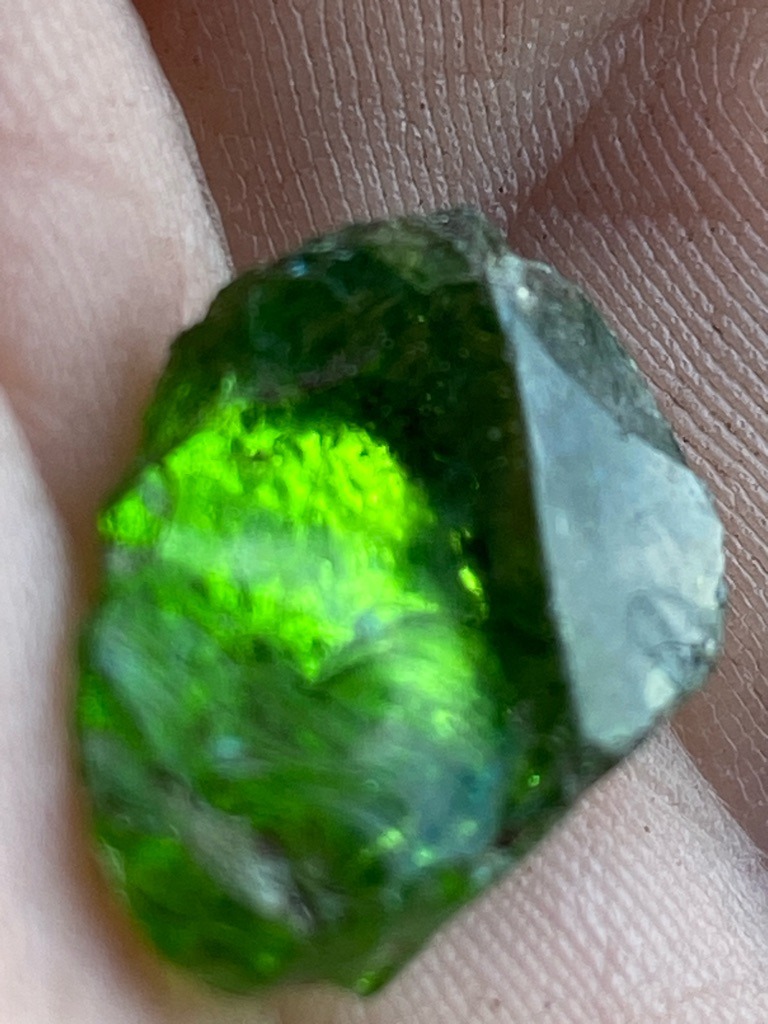
Natural rough green diamond (or potentially a green-colored gem mineral like rough emerald, tourmaline, or peridot given the intense coloration, but evaluated strictly as a rough crystal here)
Natural rough green diamond (or potentially a green-colored gem mineral like rough emerald, tourmaline, or peridot given the intense coloration, but evaluated strictly as a rough crystal here) · Rough uncut crystal / Natural irregular octahedron or fragment
Not applicable (Rough uncut stone; requires professional cutting and faceting) Cut
Carat
Estimated 2.5 to 4.0 carats based on visual scale against human fingers
Color
Fancy Intense Green to Fancy Vivid Green (natural radiation-induced coloration)
Clarity
I1 to I2 (Included, showing internal fractures, clouds, and feather inclusions typical of rough stones)
Shape
Rough uncut crystal / Natural irregular octahedron or fragment
Overall Assessment
A striking and potentially extremely rare natural green rough crystal specimen. Professional gemological laboratory testing is strongly advised to confirm natural color origin before any cutting or commercial valuation.
Cut Quality
Not applicable (Rough uncut stone; requires professional cutting and faceting)
Brilliance
Low to moderate in rough form; will increase significantly upon proper faceting
Fire
Subdued in rough form, though strong green body color masks dispersion
Scintillation
Minimal in rough state; flash scintillation expected only after cutting
Proportions
N/A for rough stones; variable depth and angles prior to lapidary work
Symmetry
Natural crystal symmetry, asymmetric due to rough, unpolished state
Polish
Unpolished natural crystal faces (trigons and natural growth lines likely present)
Fluorescence
Likely Strong Green or Yellowish-Green under long-wave UV light
Inclusions
Internal feather fractures, cloud clusters, and dark mineral spots visible
Blemishes
Natural surface pitting, rough skin, and irregular growth cavities
Origin
Likely alluvial deposit from regions known for green diamonds (e.g., Brazil, Africa, or Guyana)
Treatment Detection
Lab testing required (FTIR/Spectroscopy) to rule out artificial irradiation or surface coating
Estimated Value
Highly variable; natural green diamonds of this saturation are extremely rare and valuable, potentially ranging from $5,000 to $20,000+ per carat depending on exact spectroscopic verification
Certification Estimate
GIA or HRD Colored Diamond Origin Report confirming natural irradiation color origin
Investment Potential
Exceptionally high if certified as a natural, untreated fancy vivid green diamond due to extreme market scarcity
Similar Diamonds
Dresden Green Diamond (historical comparison for color saturation), natural fancy green rough parcels
Setting Suggestions
Custom bespoke prong or bezel setting designed specifically to protect raw crystal edges, paired with yellow or white gold
Care & Maintenance
Avoid harsh ultrasonic cleaners due to internal feather inclusions; store separately to prevent scratching other gems
Interesting Facts
Natural green diamond color is caused by natural radiation in the earth over millions of years, which displaces carbon atoms in the crystal lattice