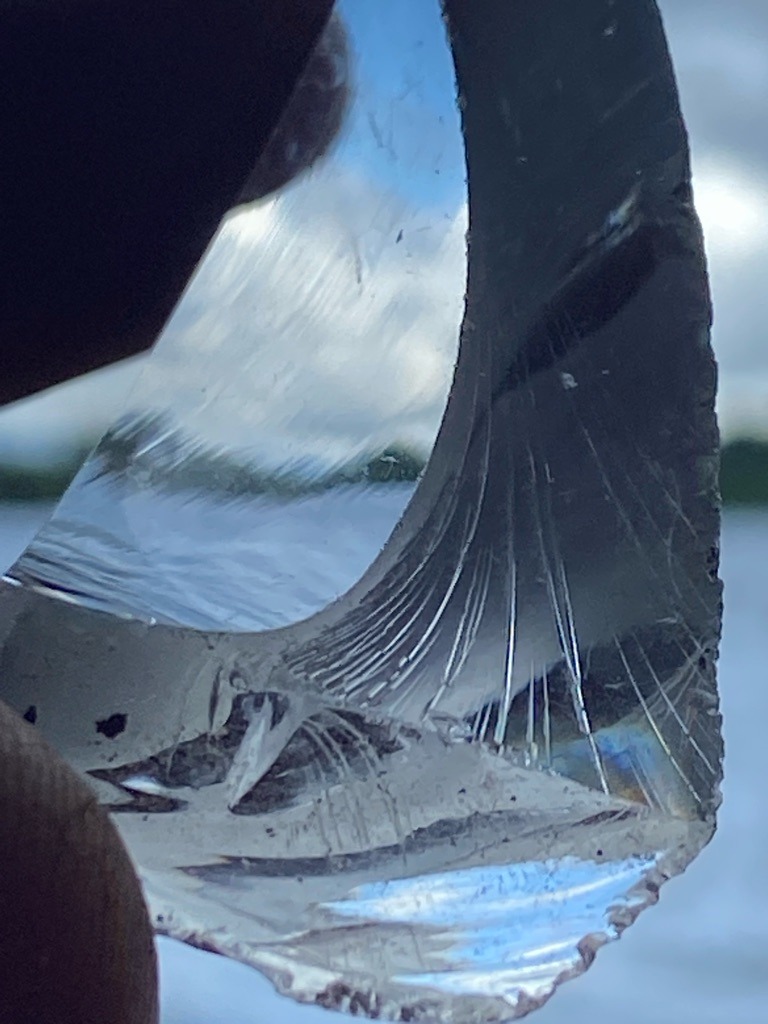
Not a diamond; this specimen is a piece of glass exhibiting characteristic conchoidal fracture patterns.
Not a diamond; this specimen is a piece of glass exhibiting characteristic conchoidal fracture patterns. · Irregular fragment with curved conchoidal breakage
Poor / Uncut raw fragment Cut
Carat
Not applicable (glass, substantial weight but zero gemological carat value)
Color
Colorless / Clear
Clarity
Not applicable (glass contains internal flow lines and bubbles rather than diamond inclusions)
Shape
Irregular fragment with curved conchoidal breakage
Overall Assessment
This object is clearly glass rather than a diamond. It displays characteristic conchoidal fracture lines and surface striations entirely inconsistent with crystalline diamond structure. It holds no gemological or monetary value as a gemstone.
Cut Quality
Poor / Uncut raw fragment
Brilliance
Low to moderate, highly dependent on angle and background reflection
Fire
None (glass lacks the high refractive index and dispersion of diamond)
Scintillation
Minimal to none due to lack of standard facets
Proportions
N/A - Non-standard amorphous shape
Symmetry
Asymmetrical due to random fracture
Polish
Unpolished natural fracture surface
Fluorescence
Unknown / Not tested under UV light
Inclusions
Internal flow lines and potential microscopic gas bubbles typical of manufactured glass
Blemishes
Numerous surface striations, conchoidal ripple marks, and edge chipping
Origin
Man-made glass (likely melted quartz or silica glass scrap)
Treatment Detection
Standard synthetic amorphous glass material with no gemstone treatments
Estimated Value
Minimal/Near zero (decorative or industrial glass scrap value only)
Certification Estimate
Cannot be certified as a gemstone; would be identified as glass by any standard gemological laboratory (GIA, IGI, etc.)
Investment Potential
None as an investment asset
Similar Diamonds
None, as this material shares no physical or chemical properties with diamond
Setting Suggestions
Not suitable for jewelry setting due to softness and lack of durability
Care & Maintenance
Handle with care to avoid sharp edges; store separately to prevent scratching other softer materials
Interesting Facts
The curved ripple patterns visible on the surface are known as conchoidal fractures, which are typical of amorphous solids like glass, obsidian, and quartz when broken.