Natural Raw Diamond Crystal / Industrial Grade Diamond Rough
Natural Raw Diamond Crystal / Industrial Grade Diamond Rough · Uncut / Rough (Natural octahedral distortion or macle fragment)
None (Rough/Uncut) Cut
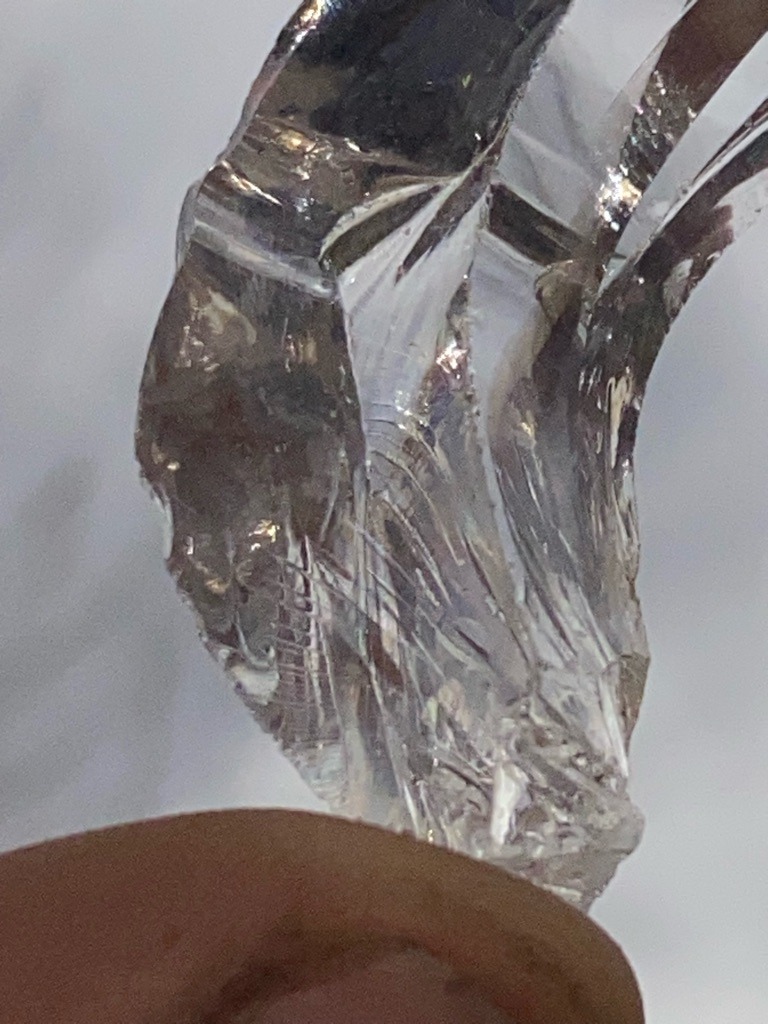
Carat
Estimated 3.00 to 5.00 carats based on finger scale
Color
Near-colorless to Faint Yellow (Estimated I-K range)
Clarity
Included (I1-I2 equivalent) due to significant internal graining and fractures
Shape
Uncut / Rough (Natural octahedral distortion or macle fragment)
Overall Assessment
This is a natural diamond in its raw, uncut state. It shows classic conchoidal fracturing and trigons. While it has good size, the heavy internal graining suggests it may be better suited as a specimen or for industrial use rather than being cut into a high-clarity gemstone.
Cut Quality
None (Rough/Uncut)
Brilliance
Low (Light reflects off surface only, not internally refracted)
Fire
Low (Minimal dispersion in uncut state)
Scintillation
Low (Visible only on surface plane reflections)
Proportions
Uncut crystal with visible growth striations and trigons
Symmetry
N/A (Natural asymmetric growth)
Polish
N/A (Natural crystal faces)
Fluorescence
Cannot be determined without UV light source
Inclusions
Heavy internal graining, needles, and possible twinning wisps
Blemishes
Conchoidal fractures and percussion marks typical of rough extraction
Origin
Likely African (Democratic Republic of Congo or Botswana)
Treatment Detection
None apparent; looks like untreated natural rough
Estimated Value
$400 - $1,200 (Highly dependent on yield potential for cutting)
Certification Estimate
GIA Rough Diamond Inspection (Identifies origin and weight)
Investment Potential
Low as a single stone; primarily valued for specimen interest or manufacturing yield
Similar Diamonds
Kimberlite pipe rough or alluvial diamond specimens
Setting Suggestions
Rough diamond specimen setting or custom 'claw' tension mount for organic jewelry
Care & Maintenance
Avoid ultrasonic cleaners if deep internal fractures are present; clean with mild soap
Interesting Facts
Rough diamonds often have 'growth lines' or striations that act as a roadmap for diamond cutters