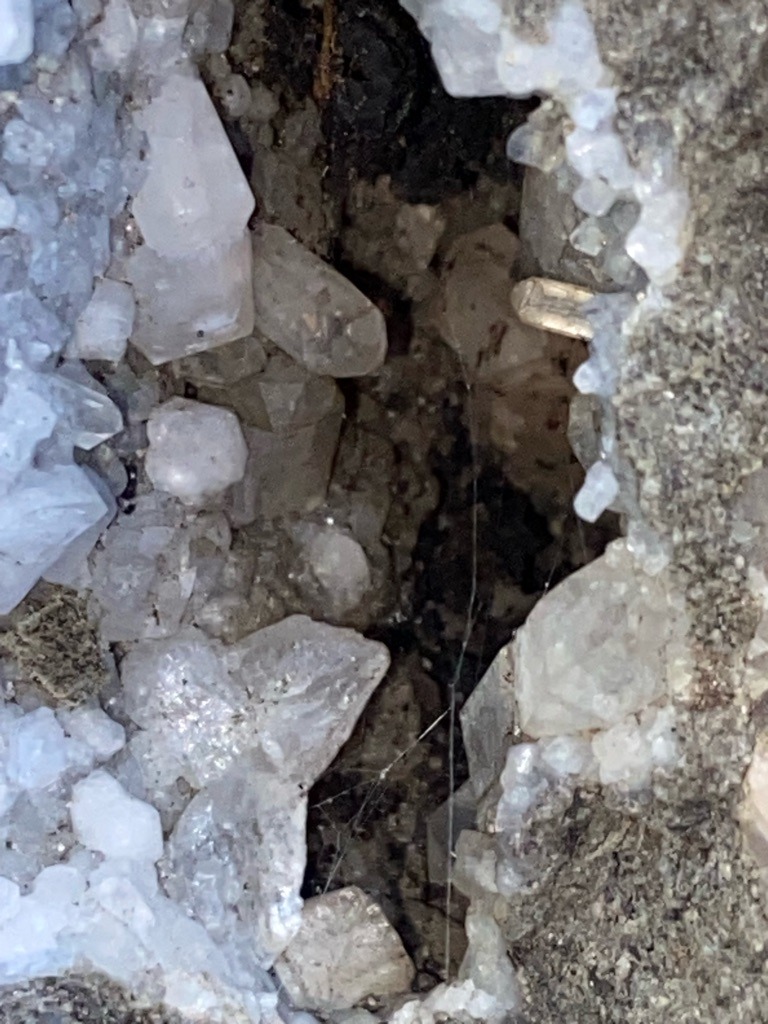
Not a diamond; the image shows raw quartz crystal formations in a geode or vug, likely containing quartz or calcite.
Not a diamond; the image shows raw quartz crystal formations in a geode or vug, likely containing quartz or calcite. · Natural rough crystal habit, predominantly hexagonal prismatic and rhombohedral forms typical of quartz.
Not applicable; these are unpolished, raw natural crystal formations. Cut
Carat
Not applicable as these are rough, uncarved mineral clusters.
Color
Colorless to pale white/grey in their natural rough state.
Clarity
Varies from transparent to translucent with visible internal fracturing and natural mineral inclusions.
Shape
Natural rough crystal habit, predominantly hexagonal prismatic and rhombohedral forms typical of quartz.
Overall Assessment
The image depicts a natural mineral vug or geode lined with unworked quartz crystals rather than a cut diamond, displaying typical raw geological characteristics.
Cut Quality
Not applicable; these are unpolished, raw natural crystal formations.
Brilliance
Vitreous to sub-adamantine reflection from natural crystal faces.
Fire
Low to moderate dispersion, characteristic of quartz rather than diamond.
Scintillation
Not applicable to rough, unfaceted mineral clusters.
Proportions
Natural geological formation; table and depth percentages do not apply.
Symmetry
Natural crystal growth symmetry, showing typical trigonal system formations.
Polish
Natural unpolished crystal faces exhibiting natural luster (vitreous).
Fluorescence
Inert to faint, depending on specific mineral impurities present within the host rock.
Inclusions
Typical natural mineral inclusions, fluid inclusions, and fractures inherent in rough crystal growth.
Blemishes
Natural surface etching, growth hillocks, and contact areas with the host matrix.
Origin
Natural geological deposit, likely hydrothermal vein or sedimentary cavity (geode).
Treatment Detection
No treatments detected; entirely natural rough mineral matrix.
Estimated Value
Valued as a mineral specimen or decorative rock rather than a faceted gemstone, depending on size and aesthetics.
Certification Estimate
Gemological reports for such specimens typically identify them as natural quartz/geode formations rather than issuing grading reports.
Investment Potential
Held primarily for mineral collecting, educational, or decorative purposes rather than traditional gemstone investment.
Similar Diamonds
None, as the specimens are quartz crystals, not diamonds.
Setting Suggestions
Best displayed as a raw mineral specimen in its natural matrix rather than set in jewelry.
Care & Maintenance
Clean gently with warm soapy water and a soft brush; avoid harsh acids or dropping, as quartz can fracture along planes.
Interesting Facts
Quartz is one of the most abundant minerals on Earth, forming in a wide variety of geological environments.