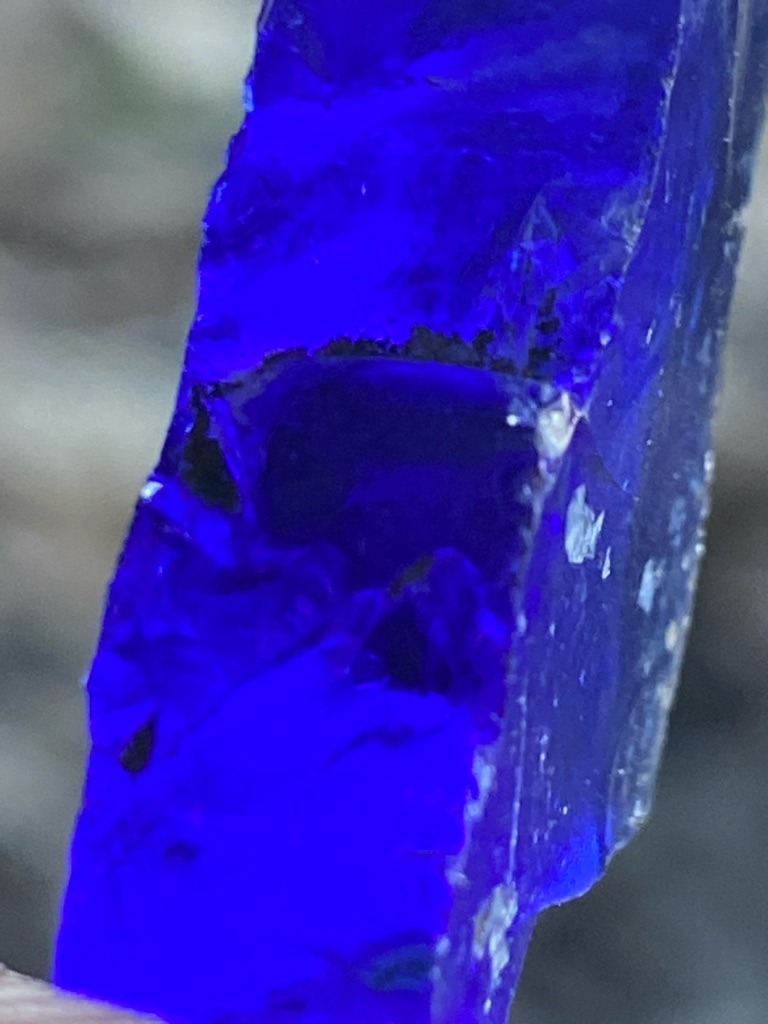
Not a diamond; this specimen appears to be cobalt blue glass or synthetic slag, displaying conchoidal fracture patterns characteristic of glass rather than crystalline diamond or gemstone rough.
Not a diamond; this specimen appears to be cobalt blue glass or synthetic slag, displaying conchoidal fracture patterns characteristic of glass rather than crystalline diamond or gemstone rough. · Rough uncut specimen with conchoidal fractures, unpolished and irregular.
Not applicable (raw, unfaceted, man-made vitreous material) Cut
Carat
Cannot be precisely determined without density testing, but visually appears to be a substantial fragment (exceeding 50+ carats if it were gem material).
Color
Deep Vivid Cobalt Blue
Clarity
Translucent to opaque with internal bubbles and flow lines typical of manufactured glass.
Shape
Rough uncut specimen with conchoidal fractures, unpolished and irregular.
Overall Assessment
The specimen is clearly identified as a piece of cobalt blue glass featuring characteristic conchoidal fracture surfaces and internal bubbles, possessing no gemological or diamond characteristics.
Cut Quality
Not applicable (raw, unfaceted, man-made vitreous material)
Brilliance
Vitreous luster; reflects light like polished or fractured glass rather than diamond adamantine brilliance.
Fire
Very low dispersion compared to diamond or moissanite.
Scintillation
Limited to reflections off the fractured vitreous surfaces.
Proportions
Irregular block fragment with no standard gem proportions, table, or pavilion angles.
Symmetry
Asymmetrical due to random fracture and breakage.
Polish
Unpolished, rough surface showing natural fracture textures.
Fluorescence
Inert to moderate inertness, depending on specific glass composition.
Inclusions
Gas bubbles, swirl marks, and internal impurities common in manufactured glass.
Blemishes
Surface chips, rough edges, and abrasion marks along the fractured planes.
Origin
Man-made / Industrial origin (likely industrial glass cullet or decorative blue glass).
Treatment Detection
Dyed or colored glass matrix created through thermal manufacturing processes with cobalt additives.
Estimated Value
Nominal decorative or collector value (less than $10), as it is industrial/decorative glass rather than a genuine gemstone.
Certification Estimate
Not certifiable as a gemstone by standard labs (GIA, AGS, IGI); would be classified as decorative glass or cullet.
Investment Potential
None as an investment asset.
Similar Diamonds
None, as this is completely unrelated to diamond mineralogy.
Setting Suggestions
Not suitable for fine jewelry settings due to low hardness and non-gem status.
Care & Maintenance
Handle with care to avoid sharp edges from the conchoidal fractures; clean with mild soap and water.
Interesting Facts
Cobalt glass has historically been used to imitate blue sapphire or lapis lazuli in costume jewelry and decorative arts since ancient times.